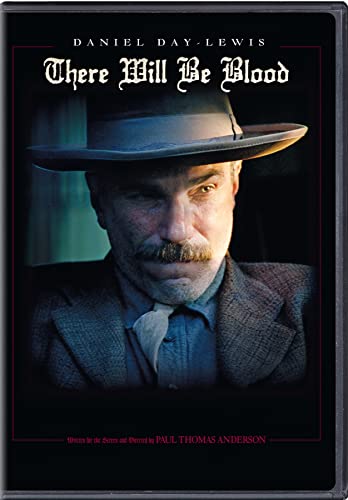

A sprawling epic of family, faith, power and oil, There Will Be Blood is set on the incendiary frontier of California's turn-of-the-century petroleum boom. The story chronicles the life and times of one Daniel Plainview (Daniel Day-Lewis), who transforms himself from a down-and-out silver miner raising a son on his own into a self-made oil tycoon. When Plainview gets a mysterious tip-off that there s a little town out West where an ocean of oil is oozing out of the ground, he heads with his son, H.W. (Dillon Freasier), to take their chances in dust-worn Little Boston. In this hardscrabble town, where the main excitement centers around the holy roller church of charismatic preacher Eli Sunday (Paul Dano), Plainview and H.W. make their lucky strike. But even as the well raises all of their fortunes, nothing will remain the same as conflicts escalate and every human value love, hope, community, belief, ambition and even the bond between father and son is imperiled by corruption, deception and the flow of oil. Review: Epic Movie about an Epic Era - This movie is as good as it gets in modern moviemaking. Daniel Day-Lewis, our greatest living actor, adds his greatest character portrayal yet to a seemingly unlimited range of characters past. He plays Daniel Plainview an oil wildcatter during the age of the post-Reconstruction "Robber Barons." Not all of the Robber Barons were financial wizards like Jay Gould or conniving accounting monopolists like John D. Rockefeller, unethically stealing the profits of the hard working entrepreneurs who made the great oil and mineral discoveries of the time. Daniel represents the driven, rugged individualist who resisted and defeated Rockefeller and the railroads' attempts to reap the fortune of his almost literally back-breaking efforts. But in his quest, struggle and ultimate financial success Plainview pays a heavy price. The brutal, ruthless life he leads to attain his ambition for wealth leaves him resembling more a denizen of nature than a resident of the human race. Whether he lost his soul in his childhood, in his quest, or never had one in the first place, is for the viewer to decide. The scene with his "brother", Henry, is truly chilling when Daniel first reveals his brutal, misanthropic nature. Only Daniel Day-Lewis could deliver such blood curdling dialogue in that scene; slowly, in a philosophical manner explaining to Henry his hateful feelings toward all others with a fatalistic smile on his face. He is a man comfortable in a skin in which many others would not be. Kevin J. O'Connor's portrayal of Henry is outstanding as a desperate soul who never betrays Daniel, and is as loyal as a brother, but dies at Daniel's hand. Daniel, as is shown throughout the movie, has a very perverse view of family and loyalty. The development of his relationship with his adoptive son, H.W., is the clearest view into Daniel's character and ultimately renders the final verdict on Daniel's lifelong quest for wealth. Daniel's hardened and embittered nature is never shown more pointedly, and brutally, than in his final scene with H.W. ("a [...]in a basket!"). It is the savagely destructive psychological counterpart to the physical destruction Daniel wreaks in the final scene with Eli Sunday, the "false prophet". Paul Dano as Eli Sunday, the greedy charismatic preacher, has received many accolades for his performance. It is good, though not as good as O'Connor's "Henry" or the young H.W. (Dillon Freasier). The main problem is not so much Dano's performance as his character's physical appearance. Day-Lewis ages slowly but markedly through the thirty-five year period of the movie. Dano, however, looks exactly the same age in the final confrontation in the bowling alley as he does when he first encounters Daniel at Eli's family dinner table. There is also a scene later in the movie, some time after the scene at the family dinner table, in which Daniel beats and humiliates Eli in front of others. It is almost a cinematic non-sequitur since the tension and rivalry between the two has not built to the point to justify the scene. Regardless, those two items of criticism are slight in the context of a truly great movie. The cinematography and the musical score lend greatly to its dark atmospherics. It is encouraging to see that it was written and directed by Paul Thomas Anderson whose previous undistinguished work includes the voyeuristically juvenile "Boogie Nights" and the embarrassing attempt at romantic comedy, "Punch Drunk Love". It does shows that an artist can grow beyond the exploitative and immature sides of Hollywood cinema as he matures. It undoubtedly helped Thomas to have Daniel Day-Lewis as the star, rather than an Adam Sandler. This is Day-Lewis's movie and he is the best. I have used the word "brutal" on a number of occasions in this review. The era of the Robber Barons was just that. This movie effectively conveys the history you may read about the era and the unforgiving state of nature that produced men like Daniel Plainview. As has been mentioned by other reviewers, the Plainview character is "loosely" based on a character named Vern Roscoe in the novel "Oil," written by Upton Sinclair. Sinclair's fictional character, in turn, was "loosely" based on a real person, named Edward L. Doheny. He is profiled in Wikipedia if you would like more information about him. All such "loose" associations are irrelevant in a great movie. Anderson and Daniel Day-Lewis have produced a cinematic masterpiece. It will be considered a classic in due time because of the timelessness of its theme and the greatness of its performances. I'm finished. Review: I drink your milkshake!... (slurp!)... I drink it all up! - Awesome film, one of DD-L's best. The final scene alone is worth the cost - when our "hero" bludgeons the scumbag (played by Paul Dano) to death with a bowling pin... Oh, and just prior to that is the "milkshake" scene... It's just too good. Hollywood is completely incapable of making movies like this today.


| ASIN | B072ZM1FQZ |
| Actors | Daniel Day Lewis, Paul Dano |
| Best Sellers Rank | #3,557 in Movies & TV ( See Top 100 in Movies & TV ) #420 in Drama DVDs |
| Customer Reviews | 4.6 4.6 out of 5 stars (4,195) |
| Director | Paul Thomas Anderson |
| Dubbed: | French, Spanish |
| Is Discontinued By Manufacturer | No |
| MPAA rating | R (Restricted) |
| Media Format | Subtitled |
| Number of discs | 1 |
| Product Dimensions | 0.7 x 7.5 x 5.4 inches; 1.83 ounces |
| Release date | September 12, 2017 |
| Run time | 2 hours and 38 minutes |
| Studio | PARAMOUNT |
| Subtitles: | French, Spanish |
C**C
Epic Movie about an Epic Era
This movie is as good as it gets in modern moviemaking. Daniel Day-Lewis, our greatest living actor, adds his greatest character portrayal yet to a seemingly unlimited range of characters past. He plays Daniel Plainview an oil wildcatter during the age of the post-Reconstruction "Robber Barons." Not all of the Robber Barons were financial wizards like Jay Gould or conniving accounting monopolists like John D. Rockefeller, unethically stealing the profits of the hard working entrepreneurs who made the great oil and mineral discoveries of the time. Daniel represents the driven, rugged individualist who resisted and defeated Rockefeller and the railroads' attempts to reap the fortune of his almost literally back-breaking efforts. But in his quest, struggle and ultimate financial success Plainview pays a heavy price. The brutal, ruthless life he leads to attain his ambition for wealth leaves him resembling more a denizen of nature than a resident of the human race. Whether he lost his soul in his childhood, in his quest, or never had one in the first place, is for the viewer to decide. The scene with his "brother", Henry, is truly chilling when Daniel first reveals his brutal, misanthropic nature. Only Daniel Day-Lewis could deliver such blood curdling dialogue in that scene; slowly, in a philosophical manner explaining to Henry his hateful feelings toward all others with a fatalistic smile on his face. He is a man comfortable in a skin in which many others would not be. Kevin J. O'Connor's portrayal of Henry is outstanding as a desperate soul who never betrays Daniel, and is as loyal as a brother, but dies at Daniel's hand. Daniel, as is shown throughout the movie, has a very perverse view of family and loyalty. The development of his relationship with his adoptive son, H.W., is the clearest view into Daniel's character and ultimately renders the final verdict on Daniel's lifelong quest for wealth. Daniel's hardened and embittered nature is never shown more pointedly, and brutally, than in his final scene with H.W. ("a [...]in a basket!"). It is the savagely destructive psychological counterpart to the physical destruction Daniel wreaks in the final scene with Eli Sunday, the "false prophet". Paul Dano as Eli Sunday, the greedy charismatic preacher, has received many accolades for his performance. It is good, though not as good as O'Connor's "Henry" or the young H.W. (Dillon Freasier). The main problem is not so much Dano's performance as his character's physical appearance. Day-Lewis ages slowly but markedly through the thirty-five year period of the movie. Dano, however, looks exactly the same age in the final confrontation in the bowling alley as he does when he first encounters Daniel at Eli's family dinner table. There is also a scene later in the movie, some time after the scene at the family dinner table, in which Daniel beats and humiliates Eli in front of others. It is almost a cinematic non-sequitur since the tension and rivalry between the two has not built to the point to justify the scene. Regardless, those two items of criticism are slight in the context of a truly great movie. The cinematography and the musical score lend greatly to its dark atmospherics. It is encouraging to see that it was written and directed by Paul Thomas Anderson whose previous undistinguished work includes the voyeuristically juvenile "Boogie Nights" and the embarrassing attempt at romantic comedy, "Punch Drunk Love". It does shows that an artist can grow beyond the exploitative and immature sides of Hollywood cinema as he matures. It undoubtedly helped Thomas to have Daniel Day-Lewis as the star, rather than an Adam Sandler. This is Day-Lewis's movie and he is the best. I have used the word "brutal" on a number of occasions in this review. The era of the Robber Barons was just that. This movie effectively conveys the history you may read about the era and the unforgiving state of nature that produced men like Daniel Plainview. As has been mentioned by other reviewers, the Plainview character is "loosely" based on a character named Vern Roscoe in the novel "Oil," written by Upton Sinclair. Sinclair's fictional character, in turn, was "loosely" based on a real person, named Edward L. Doheny. He is profiled in Wikipedia if you would like more information about him. All such "loose" associations are irrelevant in a great movie. Anderson and Daniel Day-Lewis have produced a cinematic masterpiece. It will be considered a classic in due time because of the timelessness of its theme and the greatness of its performances. I'm finished.
N**O
I drink your milkshake!... (slurp!)... I drink it all up!
Awesome film, one of DD-L's best. The final scene alone is worth the cost - when our "hero" bludgeons the scumbag (played by Paul Dano) to death with a bowling pin... Oh, and just prior to that is the "milkshake" scene... It's just too good. Hollywood is completely incapable of making movies like this today.
S**Y
Daniel Day-Lewis gives one of the best performances I've ever seen
If you ever explore threads asking people to list the movies they find the most boring, you'll see that There Will Be Blood is often mentioned. I can understand why. The opening 14-and-a-half minutes doesn't contain any dialogue unless you count the occasional grunt or cry of pain. The score is often unsettling and unlike anything you would expect to hear. The pacing is slow and the film has plenty of painful scenes. The opening scene is set in 1898 and gives us immediate insight into the character of Daniel Plainview (Day-Lewis). We see him working alone, prospecting for oil. It's a physically demanding occupation which is full of danger. One small lapse can cause a severe injury or even death. Plainview falls down a well shaft and breaks his leg, but discovers oil in the process. We then see him crawl backwards as he slowly makes his way into town to register the find. He's one of the most stubborn and driven characters you will ever see portrayed on film. In 1902, he's working with a group of men, and we are reminded again how dangerous the work is. A tiny mistake results in the death of a man and Plainview adopts his orphaned baby boy. The story jumps forward several years and we see Plainview and his adopted son, HW, attending a town meeting. Plainview has discovered that the region contains oil and we see him making an offer to extract the oil. His argument is calm, reasonable, and logical. He's quite a salesman. He talks of other offers the town may receive and why his own proposal is the best solution for everyone. We are given the impression that he knows what he's talking about and it's difficult to resist his offer. When Plainview is visited by Paul Sunday (Dano), the main part of the film begins. Paul offers to reveal the location of land rich in oil and he negotiates a price for the information. Plainview visits the town and finds that the information is accurate. He begins buying up all the available land. The film contains a power struggle between Plainview and Eli Sunday (also played by Dano). Eli becomes Plainview's enemy immediately by negotiating a higher price for his father's ranch than Plainview expected to pay. Eli is also the town's priest and he seeks power and recognition at every available opportunity. Plainview sees him as a fake and doesn't seem to have any religious beliefs of his own, but he's forced to bow to Eli's wishes on several occasions. I've barely touched on the plot, but I won't reveal any more. This is a sprawling story spanning several decades. It's one of the most intense character studies that I've ever seen. You'll see how Plainview relates to other people and his adopted son. He's a ruthless businessman and it's dangerous to cross him. In one scene, we hear his honest thoughts on society: "I have a competition in me. I want no one else to succeed. I hate most people." That last sentence is spoken with irony, but Plainview makes it clear that he understands his own true character. As the story progresses, we see what obsession and hatred can do to a man when it's maintained over a long period of time. My knowledge of film isn't as deep as you would expect for someone of my age. It's a relatively new obsession in my life. However, I believe that Daniel Day-Lewis delivers the best acting performance I have ever seen. I didn't doubt for a moment that he was a bitter, obsessed, driven man, capable of doing anything to bring him closer to his goals. Day-Lewis is in every scene and the film wouldn't have had the same impact without his astonishing performance. The technical aspects of the film are also superb. Jonny Greenwood's unusual score is particularly effective. One of my favorite moments happens during a drilling accident when the percussion increases in tempo as the scene unfolds. The cinematography is breathtaking at times. There's an early scene in which Plainview and HW approach the crest of a hill and the distant landscape is revealed. It's one of several moments of extreme beauty in the film. If the film has a fault, I would say that the final 20 minutes don't quite match the quality of the rest of the story. This closing sequence still works, and contains a few memorable moments, but the first two hours are close to perfect. If you enjoy character studies that aren't afraid to take the time to tell a story, There Will Be Blood might be your kind of film. If you need action and an upbeat conclusion, then it's probably not for you.
S**E
Fantastic, एपिक movie, Danielle de Luis as usual is great
R**Y
Wahnsinnig betörende, faszinierende aber auch ganz dreckige Kinobilder, die so nachhaltig wirken dürften, wie die unvergessenen Bilder in Malicks "Glut des Südens" : Der Oscarprämierte Kameramann Robert Elswitt zeigt dem Zuschauer ein noch unerschlossenes, weites und erhabenes Land nach dem Sieg gegen die Ureinwohner: Trockene Öde, steinige Prärie, herbstliche Wälder. Die zweite Teil der Eroberung wird eingeleitet. Inmitten dieser wunderbaren, teils sehr spröden Landschaft agiert der Ölmann Daniel Plainview (Daniel Day Lewis). Reiner Zufall, denn er hat 1898 nach Silber gegraben und stösst überraschend auf Öl. Er kann Geld damit machen und betätigt sich fortan mit seinem kleinen Sohn (Dillon Freasier) als kleines Familienunternehmen in Sachen Ölbohrungen. Als ein Farmerjunge ihm von einer noch unerschlossenen Ölquelle im Hinterland der USA berichtet, kauft er Grundstück um Gründstück zu Spottpreisen von den vielen armen und extrem religiösen Farmerfamilien auf und beginnt mit den Bohrungen. Dies wird der Sprung vom Unternehmen zum Grosskapitalisten....mit allen Begleiterscheinungen. Paul Thomas Andersons oscarprämierter Film ist eine gallige und morbide Abhandlung über diese erstrebenswerten Ziele des Menschen, Reichtum und Macht, der die Menschen auf diesem Weg dorthin natürlich verändert und sie gierig werden lässt. Demgegenüber stellt er den um 1900 bis heute ständig erstarkten christlichen Fundamentalismus im Land der unbegrenzten Möglichkeiten mit einem jungen, charsmatischen Prediger, Eli Sunday (Paul Franklin Dano, bekannt aus Little Miss Sunshine), der sich vom unscheinbaren, gottesfürchtigen Farmerjungen zum bigotten, demagogischen Hassprediger ebenso wie Plainview wandelt. Der Film spukt auf die Verklärung der Gründerjahre und lässt diese zwei amerikanischen Werte "Money and God" aufeinanderprallen, führt sie in Kombination als verlogene und unglückmachende Zweckgemeinschaft vor. Durch die heutigen Ereignisse um Öl, Terror, Wirtschaftskrisen, Börsencrash und dem Fehlen von wahrhaftigen moralischen Instanzen ein hochaktuelles und spannendes Thema. Andersons Film zeigt uns die Anfänge des Kapitalismus ab 1900. Als die Bodenschätze gierig erschlossen wurden und der Grundstein gelegt wurde, dass die USA zur grössten und reichsten Weltmacht mit "Gottes Segen" werden konnte. Einer der grossen Filme des Jahres, in der epischen und suggestiven Machart ein bisschen mit "die Ermordung des Jesse James" verwandt - lediglich einen Tick näher am Puls der Zeit. Nach "Last Exit Reno", "Boogie Nights" und "Magnolia" ein weiteres, grandioses Kino des jetzt schon legendären Directors. Vielleicht sogar sein Meisterwerk.
J**X
Una película ,que todavía no la he visto,pero la he chequeado capítulo a capítulo.y se ve y de olle de fábula .una copia muy buena sin grano aparente,ni siquiera en las sombras
M**Y
More than an epic tale of an early 20th Century oilman, this is a fascinating study of the greed for power and what it does to a man. We meet Daniel Plainview down the bottom of a mine, exerting himself in mind-numbingly monotonous and backbreaking work, looking for gold or silver. He is a man willing to endure pain and humiliation to grasp more money, or more power. As he quickly moves from gold to black gold, he becomes more powerful, and his ruthlessness and underhandedness become more and more apparent, combined with the charisma required to persuade landowners to part with the mineral rights of their property. We learn about how he sees other people when he adopts a boy who he finds useful to put a kind face on his activities, and how he treats a man appears claiming to be his half brother. The movie kicks into gear though when he meets an equally power hungry man in the unlikely form of the young faith healer and preacher, to whom he takes a seemingly instant dislike. With the relationships with these three characters, we see his dilemna- his power is only something if he can pass it on, but when he sees only the worst in other people, how can he? Who will be worthy of the three to take on his mantle..? The style of the movie has some stunning direction which tells us much of the story through scenes and images, rather than words, yet this is married with an intelligent, absorbing and uncompromising script. The music is daringly inventive, although with me the jury is out whether it is a success or a distraction. Daniel Day-Lewis turns in yet another 100% authentic and believable performance, creating a chilling and yet at times charismatic character, and Paul Dano is remarkable as the young preacher. Sure, women are given little to no role in the story, and it is unremitting in its bleakness, at times feeling like it has been designed to within an inch of its cinematic life. It's not going to be to everyone's taste.. However the authenticity, stunning performances and script that demands the viewer engage in some thought, have created what might just be a bona fide masterpiece, even with its flaws.
L**X
Livraison rapide état impeccable
TrustPilot
1天前
1 周前