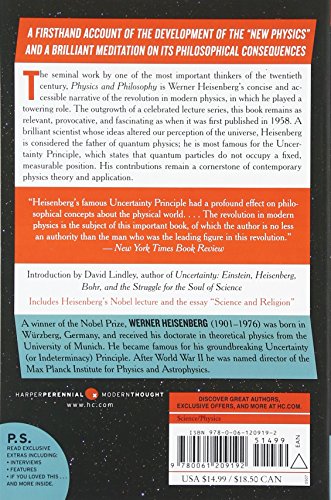


Buy Physics and Philosophy: The Revolution in Modern Science on desertcart.com ✓ FREE SHIPPING on qualified orders Review: PROBLEMS STILL NOT SOLVED - On my personal journey reading 'classical' books from the past I have recently read Heisenberg's 'Physics and Philosophy' , originally published 1958. More than 50 years later this seems to be still a very remarkable book, with an easy reading and a scope of thinking which is rare today. PHYSICS Heisenberg describes in his book the modern findings in physics in a language which does not presuppose any mathematics. And he describes these central findings in a way which is even clearer than written in the complex mathematical machinery of modern physics. The detection of the atomic structure of matter, the discrete structure of the energy levels, the velocity of light as the upper limit of the velocity of all moving bodies, the uncertainty in the description of the behavior of the atomic elements caused by the inevitable interaction between observer and observed object, the equivalence of matter and energy as well as the new structure of the physical space (non-euclidean) compared to the space of our perceptions, imaginations and the everyday space of daily actions. I can not remember any other book about physics which explains these developments in such a clearness and directness. PHILOSOPHY The book gains even more because Heisenberg compares the concepts of the modern physics with the main concepts of the old Greek philosophy as well as with philosophers like Descartes, Locke, Hume, Berkeley, and Kant. It is interesting to see that human kind was more than 2000 years ago capable to develop conceptual models of matter and nature which logically come very close to the modern concepts of the atom and its parts. At the same time it is interesting to see, that despite of this astonishing conceptual thinking the lack of proper measurement instruments and the lack of a sufficient mathematical language didn't allow better theories. Thus the development of new measurement instruments, new strong languages like modern mathematics as well as the right experiments appear to play a fundamental role in the construction of better world models; they are not 'outside' of the story but a central moment of it. LANGUAGE Heisenberg describes in length the insufficiency of language to describe the new findings in physics, especially those headed under the label of quantum mechanics, not an insufficiency only of the everyday language, but also an insufficiency of the mathematical language as such. While the concrete experiments are described with everyday language expressions and the terms of classical physics do the mathematical expressions describe formal structures like probability fields which encode expectations about the behavior of the quanta which as such are not concrete objects. From the point of theory there is no complete consistent solution conceivable for this problem, only 'practically' by relating concrete experimental data with the abstract mathematical models. WELTBILD/ WORLD VIEW Heisenberg describes not only the development of modern physics but considers also the effect of this new world picture on the overall world view of mankind. He suggests that the physical world view before quantum theory was too narrow, not giving satisfying answers to central phenomena like biological life, the human mind or even the concept of human soul. Only quantum theory has -according to Heisenberg-- forced an opening of central concepts, has widened the concept of objectivity, has reinforced the awareness that the observer is a central moment of the observed object; there is no 'real objectivity'. Knowledge is always a construct under certain conditions where we have to 'extrapolate' the 'hidden' structures with some probability. With regard to biology he states explicitly "...we are obviously still very far from such a coherent and closed set of concepts for he description of biological phenomena. The degree of complication in biology is so discouraging that one can at present not imagine any set of concepts in which the connections could be so sharply defined that a mathematical representation could become possible". (PP79f)" If we go beyond biology and include psychology in the discussion then there can scarcely be any doubt but that the concepts of physics, chemistry, and evolution together will not be sufficient to describe the facts ..".(PP80) CRITICAL REMARKS If one wants to find weak points in the wonderful book, one can mention some. There is nearly no citation; this makes it difficult to follow the sources (if one wants). The look to philosophy is very narrow; many modern developments have not been cited, especially not the large amount of work in semiotics, philosophy of language, and formal logic. He mentions the limits of mathematical theories without citing the famous results of Goedel (1931) and Turing (1936/7). Or, he mentions the logic of quanta proposed by Weizsäcker which has the format of a type logic; this has been introduced by Whitehead-Russel already in 19010ff. Heisenberg argues for the limits of physics with regard to biology using arguments which resemble those of Schroedinger in his famous book of 1944, without mentioning Schrödinger. Despite all this, for me this is a very remarkable book, extremely clear, and very inspiring. FUTURE The book shows that central questions regarding man are not solved. The phenomenon of life is still the big challenge of science. Review: Turning Point - I will only mentioned a few aspects of the world of quantum mechanics and then if you get bored you can read the last part where I mention some aspects of the book. Werner Heisenberg is one of the most important figures within the world of quantum mechanics. Since Max Planck discovered that electromagnetic energy could be emmited in quantized forms a series of new discoveries revolutionised the world of physics. Albert Einstein confirmed Plancks's discoveries and theorized that light was composed of discrete quanta. This discovery was just too strange. How can light behave as a wave and as a particle. You can see the double slit experiment and observe how light behave when one slit is open and when the two slits are open, just amazing.So it seems that dualistic thought can not be applied here. Is light particle or wave, the answer: BOTH!As Heisenberg says in the book: "that what we observe is not nature in itself but nature exposed to our method of questioning". Thus observer and observed are in some way connected and not separated as in cartesian-newtonian world.In the introduction is written clearly: "...the act of of measurement defines the thing being measured, or that the thing being measured and the thimg doing the measuring are inextricably interwined" This is why there have been some analogies between this new physics and eastern traditions (like Fritjof Capra's Tao of Physics)like buddhism and the Indian philosopher Nagarjuna, founder of the Madhamyaka school that developed the concept of emptyness, that is, all phenomenon had no "self-nature" "or idependent origins", there is no such thing as Parmenide's Being.All is interconnected,like Indra's jewels in Hinduism there is no gap between the observer and the observed in the world of quantum physics. Quantum mechanics is more familiar with Heraclitus where Change is the main principle, Becoming and not Being.Particles are not "things" but are like Aristotle's potentia. Heisenberg tell us: "A quantum object, in itself, is neither one thing not the other. If you decide to measure a wave-like property, the thing you are observing will look like a wave. Measure a particle property (position or velocity), on the other hand, and you will see particle-like behaviour." Note that Heisenberg that one can measure position OR velocity, this is the pillar of the uncertainty principle. In Heisenberg's words: 2The better you measure the position of a particle, the less you can find out its velocity, and vice versa." Thus, the first years of the 1920s was a turning point in the world of physics. The Copenhagen Interpretation established the principles of quantum mechanics, some of this are: The uncertainty principle, the Complementary Principle (wave-particle duality of light) and that the description of nature is probabilistic. Now you can have a little clue about the book subtitle: "The revolution in modern science". Newtonian mechanics can' t be applied to the subatomic world.Thus, the view of nature as a Big, impersonal Machine and that it was a matter of time that "all mighty rational humanity" was to discover all its laws is far from true. Even Einstein was not happy with this group of physicians that were saying "there is no such thing called objectivity" "newtonian laws are like a fish in the desert". Einstein after the theory of special and general relativity spent much of his time lookink for a Theory of Everything (TOE), and in some isolated himself from this great discoveries being made in the field of quantum mechanics. Today there is this String Theory or M Theory wandering arround, and could be the best candidate that will unify the 4 forces: Gravity, electromagnetism, strong and weak interaction. Time will tell... About the book: Heisenberg explains the developmet pf pshysics reviewing Thales, Anaximander, Anaximenes (the three Milesians)Heraclitus, Parmenides, Empedocles, Anaxagoras, Democritus, Leucippus, then a quntum leap to Descartes and Kant. He explains relativity, space, time, the Copenhagen Interpretation, the limits of language to describe the quantum world, the role of scientists, his Nobel Lecture and much more. I think it is not a difficult book, but don't expect to understand quantum mechanics, because if you do, you really didn't understand a thing about it. So forget about binary-aristotelic logic and start developing fuzzy logics to understand a lot of weird things.
| Best Sellers Rank | #40,973 in Books ( See Top 100 in Books ) #22 in Relativity Physics (Books) #33 in Quantum Theory (Books) #125 in History & Philosophy of Science (Books) |
| Customer Reviews | 4.5 4.5 out of 5 stars (478) |
| Dimensions | 5.31 x 0.58 x 8 inches |
| Edition | unknown |
| ISBN-10 | 0061209198 |
| ISBN-13 | 978-0061209192 |
| Item Weight | 2.31 pounds |
| Language | English |
| Print length | 256 pages |
| Publication date | May 8, 2007 |
| Publisher | Harper Perennial Modern Classics |
D**H
PROBLEMS STILL NOT SOLVED
On my personal journey reading 'classical' books from the past I have recently read Heisenberg's 'Physics and Philosophy' , originally published 1958. More than 50 years later this seems to be still a very remarkable book, with an easy reading and a scope of thinking which is rare today. PHYSICS Heisenberg describes in his book the modern findings in physics in a language which does not presuppose any mathematics. And he describes these central findings in a way which is even clearer than written in the complex mathematical machinery of modern physics. The detection of the atomic structure of matter, the discrete structure of the energy levels, the velocity of light as the upper limit of the velocity of all moving bodies, the uncertainty in the description of the behavior of the atomic elements caused by the inevitable interaction between observer and observed object, the equivalence of matter and energy as well as the new structure of the physical space (non-euclidean) compared to the space of our perceptions, imaginations and the everyday space of daily actions. I can not remember any other book about physics which explains these developments in such a clearness and directness. PHILOSOPHY The book gains even more because Heisenberg compares the concepts of the modern physics with the main concepts of the old Greek philosophy as well as with philosophers like Descartes, Locke, Hume, Berkeley, and Kant. It is interesting to see that human kind was more than 2000 years ago capable to develop conceptual models of matter and nature which logically come very close to the modern concepts of the atom and its parts. At the same time it is interesting to see, that despite of this astonishing conceptual thinking the lack of proper measurement instruments and the lack of a sufficient mathematical language didn't allow better theories. Thus the development of new measurement instruments, new strong languages like modern mathematics as well as the right experiments appear to play a fundamental role in the construction of better world models; they are not 'outside' of the story but a central moment of it. LANGUAGE Heisenberg describes in length the insufficiency of language to describe the new findings in physics, especially those headed under the label of quantum mechanics, not an insufficiency only of the everyday language, but also an insufficiency of the mathematical language as such. While the concrete experiments are described with everyday language expressions and the terms of classical physics do the mathematical expressions describe formal structures like probability fields which encode expectations about the behavior of the quanta which as such are not concrete objects. From the point of theory there is no complete consistent solution conceivable for this problem, only 'practically' by relating concrete experimental data with the abstract mathematical models. WELTBILD/ WORLD VIEW Heisenberg describes not only the development of modern physics but considers also the effect of this new world picture on the overall world view of mankind. He suggests that the physical world view before quantum theory was too narrow, not giving satisfying answers to central phenomena like biological life, the human mind or even the concept of human soul. Only quantum theory has -according to Heisenberg-- forced an opening of central concepts, has widened the concept of objectivity, has reinforced the awareness that the observer is a central moment of the observed object; there is no 'real objectivity'. Knowledge is always a construct under certain conditions where we have to 'extrapolate' the 'hidden' structures with some probability. With regard to biology he states explicitly "...we are obviously still very far from such a coherent and closed set of concepts for he description of biological phenomena. The degree of complication in biology is so discouraging that one can at present not imagine any set of concepts in which the connections could be so sharply defined that a mathematical representation could become possible". (PP79f)" If we go beyond biology and include psychology in the discussion then there can scarcely be any doubt but that the concepts of physics, chemistry, and evolution together will not be sufficient to describe the facts ..".(PP80) CRITICAL REMARKS If one wants to find weak points in the wonderful book, one can mention some. There is nearly no citation; this makes it difficult to follow the sources (if one wants). The look to philosophy is very narrow; many modern developments have not been cited, especially not the large amount of work in semiotics, philosophy of language, and formal logic. He mentions the limits of mathematical theories without citing the famous results of Goedel (1931) and Turing (1936/7). Or, he mentions the logic of quanta proposed by Weizsäcker which has the format of a type logic; this has been introduced by Whitehead-Russel already in 19010ff. Heisenberg argues for the limits of physics with regard to biology using arguments which resemble those of Schroedinger in his famous book of 1944, without mentioning Schrödinger. Despite all this, for me this is a very remarkable book, extremely clear, and very inspiring. FUTURE The book shows that central questions regarding man are not solved. The phenomenon of life is still the big challenge of science.
J**D
Turning Point
I will only mentioned a few aspects of the world of quantum mechanics and then if you get bored you can read the last part where I mention some aspects of the book. Werner Heisenberg is one of the most important figures within the world of quantum mechanics. Since Max Planck discovered that electromagnetic energy could be emmited in quantized forms a series of new discoveries revolutionised the world of physics. Albert Einstein confirmed Plancks's discoveries and theorized that light was composed of discrete quanta. This discovery was just too strange. How can light behave as a wave and as a particle. You can see the double slit experiment and observe how light behave when one slit is open and when the two slits are open, just amazing.So it seems that dualistic thought can not be applied here. Is light particle or wave, the answer: BOTH!As Heisenberg says in the book: "that what we observe is not nature in itself but nature exposed to our method of questioning". Thus observer and observed are in some way connected and not separated as in cartesian-newtonian world.In the introduction is written clearly: "...the act of of measurement defines the thing being measured, or that the thing being measured and the thimg doing the measuring are inextricably interwined" This is why there have been some analogies between this new physics and eastern traditions (like Fritjof Capra's Tao of Physics)like buddhism and the Indian philosopher Nagarjuna, founder of the Madhamyaka school that developed the concept of emptyness, that is, all phenomenon had no "self-nature" "or idependent origins", there is no such thing as Parmenide's Being.All is interconnected,like Indra's jewels in Hinduism there is no gap between the observer and the observed in the world of quantum physics. Quantum mechanics is more familiar with Heraclitus where Change is the main principle, Becoming and not Being.Particles are not "things" but are like Aristotle's potentia. Heisenberg tell us: "A quantum object, in itself, is neither one thing not the other. If you decide to measure a wave-like property, the thing you are observing will look like a wave. Measure a particle property (position or velocity), on the other hand, and you will see particle-like behaviour." Note that Heisenberg that one can measure position OR velocity, this is the pillar of the uncertainty principle. In Heisenberg's words: 2The better you measure the position of a particle, the less you can find out its velocity, and vice versa." Thus, the first years of the 1920s was a turning point in the world of physics. The Copenhagen Interpretation established the principles of quantum mechanics, some of this are: The uncertainty principle, the Complementary Principle (wave-particle duality of light) and that the description of nature is probabilistic. Now you can have a little clue about the book subtitle: "The revolution in modern science". Newtonian mechanics can' t be applied to the subatomic world.Thus, the view of nature as a Big, impersonal Machine and that it was a matter of time that "all mighty rational humanity" was to discover all its laws is far from true. Even Einstein was not happy with this group of physicians that were saying "there is no such thing called objectivity" "newtonian laws are like a fish in the desert". Einstein after the theory of special and general relativity spent much of his time lookink for a Theory of Everything (TOE), and in some isolated himself from this great discoveries being made in the field of quantum mechanics. Today there is this String Theory or M Theory wandering arround, and could be the best candidate that will unify the 4 forces: Gravity, electromagnetism, strong and weak interaction. Time will tell... About the book: Heisenberg explains the developmet pf pshysics reviewing Thales, Anaximander, Anaximenes (the three Milesians)Heraclitus, Parmenides, Empedocles, Anaxagoras, Democritus, Leucippus, then a quntum leap to Descartes and Kant. He explains relativity, space, time, the Copenhagen Interpretation, the limits of language to describe the quantum world, the role of scientists, his Nobel Lecture and much more. I think it is not a difficult book, but don't expect to understand quantum mechanics, because if you do, you really didn't understand a thing about it. So forget about binary-aristotelic logic and start developing fuzzy logics to understand a lot of weird things.
E**X
Preso come regalo di Natale per mio genero, ingegnere cervellone che quando lo ha visto ne è rimasto entusiasta. Contento lui….
S**H
The evolution of scientific thought should be a prerequisite in natural sciences universities, helps us contextualise how we got to this point and what can take us forward. This book does a great job at that!
E**N
Heisenburg a total genuis and started an important branch of physics quantum physics explains the old and new philosophical limitations.
A**N
Loved this book that exposits physics and philosophy (what used to be called natural science), from one of the leading theoretical physicists of the last century. We may have made a mistake in our materialistic view of the world, our apparent sense of rationality driven by subject-object boundaries that have taken place in the last 4 centuries since Newton. This has been a subject of intense interest to me last few years and this book was like having a conversation with a friend with similar interests. There are no pretensions, no hiding behind abstractions - just simple, plain speak from the scientist who formulated the uncertainty principle. My notes - • Strange ideas in relativity - time dilation and length contraction, curved spaces and black holes. There is no absolute universal time and no concept of simultaneity in the universe • The deepest philosophical problem with theory of relativity is the possibility that the universe came into existence at a finite moment in the past and with it were born not just matter and energy but also space and time (Time may not stretch back to all eternity) • Its easy to see what the theory predicts (quantum mechanics) but hard to understand what it “means” • Heisenberg’s uncertainty principle - all physical quantities observed are subject to unpredictable fluctuations, their values are not precisely defined. Uncertainty in position x Uncertainty in momentum = Planck’s constant (So there’s a trade-off in precision when measuring one over the other). The particle simply does not posses simultaneously precise values of position and momentum (with respect to us, the observers - akin to ‘if a tree falls in a forest…’ problem) • Uncertainty in physical processes (markets/thermodynamics) is due to missing information rather than a fundamental limitation as in quantum particles • The popular model of atom with electrons circling the nucleus is badly misleading as its impossible to know precise trajectory of electron from point A to point B • Two quantum systems initially identical may go on and do different things (all else remaining equal) - its still not complete anarchy as these different things can be defined by probabilities • quantum mechanics is a statistical theory - definite predictions about ensembles but not of individual systems • weather prediction is also statistical mechanics - but chance element is “inherent” in quantum systems, rather than our limited grasp of information of variables • Einstein hoped that beneath the quantum chaos might lie a familiar deterministic dynamic (hence “god does not play dice”). Heisenberg and Bohr strongly opposed Einstein on this • EPR paradox - A system of two particles that interact and fly apart that carry information of the other - by measuring one particle, it would be then possible to know either position of momentum of the other - speed of light prohibits such measurement as information cannot carry faster than “c”- heart of the conflict between Einstein’s classical worldview (dogmatic realism) and Heisenberg and Bohr’s uncertain one • In classical world, our observations do not “create” reality - merely “uncovers” reality. According to Copenhagen interpretation of quantum mechanics, there’s no objective reality in the quantum world - nothing is well-defined. It is our observations that create the reality we perceive (An electron is not a “thing”, as a billiard ball may be) • Bohr’s principle of complementarity - same system can display apparently contradictory properties - like electron behaving as both a wave and a particle - this ambiguity is not contradictory but is complementary faces of a single reality - its up to the experimenter to expose the aspect he so chooses to (position vs momentum, wave vs particle) - so observation/experiment is a crucial part of the observation - the transition from the possible to the actual happens in the act of observation • Our language is limited by our real-world and limits our imagination. any attempt to explain what really happens in the quantum world is thus limited by our limits of imagination based on the real-world we observe (hence intuition doesn’t work!) • Blackbody radiation, photoelectric effect, electromagnetic waves - were some of the earliest precursors that led to definition of quantum theory • Asking the right question is frequently more than halfway to the solution of the problem (well stated is half solved) • Quantum properties arise due to our deficiency in knowledge of the electron, than as an inherent property of the electron (same as in weather systems - epistemology vs ontology) • Thales of Miletus in 6th Century BC thought Water was the fundamental material. Anaximander, pupil of Thales denied it could be water or any known substance. He taught the primary substance was infinite, eternal and ageless - Being and Becoming - the primary substance infinite and ageless was “Being” and it degenerates into various forms (“Becoming”) leading to endless struggles and returns back into that which is shapeless and characterless (Sort of Hindu philosophy, sort of pre-empted big bang) • Throughout history we have had an obsession to find the fundamental particle - we thought it was water (Thales), then air (Anaximenes), then fire (Heraclitus), pluralism from monism (earth, water, air and fire) of Empedocles, an infinitely small seed from which everything was made of (Anaxigoras) - sort of precursor to atom, and so on • Modern physics is closer to Heraclitus - replace “fire” with “energy” - that which makes all elementary particles, that which moves - causes all change in the world • Plato - prisoners in a cave thought experiment - men bound in a cave looking in only one direction with fire behind them see objects behind them and themselves only as shadows on the wall • Descartes - in “Discourse on method” - not believing senses, driven by doubt and thus thought - the famous “cogito ergo sum” - he thus made the triangle of “God-World-I” - separating and elevating God from the world - here on philosophy and natural science separated ‘res cogitans’ and ‘res extensa’ - me and my world - subject and object - cartesian division between self and the world - the world was then described by physics and chemistry and same applied to the mind led to concept of “free will” and that one can speak about the world without speaking about God or ourselves (God here in my opinion is nothing but probability) - we need to get back to “practical realism” of natural science from the “dogmatic realism” of modern physics concerning the material world. • Locke, Berkeley, Hume - empiristic philosophy - All knowledge is ultimately founded in experience (Locke). If all knowledge is founded in experience, there’s no meaning to the statement that things really exist (Berkeley). Hume denied induction and causation which when taken seriously would destroy the basis of all empirical science • If we attach symbols to phenomena, the symbols can then be combined by certain rules (as in math) and statements about the phenomena can be represented as combinations of symbols. Now, a combination of symbols that doesn’t comply with rules is not wrong but conveys no meaning (like complex numbers) • Kant - ‘Critique of pure reason’ - Our knowledge is in part ‘a priori’ and not inferred inductivity from experience - he also distinguished analytic (what follows from logic) and synthetic propositions (empirical knowledge) • It will never be possible by pure reason to arrive at some absolute truth • Space and time belonged both to newtonian mechanics and theory of relativity - in the former they were independent and in the latter, they were connected by Lorentz transofmration • Newtonian mechanics, theory of heat, electricity and magnetism, quantum theory - all arose as closed system of concepts with their own axioms - there may arise a 5th set in the future with theory of elementary particles • While chemistry can be understood as a limiting case of physics, biology and living organisms display a degree of stability that cannot be explained by physical and chemical laws alone - its the stability of process or function, rather than stability of form (as in atoms/crystals) • Some scientists were inclined to think psychology could be explained by physical and chemical phenomena - from quantum-theoretical standpoint, there’s no reason for such an assumption. Quantum theory does not allow a completely objective description of nature. • Every energy carries some mass with it but it is miniscule and that’s why it was not observed before *(E = mc^2 for intuition). The binding energy of particles in the nucleus of an atom is what shows up in their masses (and in the atomic bomb) • The concepts of space and time belong to our relation to nature, not to nature itself (Kant) • Every act of observation is by its very nature, an irreversible process • Matter in itself is not a reality but only a possibility (potentia) - Aristotle. The statue is potentially in the marble, before it is cut out by the sculptor • Our natural language and concepts of classical physics can only apply to phenomena for which velocity of light can be considered infinite - a mathematical language is necessary for everything else in the universe. With expansion of scientific knowledge, our language also expands and with it the word’s applicability in a wider sense (Eg. energy, electricity, entropy are widely used in different contexts in natural language) • Most fruitful developments frequently take place when two different lines of thought meet It is always lovely when a scientist tries to unify disparate modes of thought, history, philosophy and is so open to ideas from different disciplines. This is like reading the diary of such a great scientist and if the topic of uncertainty/probability, subject-object boundaries, what makes up the fabric of reality and who we are, interests you, then this book is a must read. 11/10
A**7
Complex book. Takes some time to gasp all the concepts and links with Philosophy. But once you start to assimilate, well you’re a changed man. I would recommend to read once, then a second time with a little notebook to jot down important concepts.