We remain fully operational. Our teams are working around the clock to ensure your deliveries continue safely.

下载应用程序



Buy anything from 5,000+ international stores. One checkout price. No surprise fees. Join 2M+ shoppers on Desertcart.
Desertcart purchases this item on your behalf and handles shipping, customs, and support to Taiwan.
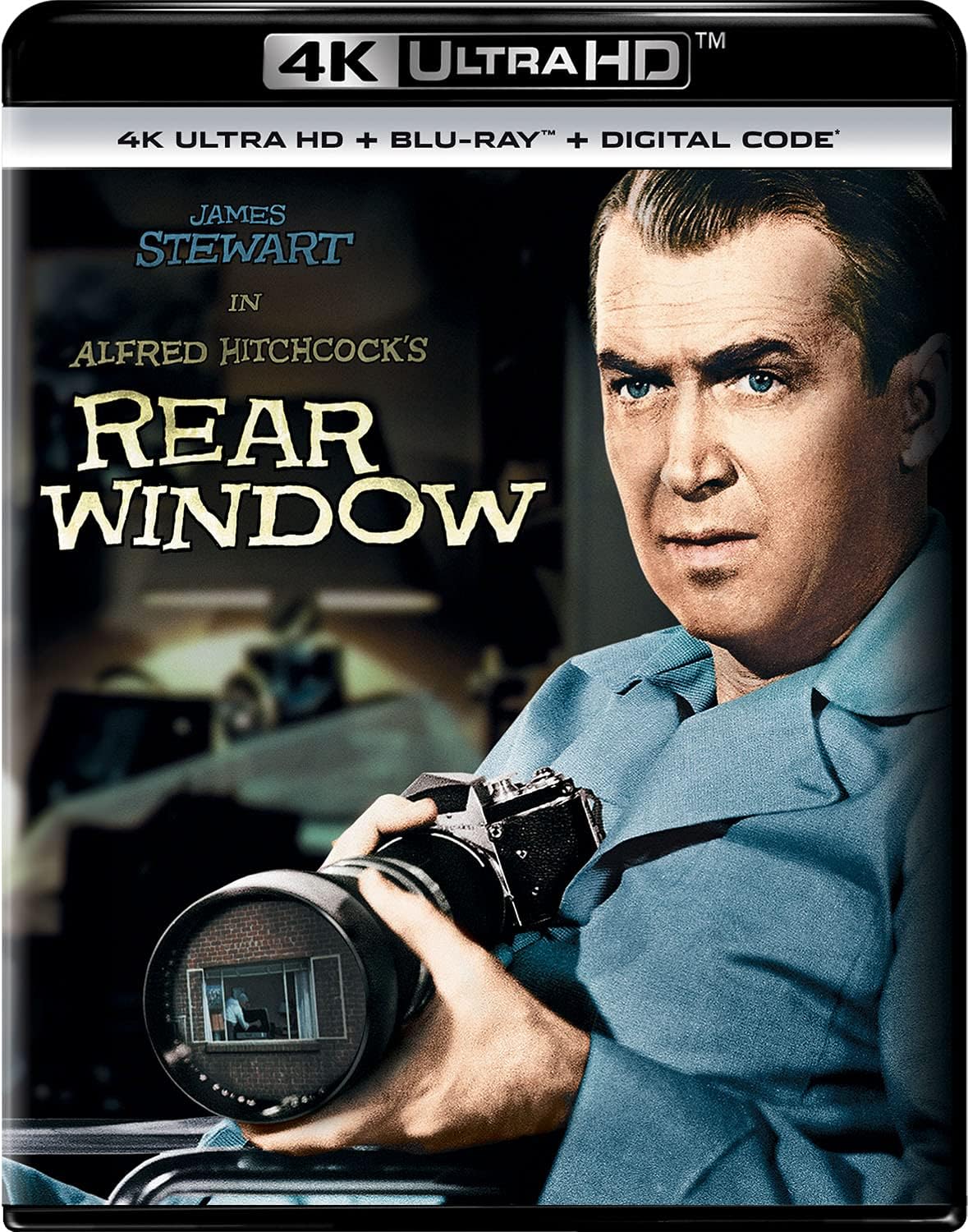
Rear Window [Blu-ray] Review: Llegó en excelentes condiciones Review: Good product and received earlier than expected


| ASIN | B0991FG2GH |
| Best Sellers Rank | 34,911 in DVD & Blu-ray ( See Top 100 in DVD & Blu-ray ) 12,653 in Blu-ray |
| Customer reviews | 4.8 4.8 out of 5 stars (3,072) |
| Language | English |
| Media Format | 4K |
| Number of discs | 2 |
| Package Dimensions | 17.4 x 13.9 x 1.3 cm; 0.52 g |
| Release date | 7 Sept. 2021 |
| Run time | 115 minutes |
| Studio | Studio Distribution Services |
J**R
Llegó en excelentes condiciones
S**H
Good product and received earlier than expected
D**I
194us Rear window (Alfred Hitchcock, 1954, 112') Written by John Michael Hayes (with whom there is a delightful interview in the features of the dvd, and who won a 1955 Edgar Award for Best Motion Picture), based on Cornell Woolrich's 1942 short story "It Had to Be Murder". Originally released by Paramount Pictures, the film stars James Stewart, Grace Kelly, Wendell Corey, Thelma Ritter and Raymond Burr. It was screened at the 1954 Venice Film Festival. The film is considered by many filmgoers, critics and scholars to be one of Hitchcock's best. After breaking his leg during a dangerous assignment, professional photographer L B "Jeff" Jeffries (Stewart) is confined in his Greenwich Village apartment, using a wheelchair while he recuperates. His rear window looks out onto a small courtyard and several other apartments. During a summer heat wave, he passes the time by watching his neighbors, who keep their windows open to stay cool. They include a dancer ("Miss Torso", played by Georgine Darcy), a lonely woman ("Miss Lonelyheart"), a songwriter, several married couples, a middle-aged sculptor, and Lars Thorwald (Burr), a wholesale jewelry salesman with a bedridden wife. Jeff discusses his observations with his wealthy socialite girlfriend Lisa Fremont (Kelly) and his insurance company home-care nurse Stella (Ritter), and becomes obsessed with their theory that Thorwald murdered his wife. He explains their theory to his friend Tom Doyle (Corey), a New York City Police detective, who looks into the situation but finds nothing suspicious. A few days later, the heat has lifted. The lonely neighbor woman chats with the songwriter in his apartment, the dancer's lover returns home from the army, the couple whose dog was killed have a new dog, and the newly married couple are bickering. In the last scene of the film, Lisa reclines beside Jeff, appearing to read a book on foreign travel in order to please him, but as soon as he is asleep, she puts the book down and happily opens a fashion magazine. The film received overwhelmingly positive reviews from critics and is considered one of Hitchcock's finest films. Time called it "just possibly the second most entertaining picture (after The 39 Steps) ever made by Alfred Hitchcock" and a film in which there is "never an instant ... when Director Hitchcock is not in minute and masterly control of his material." The same review did note "occasional studied lapses of taste and, more important, the eerie sense a Hitchcock audience has of reacting in a manner so carefully foreseen as to seem practically foreordained." François Truffaut in the Cahiers du cinéma in 1954 centers on the relationship between Jeff and the other side of the apartment block, seeing it as a symbolic relationship between spectator and screen. Film theorist Mary Ann Doane has made the argument that Jeff, representing the audience, becomes obsessed with the screen, where a collection of storylines are played out. This line of analysis has often followed a feminist approach to interpreting the film. In his book, Alfred Hitchcock's "Rear Window", John Belton addresses the underlying issues of voyeurism, scopophilia, patriarchy and feminism that are evident in the film. He quotes "Rear Window's story is "about" spectacle; it explores the fascination with looking and the attraction of that which is being looked at." Generally, Belton's book asserts that there is more to Hitchcock's thriller than what initially meets the eye. These issues that society faces today are all more than just present in the film, they are emphasized and strengthened. Hitchcock uses sound to convey the thematic elements behind Jeff's behavior and the audience's relationship to his subjective point of view. The music in Rear Window is entirely diegetic, and therefore every character in the courtyard hears the sound and acts based on what they hear. Hitchcock is less interested in reality than in how reality is perceived. Thus his use of entirely diegetic sound illustrates the idea that what we see as the audience is real. 194us - Rear window (Alfred Hitchcock, 1954, 112') -Rare view - 10/10/2012
S**X
Great item!
A**L
Es toda una sensación este hermoso clásico de Alfred Hitchcock, está bien tratado en una versión sensacional que incluye subtítulos en español.