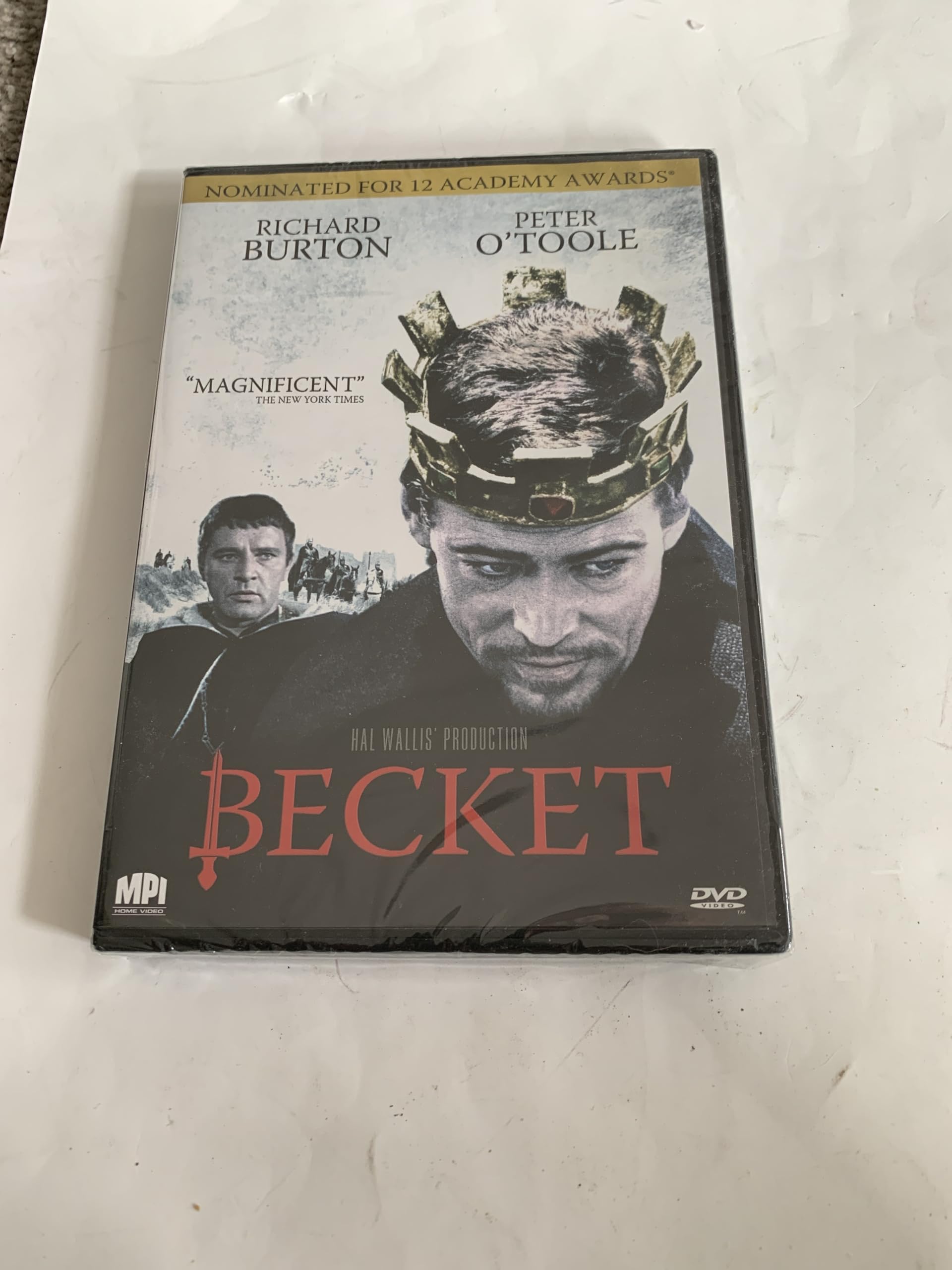


Becket
产品编号: 4399687
细节
- FormatColor Dolby
- GenreDrama
- LanguageEnglish Latin
- Runtime2 hours and 28
Classic struggle between Church and Monarchy. Thomas Becket and King Henry Mantagenet engage in one of the most famous power struggles in English history. When Becket first becomes chancellor and later Archbishop of Canterbury, a rift grows between Henry II and his old friend. Some eager drunken knights trying to please the disgruntled monarch assassinate the cleric in the cathedral. Director Peter Glenville Star Richard Burton, Peter O'Toole, John Gielgud Special Features: Widescreen Format, Commentary. Review: Rendering unto Caesar... - "Becket" explores the question put to Christ two millenia ago of whether man owes his primary loyalty to his monarch or to God. The search for the resolution of that question, and how it was answered, makes "Becket" one of the best historical dramas ever made. Peter O'Toole and Richard Burton are in top form as the young Henry II of England and his partner-in-mayhem Thomas Becket, whose primary interests are wine and women and not necessarily in that order. England in the 12th century was devoutly Roman Catholic, and the Catholic hierarchy enjoyed a level of power and prestige equal to, if not higher than, the king himself. But when the old archbishop dies and Henry needs to appoint a successor in his place, Henry outfoxes everyone by doing an end run around the bishops and naming Becket as the new archbishop. The bishops are upset; they believe Henry intends for Becket to be a puppet figure to be used to further the king's own ends. But to everyone's surprise, Becket takes his job more seriously than Henry ever intended. No one could be more stunned and shocked at this development than Henry himself. The confrontation between Henry and the clergy is set immediately following the old archbishop's death, when Henry informs the assembled bishops that there will only be one head honcho in England, and that is the king. The bishops are not used to having their power abrogated by anyone outside the church; they answer only to the pope and to God. The king and clergy are on collision course, and Henry, to his chagrin, finds that Becket is solidly on the side of the Church his king has appointed him to represent. There will be no compromise here. The stage is thus set for a fateful confrontation. One has to wonder: when Henry blurted out his petulant rhetorical question "Will no one rid me of this turbulent priest?", did he really not expect to be taken at his word? He's made it clear over and over again that he is the king, and the king is the law. So it's hard not to feel a sense of disgust at Henry's hypocrisy as he undergoes a ritual flogging in the cathedral crypt to expiate his guilt at having instigated Becket's murder, and immediately afterwards announces on the church steps that Becket will be venerated as a saint. Power-hungry to the last, Henry has abrogated to himself the privilege of an announcement that should have come from the new archbishop, or from the pope who alone has the power of canonization. The film has everything going for it: a great plot, two excellent performances by Burton and O'Toole, terrific direction and cinematography, and fine historical accuracy. The Gregorian chant running through the scenes in the cathedral transport the viewer 700 years back in time. For two unforgettable hours, we're part of 12th century England. And finally, let me add my request to those of the other reviewers of this excellent movie: Will someone please hurry up and release this film on DVD? I'll be first in line to buy it. This review is being UPDATED on 5/23/07 to add the following: Since I first reviewed this movie three years ago, my opinion of the acting, plot, characterization and script writing has not changed. This is a magnificent film by any criteria. I wish I say the same for the DVD. The picture quality is terrific. The sound quality, however, is not nearly as good, and for anyone who is hearing-impaired, a very serious problem is that this DVD is NOT closed captioned. The audio track is in English, French and Spanish. There are English subtitles for those who require them, but accessing them is tricky on some DVD players. It looks like whoever put this film on DVD was trying to cut corners. This movie deserves better. Judy Lind Review: Two outstanding performances! - What a great film I can see why both Peter O'Toole & Richard Burton were nominated for an Oscar performance. A film adaptation of the play Becket or the Honour of God by Jean Anouilh that starts light hearted but becomes much more indeed. I had never heard the story before, and so it was all new and refreshing to me. A heart breaking story of love, but not in the traditional way that we think of it. Two men, King Henry II & Thomas Becket two friends......I felt for each character and that is what makes the acting in this classic so great. I tip my hat to both O'Toole & Burton! One that will definitely be added to my blu-ray collection! 7/3/14 Update: I watched the Blu-ray version of this restored film I just bought, truly beautiful, you really get to to see the details of the sets, wardrobe, and even actual sweat from the actors! The sound quality of the soundtrack is top notch. What an amazing story that was brought to life by two strong leading men Peter O'Toole & Richard Burton. I was really looking forward to getting this when I saw that Peter O'Toole had done an audio commentary. After watching this film for the first time last month I was certain that I had picked up on the little nuances of the story. Peter O'Toole's commentary let me know that I had indeed pick up on a lot of the cues read by the actors or looks given. I also learned so much more into how Mr. O'Toole works and how he goes about putting that into action. It was great to hear his perspective on scenes, and learn things that I had not picked up on, or even just behind the scene anecdotes. My only complaint is also about the audio commentary that was moderated by Mark Kermode....for the most part his leading questions were great, but that said there were times when he would cut Mr. O'Toole off, or start talking when Mr. O'Toole was clearly trying to enjoy a particular scene. Now it could have just been me, but I just wanted him to shut up at certain points. Here I am trying to listen to one of the greatest actors of his time, talking about an amazing piece of film he worked on, and he dares to interrupt him, shame! If you are going to buy this film I would most certainly go for the Blu-ray....not only for the great film restoration but the price alone is worth Peter O'Toole's commentary!
| ASIN | B00007G1WH |
| Actors | Gino Cervi, John Gielgud, Paolo Stoppa, Peter O'Toole, Richard Burton |
| Aspect Ratio | 2.35:1 |
| Best Sellers Rank | #11,945 in Movies & TV ( See Top 100 in Movies & TV ) #1,525 in Drama DVDs |
| Customer Reviews | 4.7 4.7 out of 5 stars (1,137) |
| Director | Peter Glenville |
| Is Discontinued By Manufacturer | No |
| Item model number | 1053 |
| Language | English (Dolby Digital 2.0 Stereo), English (Dolby Digital 5.1), French (Dolby Digital 2.0 Stereo), Spanish (Dolby Digital 2.0 Stereo), Unknown (Dolby Digital 5.1), Unqualified |
| MPAA rating | PG-13 (Parents Strongly Cautioned) |
| Media Format | Closed-captioned, Color, Dolby, Multiple Formats, NTSC, Widescreen |
| Number of discs | 1 |
| Product Dimensions | 0.6 x 5.3 x 7.5 inches; 2.72 ounces |
| Release date | May 15, 2007 |
| Run time | 2 hours and 28 minutes |
| Studio | MPI Home Video |
| Writers | Edward Anhalt, Jean Anouilh, Lucienne Hill |
J**5
Rendering unto Caesar...
"Becket" explores the question put to Christ two millenia ago of whether man owes his primary loyalty to his monarch or to God. The search for the resolution of that question, and how it was answered, makes "Becket" one of the best historical dramas ever made. Peter O'Toole and Richard Burton are in top form as the young Henry II of England and his partner-in-mayhem Thomas Becket, whose primary interests are wine and women and not necessarily in that order. England in the 12th century was devoutly Roman Catholic, and the Catholic hierarchy enjoyed a level of power and prestige equal to, if not higher than, the king himself. But when the old archbishop dies and Henry needs to appoint a successor in his place, Henry outfoxes everyone by doing an end run around the bishops and naming Becket as the new archbishop. The bishops are upset; they believe Henry intends for Becket to be a puppet figure to be used to further the king's own ends. But to everyone's surprise, Becket takes his job more seriously than Henry ever intended. No one could be more stunned and shocked at this development than Henry himself. The confrontation between Henry and the clergy is set immediately following the old archbishop's death, when Henry informs the assembled bishops that there will only be one head honcho in England, and that is the king. The bishops are not used to having their power abrogated by anyone outside the church; they answer only to the pope and to God. The king and clergy are on collision course, and Henry, to his chagrin, finds that Becket is solidly on the side of the Church his king has appointed him to represent. There will be no compromise here. The stage is thus set for a fateful confrontation. One has to wonder: when Henry blurted out his petulant rhetorical question "Will no one rid me of this turbulent priest?", did he really not expect to be taken at his word? He's made it clear over and over again that he is the king, and the king is the law. So it's hard not to feel a sense of disgust at Henry's hypocrisy as he undergoes a ritual flogging in the cathedral crypt to expiate his guilt at having instigated Becket's murder, and immediately afterwards announces on the church steps that Becket will be venerated as a saint. Power-hungry to the last, Henry has abrogated to himself the privilege of an announcement that should have come from the new archbishop, or from the pope who alone has the power of canonization. The film has everything going for it: a great plot, two excellent performances by Burton and O'Toole, terrific direction and cinematography, and fine historical accuracy. The Gregorian chant running through the scenes in the cathedral transport the viewer 700 years back in time. For two unforgettable hours, we're part of 12th century England. And finally, let me add my request to those of the other reviewers of this excellent movie: Will someone please hurry up and release this film on DVD? I'll be first in line to buy it. This review is being UPDATED on 5/23/07 to add the following: Since I first reviewed this movie three years ago, my opinion of the acting, plot, characterization and script writing has not changed. This is a magnificent film by any criteria. I wish I say the same for the DVD. The picture quality is terrific. The sound quality, however, is not nearly as good, and for anyone who is hearing-impaired, a very serious problem is that this DVD is NOT closed captioned. The audio track is in English, French and Spanish. There are English subtitles for those who require them, but accessing them is tricky on some DVD players. It looks like whoever put this film on DVD was trying to cut corners. This movie deserves better. Judy Lind
M**T
Two outstanding performances!
What a great film I can see why both Peter O'Toole & Richard Burton were nominated for an Oscar performance. A film adaptation of the play Becket or the Honour of God by Jean Anouilh that starts light hearted but becomes much more indeed. I had never heard the story before, and so it was all new and refreshing to me. A heart breaking story of love, but not in the traditional way that we think of it. Two men, King Henry II & Thomas Becket two friends......I felt for each character and that is what makes the acting in this classic so great. I tip my hat to both O'Toole & Burton! One that will definitely be added to my blu-ray collection! 7/3/14 Update: I watched the Blu-ray version of this restored film I just bought, truly beautiful, you really get to to see the details of the sets, wardrobe, and even actual sweat from the actors! The sound quality of the soundtrack is top notch. What an amazing story that was brought to life by two strong leading men Peter O'Toole & Richard Burton. I was really looking forward to getting this when I saw that Peter O'Toole had done an audio commentary. After watching this film for the first time last month I was certain that I had picked up on the little nuances of the story. Peter O'Toole's commentary let me know that I had indeed pick up on a lot of the cues read by the actors or looks given. I also learned so much more into how Mr. O'Toole works and how he goes about putting that into action. It was great to hear his perspective on scenes, and learn things that I had not picked up on, or even just behind the scene anecdotes. My only complaint is also about the audio commentary that was moderated by Mark Kermode....for the most part his leading questions were great, but that said there were times when he would cut Mr. O'Toole off, or start talking when Mr. O'Toole was clearly trying to enjoy a particular scene. Now it could have just been me, but I just wanted him to shut up at certain points. Here I am trying to listen to one of the greatest actors of his time, talking about an amazing piece of film he worked on, and he dares to interrupt him, shame! If you are going to buy this film I would most certainly go for the Blu-ray....not only for the great film restoration but the price alone is worth Peter O'Toole's commentary!
J**S
Holy Hellraisers
Peter O'Toole and Richard Burton were often in their cups while filming this story of friendship. The two seem type cast as the two fast friends, with Peter O'Toole as the ebullient, imperious, youthful King Henry II, who misreads his much older, more mature, more whimsical companion completely, when he makes Burton's Becket the Archbishop of Canterbury. The cast is a who's who of great British stage actors of the period, including Donald Wolfit, John Gielgud, Martita Hunt, and Pamela Brown. Produced by the legendary Hal Wallis and directed by England's foremost stage director of the period, Peter Glenville, the movie won an Oscar for Best adapted screenplay from the Jean Anouilh Broadway hit of the same name. This is, for stage lovers, top drawer work from among two of the finest directors, and playwrights of that generation. But the bravura performances of the leading men dominates the film, and, for that alone, it's worth watching. Amazingly, this picture seems to have escaped the signs of the time it which it was made. The costumes and scenery are quite arresting, and the ritual of excommunication is in sound and sight just plain riveting. If you are looking for a film with wonderful dialogue and actors who can give its interpretation its due, if you are in the mood for watching friendship treated seriously as one of the four loves, and if you don't require modern digital tricks an intrusive music and sound effects, you might give it a try. The possible rewards are great, and the risk minimal.
R**Y
Thomas Becket, Sohn eines Londoner Kaufmanns, hatte im Ausland Jura und Theologie studiert und kehrte mit 22 Jahren nach England zurück. Der jünge König Heinrich II ist angetan von der Bildung, Selbstsicherheit und Intelligenz, die beiden Männer werden Freunde - Becket hingegen findet auch Gefallen am verschwenderischen Hofleben, dass der König ihm bietet und den irdischen Genüssen, die sich daraus ergeben. So wird er 1155 überraschend Lordkanzler und hilft dem König, der ihm vertraut, bei dem Streit mit dem Erzbischof Theobald von Canterbury über die Kompetenzen von kirchlicher und auf der anderen Seite weltlicher dem König obliegenden Gerichtsbarkeit. Als der Erzbischof 1161 stirbt, kommt dem König ein kluger Schachzug in den Sinn das höchste kirchliche Amt in England "seinem Mann" zu geben. So wird Becket widerstrebend neuer Erzbischof, weil er befürchtet, dass das Ausüben beider Ämter bald Probleme bringen wird. Und er behält Recht. Mit dem hohen Amt, dass dem König in Punkto Macht gleichwertig ist, wechselt Beckets Charakter vom Kollaborateur ohne Prinzipien zum glaubwürdigen Gottesmann, der im Gebet die Ehre Gottes findet, die er ab dann mit grosser Hingabe verteidigt. Doch er entfernt sich immer mehr vom König, der es nicht ertragen kann, dass sein Freund nicht ihn, sondern Gott lieben kann. Es wird Hass daraus. Gemeinsam mit dem vor Neid zerfressenen Widersacher Heinrich von Winchester schmiedet der König böse Rachepläne und falsche Anschuldigen, die Becket zur Flucht nach Frankreich zwingen. Erst Jahre später kann Becket durch die Interventionen des französischen Königs und des Papstes vom Zisterzienserkloster Pontigny als rechtmässiger Erzbischof ins heimische England zurückkehren. Doch der König ist nach wie vor von Liebe und Hass zerfressen und es kommt im Gespräch mit seinen 4 treuen Lords zur folgenschweren gewollten und geschchtsträchtigen verzweifelten Aussage "Erlöst mich denn niemand von diesem Priester".... Peter Glenville drehte nur sehr wenige Filme, er gehörte aber lange Jahre zu den renommiertesten Theaterregisseuren am New Yorker Broadway und im Londoner Westend. Herausragend gelang ihm dieser britische Historienfilm aus dem Jahre 1964 basierend auf Jean Anouihs Theaterstück, ein Film,der gleichzeitig auch Auftakt für weitere grosse britische Historienfilme wie "Mann zu jeder Jahreszeit", "Cromwell", "Königin für 1000 Tage", "Der Löwe im Winter" oder "Maria Stuart" war. Die beiden Stars Peter O'Toole und Richard Burton liefern ein gekonntes Psychoduell mit Tiefgang und klasse schauspielerische Leistungen, beide erhielten eine Oscarnominierungen als bester Darsteller, allerdings konnten sie sich gegen Rex Harrisons Performance als Dr. Higgins nicht durchsetzen - insgesamt kam der Film auf stolze 12 Oscarnominierungen. Er konnte letztendlich nur einen Preis für das beste Drehbuch ergattern - bei allen anderen Kategorien hatten die Musicals des Jahres My fair lady und Mary Poppins die besseren Karten. Eine erfreuliche DVD-Erscheinung. Bild ist gut, der deutsche Ton leider nur in Mono.
E**T
Can't tell if the product is good or not as it arrived in the wrong region code for Australia. Amazon should sell DVDs suitable for all regions. Can't play it. Very annoying, waste of money. Why do we need a region code anyway, with digital TV?? Some DVDs are available in all regions format, why not all of them?
A**I
ピーター・オトゥール演ずるヘンリー2世にとって、リチャード・バートン演ずるベケットがどのように重要な存在だったのかがわかる映画です。大法官となったベケットは王の傀儡として働くことを期待してカンタベリー大司教に任命されますが、次第に協会の利益を代弁するようになり、ついには王との間に亀裂が生じます。結果として、ベケットは王が差し向けた」4人の騎士たちによってカンタベリー大聖堂内で暗殺されることになるのですが、そうしたイギリスの歴史を学べるところがこの映画の魅力のひとつだと思います。輸入物なので字幕がないですが、英語に自信のある人にはおススメのDVDです。
C**N
Es un clásico; a los que les guste el cine de ahora donde están 20 minutos gritando ensordecedoramente, esto no les gustará; pero a los que sientan paz y profundidad espiritual, les encantará. Ideal para aprender inglés también, por su puesto.
S**N
Excellent service, delivered promptly, great film, had no problems with the dvd