We remain fully operational. Our teams are working around the clock to ensure your deliveries continue safely.

下载应用程序


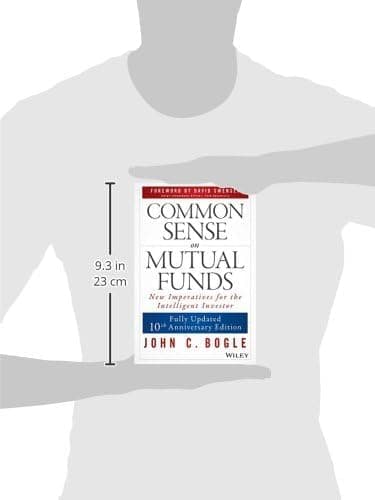
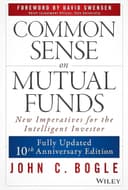

Buy Common Sense on Mutual Funds, Updated 10th Anniversary Edition 2 by Bogle, John C., Swensen, David F. (ISBN: 9780470138137) from desertcart's Book Store. Everyday low prices and free delivery on eligible orders. Review: A summary of the high priest of Index Funds main message! - This book is 605 pages long! Way too long for what the author is advocating which I am going to give you a breakdown: 1) In the short term, stocks are more volatile than bonds but produce a greater return in the long term 2) A younger investor with a longer investing outlook should allocate more of their capital in common stocks and less in bonds but the reverse for an older investor with shorter time outlook. 3) The likelihood of active investing in producing consistent returns is poor for the long-term as few managers have consistently outperformed the market. 4) An index fund is the surest way to capture returns from the whole market 5) Go for an index fund that has the lowest cost and lowest turnover to maximise returns for the investor 6) Make sure the index represents the whole market and has a cap on how much funding it is open too. 7) Use these principles to invest in both bonds and index funds 8) Take home message the lowest cost fund with the lowest turnover produces the best result in the long term. For the message, I give the book 5 Stars! Review: It's really good if you like a lot of technical detail - I thought this was a newer version of The Little Book of Common Sense Investing but it wasn't. It's really good if you like a lot of technical detail. If you like it nice, simple and entertaining then the Little Book is better. The message is the same in both books and a very powerful one. Fund managers cannot beat the market over time and will seriously deplete your investment pot while failing to deliver on the promise that they can. Why pay them all that money in Annual Management Charges for doing worse than a low cost index fund that passively tracks an index? Like the S&P500? I worked out that had my pension been in this kind of fund from 2008, rather than a big brand company, my 'pot' would be 25% bigger now. I found both books liberating and infuriating at the same time! If only I'd found them 12 years ago! Act now. Step 1 Buy the book Step 2 Open an account with a broker Step 3 Buy a low cost index fund and leave it alone
| Best Sellers Rank | 541,030 in Books ( See Top 100 in Books ) 2,425 in Professional Finance |
| Customer reviews | 4.6 4.6 out of 5 stars (557) |
| Dimensions | 16 x 4.06 x 23.11 cm |
| Edition | 2nd |
| ISBN-10 | 0470138130 |
| ISBN-13 | 978-0470138137 |
| Item weight | 1.05 kg |
| Language | English |
| Print length | 656 pages |
| Publication date | 12 Jan. 2010 |
| Publisher | Wiley |
M**A
A summary of the high priest of Index Funds main message!
This book is 605 pages long! Way too long for what the author is advocating which I am going to give you a breakdown: 1) In the short term, stocks are more volatile than bonds but produce a greater return in the long term 2) A younger investor with a longer investing outlook should allocate more of their capital in common stocks and less in bonds but the reverse for an older investor with shorter time outlook. 3) The likelihood of active investing in producing consistent returns is poor for the long-term as few managers have consistently outperformed the market. 4) An index fund is the surest way to capture returns from the whole market 5) Go for an index fund that has the lowest cost and lowest turnover to maximise returns for the investor 6) Make sure the index represents the whole market and has a cap on how much funding it is open too. 7) Use these principles to invest in both bonds and index funds 8) Take home message the lowest cost fund with the lowest turnover produces the best result in the long term. For the message, I give the book 5 Stars!
P**L
It's really good if you like a lot of technical detail
I thought this was a newer version of The Little Book of Common Sense Investing but it wasn't. It's really good if you like a lot of technical detail. If you like it nice, simple and entertaining then the Little Book is better. The message is the same in both books and a very powerful one. Fund managers cannot beat the market over time and will seriously deplete your investment pot while failing to deliver on the promise that they can. Why pay them all that money in Annual Management Charges for doing worse than a low cost index fund that passively tracks an index? Like the S&P500? I worked out that had my pension been in this kind of fund from 2008, rather than a big brand company, my 'pot' would be 25% bigger now. I found both books liberating and infuriating at the same time! If only I'd found them 12 years ago! Act now. Step 1 Buy the book Step 2 Open an account with a broker Step 3 Buy a low cost index fund and leave it alone
G**A
One slant on Funds
A good treatise of Bogles view of investing well argued but not I any way wide reaching
V**D
Peace of mind to have it and read it when in doubt
I have been investing in ETFs with huge leverages such as 1:100 to 1:500 (Stupid me) - lost around 13k Eur back in 2012 just before Christmas on Dow Jones being leveraged at 1:50. Since 2012 until I read this book I had no will power to invest, nor the knowledge to do so. Clearly did not understand what I was doing, went after get rich quick schemes and all that. After I have read this book I am owning a portfolio of over 40k and I am going to bed with the power of knowledge and not worrying about my investment. My family and my spouses family is also now trusting the information I am giving them. It is for your peace of mind to have this book.
O**.
This excellent 600 page book is longer than it needs to ...
This excellent 600 page book is longer than it needs to be. The essential message is repeated umpteen times. However there are very many useful suggestions which are supported by extensive evidence and analysis. The whole book is underpinned by a lifetime of experience in the markets, so it's worth making the effort.
H**R
Excellent read
Very convincing arguments, good use of data would say that most explanations are in a way which makes sense only for those who have some basic financial knowledge like economic variables, understanding of bond market terms like yields and knowledge of broader financial market terms like measuring risk/volatility.
M**P
A powerful book
An incredibly valuable piece of art. Love it. This part of the world was far from my circle of competence. Thanks, this phenomenal book I am aware of very interesting area of investment funds. Thank you. Very impressive. I would do anything to work for such a company with such fantastic culture. My favourite.
R**C
essential for the sensible wealth-grower
Although not as timeless, this is just as important to read as 'the Intelligent Investor', and requires the same effort and a real intellect to understand. There can be no higher praise. This is simply the best book available on the subject of investment funds, directly relevant to the current market. You need to realise that it is US-biased but translates over to the UK easily enough.
R**O
No llego el paquete
S**I
Its am amazing book, if you are willing to invest in mutual fund.
T**K
Les deux premières parties sont les plus intéressantes - Stratégie d'investissement, allocation d'actifs. Il montre d'où viennent les performances, la part de la spéculation, pourquoi l'investissement long terme permet de l'éviter. Très convaincant. - Quels moyens choisir pour investir. Evidemment il faut prendre en compte qu'il est l'inventeur de la gestion indicielle et que sa boite est le leader sur le marché, mais la supériorité de l'indexing sur la gestion active est quand même très bien argumentée. Au niveau des défauts : - pas mal de répétitions, mais c'est volontaire (construction en chapitres indépendants) - la partie 4 "on fund management", même si intéressante, apporte peu. L'anglais financier est aussi un peu technique, mais rien de grave. L'argumentation est toujours appuyée par l'actualisation des graphiques ("10 ans après") qui appuie toujours son propos. Globalement très bon bouquin qui vous évitera de payer des frais à des gestionnaires de patrimoine globalement incapables de battre le marché !
S**A
Llegó a tiempo ,era lo q quería comprar
M**S
this is *the* book to read on mutual funds. it's a hefty tome coming in at 600+ pages, but fear not. this book does not read like a dry financial report. bogle is opinionated and his writing flourishes with reminders of his personality amidst the endless but important charts and tables. to spice things up, bogle makes references to a wide variety of sources including shakespeare, thomas paine, scripture and even hegel! by the time you're done, you'll know *everything* you've ever wanted to know (and more) about the mutual fund industry, all straight from the founder of the vanguard group himself. for those afraid of the size of this book, perhaps check out bogle's "little book of common sense investing" instead and then come back to this book if you want more details. bogle's main message is that costs do matter and simplicity is the best way to avoid costs. the recommendation is to buy low cost broad-based index funds that will outperform the vast majority of actively managed mutual funds in the long run. notice by the definition of "average" that the average investor will get average market returns minus fees and taxes. notice the low cost broad-based index fund gets average market returns minus *minimized* fees and taxes. the index investor will thus outperform the average investor in actively managed mutual funds given all the extra costs associated with active management. also notice that the margin of victory from indexing will compound over the years and will lead to an even greater index fund performance in the long run. that's the gist of why indexing works. if you're not convinced, read bogle's book! even if you've already read some of the other great passive investing books espousing the virtues of indexing, you still owe it to yourself to read at least one of bogle's books. "common sense on mutual funds" is both readable as well as comprehensive, and would be a good addition to your library. burton malkiel, rick ferri, william bernstein, larry swedroe and others have all written excellent books on the subject as well, but they also hold differing opinions on the specifics, so read all of these authors! i was already convinced on indexing after first reading malkiel's book, but continued reading more on passive investing to work out all the details. these books as a whole help reinforce the main ideas while also exposing the reader to the authors' differences in perspectives, thus building confidence in the reader to think and succeed as an independent d.i.y. investor. of particular interest to me was the issue of small-cap value tilting. i was ambivalent on this practice, but bogle's book convinced me to *not* small-cap value tilt. readers who already know what small-cap value tilting is should feel free to skip to the next paragraph. now, for those unfamiliar with the terminology, stocks are divided according to size (small-cap, mid-cap, large-cap) as well as style (value, blend, growth). the size refers to the company's size as measured by its market capitalization, i.e. the number of shares multiplied by the price per share. the style is another way to partition stocks according to certain numbers such as price/book ratios and dividend yields; there's no agreed upon standard that's universally accepted for what constitutes a value/blend/growth stock. informally, you could think of value stocks as those that are not currently favored by the market for whatever reason. at the opposite extreme, growth stocks are "hot" stocks that scream potential. blend stocks are in between value and growth. given 3 sizes and 3 styles, there are thus 9 size-style combinations. according to research done by professors fama and french, small-cap value stocks significantly outperform the other 8 size-style combinations in the long run. the problem is, small-cap value stocks make up about 3% of the total stock market. small-cap value tilting means overloading on small-cap value stocks to try to capture the bonus identified in the fama/french research, but that also means underweighting 97% of the total market and potentially missing out if the other 8 size-style combinations outperform small-cap value. you see the dilemma. bogle's repeated message of simplicity, as well as his emphasis on reversion to the mean, ultimately convinced me to resist the temptation of small-cap value tilting. bogle's unwavering conviction in the simple serves as a necessary component in the chorus of voices, helping to guide your investment decisions, even on the more esoteric matters. and although the message of simplicity is easily stated, i am glad bogle wrote a comprehensive text because the details illustrating the majesty of simplicity is what finally settled the small-cap value tilting question for me. this book's huge size and scope definitely has its drawbacks, not the least of which is the sheer intimidation factor. nevertheless, i believe this book does serve a useful role in the catalog of passive investing, and bogle was the only one who could've written it.
TrustPilot
1 个月前
4天前