We remain fully operational. Our teams are working around the clock to ensure your deliveries continue safely.

下载应用程序




Buy anything from 5,000+ international stores. One checkout price. No surprise fees. Join 2M+ shoppers on Desertcart.
Desertcart purchases this item on your behalf and handles shipping, customs, and support to Taiwan.
🦠 Strategize, Collaborate, Conquer – Will You Save the World in Time?
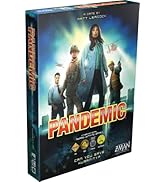
Pandemic is an award-winning cooperative board game for 2-4 players aged 8+, featuring a global map with 48 cities where players act as specialists racing against time to cure four deadly diseases. With an average 45-minute playtime, it blends strategic planning, role-based teamwork, and dynamic challenges, making it a must-have for families and strategy enthusiasts seeking immersive, high-stakes gameplay.
















| ASIN | B00A2HD40E |
| Age Range Description | Kid |
| Best Sellers Rank | #13,706 in Toys & Games ( See Top 100 in Toys & Games ) #325 in Board Games (Toys & Games) |
| Brand Name | Z-Man Games |
| CPSIA Cautionary Statement | Choking Hazard - Small Parts, No Warning Applicable |
| Color | Multi-colored |
| Customer Package Type | Standard Packaging |
| Customer Reviews | 4.8 4.8 out of 5 stars (18,824) |
| Edition | Updated Edition |
| Educational Objective | Develop critical thinking and teamwork skills |
| Estimated Playing Time | 45 Minutes |
| Game Mechanics | cooperative |
| Genre | Strategy |
| Global Trade Identification Number | 00681706711003 |
| Included Components | Toy |
| Indoor Outdoor Usage | Indoor |
| Is Assembly Required | No |
| Item Dimensions | 12 x 8.6 x 1.7 inches |
| Item Dimensions L x W | 12"L x 8.6"W |
| Item Part Number | ZMG71100 |
| Item Type Name | Pandemic Board Game |
| Item Weight | 0.91 Kilograms |
| Language | English |
| Manufacturer | Asmodee |
| Manufacturer Maximum Age (MONTHS) | 180.0 |
| Manufacturer Minimum Age (MONTHS) | 156.0 |
| Manufacturer Part Number | ZMG 71100 |
| Manufacturer Warranty Description | No Warranty |
| Material Type | Paper |
| Minimum Age Recomendation | 96 |
| Model Number | ZM7101 |
| Number of Items | 1 |
| Number of Players | 2 to 4 players |
| Operation Mode | manual |
| Rulebook Availability | Printed Included |
| Set Name | Pandemic |
| Size | 1. Standalone Game |
| Subject Character | Operation Specialist, Scientist, Medic, Researcher |
| Theme | Strategy |
| Unit Count | 1 Count |
S**T
The Greatest Cooperative Game Ever
Pandemic is a 2 to 4 player cooperative strategy game about doctors fighting diseases. All around, it’s a downright amazing game whether you’re a casual board gamer or a hard core one. Anyone who believes that the life of a doctor is boring or mundane might find a brand you appreciation for them when they play this game for the first time, but I think Pandemic’s biggest contribution to gaming is the standard it set for the many other cooperative games that came after it. In Pandemic every player is given a special role-card with a nameless character on it who has a special power that will be vital to winning the game. The game board itself is a map of the world with 48 of the most important cities connected to one another by white lines to indicate paths for movement. The four diseases you are struggling to cure are represented by tiny different colored cubes that will inhabit these cities, slowly making the population sicker and sicker. The players have two objectives that are vital to winning. If the entire supply of any one disease has been distributed across the board, the players loose. So part of the gameplay involves traveling to the world’s many cities to treat the inhabitants and removing disease cubes from those spaces. However, to overcome the diseases and win the game, players have a hand of different colored cards with the names of different cities on them. Players can travel greater distances by surrendering some of these cards, but the real goal is to visit one of the research centers on the board and surrender five cards of the same color to find a cure for one particular disease. Once the cures for all four diseases have been discovered, the players win the game. Much of the game’s intrigue comes from your hand of cards because in almost every game players will be unsure if they want to use those cards for transportation or save them instead for finding a cure. The majority of player to player interaction involves passing and exchanging these cards around to create optimal hands, but even that will prove a challenge. One of the hardest rules for the players to follow is probably the one that won’t let you exchange a card unless the city printed on that card matches the one you’re currently in. Having one person playing as the Researcher can be the greatest benefit to your team, since they get to ignore that rule. So on top of the player’s gameplay being very intriguing, the diseases also have an interesting gameplay style. The game’s difficulty is determined by how many Epidemic cards that you have shuffled into the Player Deck. The diseases themselves get a separate pile of cards called the Infection Deck. Each card from the Infection Deck has the name of a city where you will place one more disease cube at the end of each and every turn. Epidemic cards from the Player Deck are downright diabolical, because they will force you to take the discarded Infection cards and then put them back on top of the deck they came from. That means diseases will start targeting the same cities multiple times and players will be running back and forth trying to keep the diseases under control. Outbreaks are even worse, when there are already too many disease cubes on one city and the game will force you to put a cube on each connecting city instead. The mass mayhem and panic that starts to circulate around the game table is one of the most enjoyable things about Pandemic. The gameplay is a truly flawless experience, in my opinion. Turns tend to happen very quickly and each player’s unique power will strongly encourage coordination between everyone. Pandemic also balances dumb luck with careful strategic planning, because it’s possible you’ll already have the cure for a disease within the first turn of the game. However, if players don’t coordination their efforts and manage their resources wisely that is the path to certain doom. But it’s not only the balance and the coordination that makes the gameplay perfect but also the right theme. Playing as doctors and trying to do something as noble as fighting diseases is something that everybody in the world can truly admire. When the world is suffering from a pandemic it doesn’t matter what creed or nationality you are since everyone will pool their efforts to save humanity itself, hence the cooperative play. The art direction is also very complimentary of the theme. The game and the cards kind of remind me of a computer monitor that’s tracking the progress of each person and disease. It’s all very family friendly too, since there is no artwork portraying any gruesome pain or agony. Now, to nitpick on some of the game’s very few shortcomings, there are probably a few people who won’t be convinced a tiny colored cube represents a disease very well. Personally, this has never distracted me from an enjoyable game. Also, the spaces that represent each city can also be very small when trying to fit disease cubes, a research station and player pawns all together into a circle half an inch across. But once again, this has never been a problem to me if the game board isn’t shaken too much. So altogether, Pandemic is probably the single best cooperative board game that was ever created. It’s fresh and exciting every time I play it, and I always enjoy upping the difficulty to see how much better I can do against the diseases. Winning and loosing are both very fun if you work well together as a team. But even to this day, Pandemic is an example to other game designers trying to make cooperative board games, and it’s not very hard to see why when you pick it up and play it.
S**D
Best game EVER!
Okay, to start out, I love love LOVE Pandemic! I admit it, I'm a bit competitive. I hate losing games. I'm generally fine with competitive games where the best strategist (or luckiest) wins, but I really dislike games (like Settlers of Catan) where some players can gang up on others. You pretty much don't have a chance when every other player is specifically playing against YOU. Pandemic is fantastic because you cooperative with the other players and you all win or lose together. I just absolutely love sitting at the table talking about all our options and strategizing together. My son introduced me to Pandemic several months ago, and I was hooked. We've spent several afternoons/evenings playing again--and again--and again. On many occasions when I am home alone, I play all by myself (playing two roles), and we've also played four players on several occasions. With two players and four epidemics, we win every time. With five epidemics, we win about 70% of the time. We've tried six epidemics a couple times, but have not been able to beat that game yet. Still trying! Ugh! As you increase the number of players, the game gets more difficult. With four players we've only played with four epidemics, and we win probably a little over half the time. I honestly think it would be impossible with four players and six epidemics, but someone has probably proven me wrong. We've even discovered another way to lose the game, which is not listed in the rule book! It says you can lose by having too many outbreaks, running out of disease cubes, or running out of player cards. We've lost in all those lovely ways. However, a couple of times, we've had only a few outbreaks, had plenty of cubes of each color left, and plenty of player cards. Three diseases cured, with only one to go. One of those times, we'd even gotten through all the epidemics, so there were none left in the infection deck! We've got it made, right? Uh, no. Turns out we discarded too many of the same color city cards, and there were only four left total, including in our hands and in the player deck. Neither of us was the Scientist, so that was an automatic loss. This is a danger when you get dealt a nice hand at the beginning, say two or even three of the same color. You decide to collect those, so when you discard, you are discarding the other colors. If you happen to keep drawing you "discard" color and it takes too long to collect the color(s) you want, you've now discarded too many of the other color and you don't have enough left at the end to cure the disease. Beware. We have also managed to lose the game on the very first turn. We were very unlucky drawing the infection cards when setting up the game: three on Karachi and Delhi, and two on Kolkata. Our first player did not have any way to get to that location to do even a little treating, and the first card drawn from the player deck was an epidemic. After resolving the epidemic, the first card drawn was Delhi, which caused a double outbreak (Delhi/Karachi) and put the third cube on Kolkata. The second card drawn was Kolkata, which was a triple outbreak (Kolkata/Delhi/Karachi) and lost us the game as there weren't enough disease cubes. Yep, lost on the very first player card drawn and there was not a single thing we could do about it. One slight change we sometimes make in the game is to draw 10 cards at the beginning instead of 9. The first nine infect the cities, and the tenth is where we place our player pawns and the first research station. It adds a level of difficulty to the game to not always start in Atlanta. We were noticing before that we always seemed to get in trouble with black and red, and we believe it was because all our players started so close to blue and yellow so those cities were easy to get to and treat. Now that we can start anywhere on the board, blue and yellow have become equal opportunity killers. There are a few things it is easy to get wrong. When the infection rate moves up, it's easy to forget to start drawing three cards (or four) since you're so accustomed to the lower number. It's also easy to forget to discard, not noticing that you have more than 7 cards in your hand. One scenario we've encountered a few times involves having 8 cards for literally a second. You meet another player on top of a research station, and share knowledge by pulling that city card from her. You now have 8 cards in your hand, but 5 of one color. Your very next action is going to be curing a disease, which will leave you with only 3 cards. But, before you cure that disease, you have 8 cards, so we think you have to discard one even though literally on your next action you will be discarding 5 cards. This is a little frustrating, but the rules specifically say that if you EVER (my emphasis) have more than 7 cards in your hand, you must discard (or play an event card). We were also a little confused by the role of the Researcher the first time we played. To be clear, when the Researcher shares knowledge, she and the other player must be on the same city, and the card can only go FROM the Researcher TO the other player (on either player's turn, as an action). She cannot take a card from the other player (and they cannot give one to her), unless it matches the city they are sitting on. It is also extremely easy to forget to infect cities after resolving an epidemic. You've spent a bunch of time resolving, then strategizing based on where the board stands now, and you completely forget that you still have to infect before going to the next player. Lastly, you are not supposed to choose your roles. We played with one person who had played before, and he said they always choose which roles they want. I suppose you can play that way if you want, but the game would be far less interesting because people would probably tend to choose the same roles every time. The instructions say to shuffle the role cards and deal them to each player -- that means they're supposed to be random. It's far more interesting and challenging when the roles change every time. A good part of the strategy is figuring out how to maximize the advantages that each role gives you in any given game. Pandemic is basically figuring out exactly how much effort you have to spend in each game sharing knowledge in order to cure diseases versus preventing outbreaks, all while maximizing the strategic use of whatever role you are playing. Spend too much time on one, and the other will get you. Sometimes you just have to say "oh well" and let an outbreak happen, even when you could have prevented it. It may just be more important to get to that one city in order to share knowledge than to get to the city where the outbreak is about to happen in order to prevent it. However we do try hard to prevent double outbreaks because things can get very bad very quickly when that happens. Okay I've rambled enough. If you're on the edge, buy this game! It's awesome. Every game is different and it never gets boring. It is equally fun with two or more players, although the more players, the more challenging it is. You can control the difficulty level by player with fewer or more epidemic cards. A+
C**R
Perfect for a big gamer game night
Bought this game as a gift and it has been enjoyed for many years. My family likes game nights where we work together against the game and this game does not disappoint!! Every game feels different due to the randomization of infected cities, timing of epidemics & outbreaks, players' abilities, and cards in hand. There's many moving parts to this game so it's always interesting and engaging. You can also change the difficulty based on how YOU choose to set up the deck, allowing you and friends to get familiar with the game mechanics without being overwhelmed. There's lots of small pieces but the box comes with little baggies and space for everything so you don't have to worry about playing tetris just to put pandemic away. The board is great quality and after many games and years of use it doesn't have a single flake or chip anywhere. All the pieces hold together well and nothing shows any signs of wear and tear. High quality figures and high quality game.
R**E
Pandemic - in my opinion - is the best board game ever published. It takes just the right amount of time to play (30-60 minutes), is cooperative so everyone playing is a team trying to beat the game which makes the social dynamic more engaging than a competitive game, the mechanics are basic and easy to learn, and the game is different each time you play. I have yet to find another game that borders on so close to perfect as this one. It doesn't even need the expansions (except for On the Brink - you have to get that just for the petri dishes for your disease cubes) which to me complicate an already precisely balanced game. I cannot praise this game enough, and everyone I've played it with has gone out and bought their own copies.
Y**E
Erg toepasselijk thuisquarantaine vermaak! We spelen meestal op een avond een paar rondjes achter elkaar, want het klaarzetten en opruimen is wel wat werk met al die kleine onderdelen. Zeer geschikt voor mensen die niet tegen hun verlies kunnen.
F**S
Great game, kids love it
M**J
Haven't actually played yet but opened the package. Looks genuine and is in English, perfect :-)
X**N
In the midst of the global pandemic, my wife and I found ourselves spending much more time at home due to quarantine measures. To stave off boredom, we decided to try the aptly named Pandemic Board Game. Upon purchasing the game, we were intrigued by its premise - working together to fight off a global outbreak. It seemed fitting given the circumstances. We quickly found that the gameplay was engaging and provided a much-needed diversion from the outside world. The game requires strategic thinking and teamwork, making it an excellent choice for couples or families. Each round brought new challenges and decision-making opportunities. The unpredictability of the game’s progression made it feel as if we were truly in the midst of a global crisis, adding a level of realism and excitement. Interestingly, we also started to use the game as a form of divination during our time in quarantine. While a little unconventional, the outcomes of our game sessions became a source of speculation and discussion. It added another layer of fun and intrigue to our gameplay experience. In conclusion, the Pandemic Board Game is a highly engaging and thought-provoking game. It provided us with a sense of connection and adventure during a time when the outside world seemed uncertain. Whether for its strategic gameplay or as a unique form of divination, we found enjoyment and entertainment in this board game.