We remain fully operational. Our teams are working around the clock to ensure your deliveries continue safely.

下载应用程序



Buy anything from 5,000+ international stores. One checkout price. No surprise fees. Join 2M+ shoppers on Desertcart.
Desertcart purchases this item on your behalf and handles shipping, customs, and support to Taiwan.
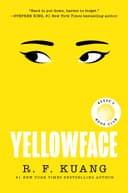
Yellowface: A Reese's Book Club Pick : Kuang, R F: desertcart.ae: Books Review: Good Story - This was a recommendation from Reece Witherspoon's Book Club, so when I received an desertcart voucher for my birthday I decided to treat myself. Good story, well written. Book arrived in excellent condition. Review: Used/Damaged Items - Received a used book the first time and after returning it, got a damaged book with torn pages the second time!


| Best Sellers Rank | #44,413 in Books ( See Top 100 in Books ) #15 in Satire #47 in Feel-Good Fiction #76 in U.S. Literature |
| Customer reviews | 4.2 4.2 out of 5 stars (2,366) |
| Dimensions | 13.49 x 2.01 x 20.32 cm |
| ISBN-10 | 0063250853 |
| ISBN-13 | 978-0063250857 |
| Item weight | 181 g |
| Language | English |
| Print length | 352 pages |
| Publication date | 7 January 2025 |
| Publisher | William Morrow & Company |
L**E
Good Story
This was a recommendation from Reece Witherspoon's Book Club, so when I received an Amazon voucher for my birthday I decided to treat myself. Good story, well written. Book arrived in excellent condition.
S**H
Used/Damaged Items
Received a used book the first time and after returning it, got a damaged book with torn pages the second time!
T**D
Book condition not very good
The pages of the book were not in good condition
C**L
The book came without the cut on the pages
The book came without the cut!!!
S**M
Brilliant book
Loved it so funny and witty
S**N
R.F. Kuang is a Chinese-American writer, young, and blessed with talent. Her previous novels were fantasy, her characters were fantastical and exaggerated. In Yellowface, Kuang takes a candid jab at the publishing industry, for their repeated and performative treatment of ethnic characters. It’s metafiction on the nose, and the nose is pointed! Since 2020, publishers have pledged to represent ethnic minorities with authenticity, instead of pressing them into reductive and ornamental molds. Kuang’s twisty plot reveals her audacious theme, and her theme is a response to publishing’s failure to pivot as they vowed. The industry continues to tokenize people of color (YF focuses on Chinese American POC), presenting them as one-dimensional figures, sugary and saccharine and simple. It’s condescending and cringey. Ms. Kuang took a deserved thwack at the industry, and the outcome is a wild and frantic ride inside the publishing houses. Yellowface is suspenseful, plot-propelled, a cat-and mouse drama with satirical varnish. Kuang is a siren when she creates characters---I thought they might walk off the page! It has a staccato pace and a comical touch in all the fatal, tragic places. The voice is light, so the book isn’t turgid, despite the torment of protagonist June Hayward. June is a white American writer who wants success, awards, fame. She’s gotten, instead, a first-book flop. Her nemesis is brainy, beautiful, and self-possessed Chinese American Athena Liu, a celebrated novelist with a Netflix series on the way. Kuang created a complex character in Athena, breaking the stereotypical “good girl” that publishers crank out with Asian characters. Fictionally, the character of Athena allows herself to be tokenized by publishing giants in order to prevail as a celebrity best-selling author. Kuang pulls no punches--Athena is cunning and egocentric. And so is June, her white frenemy who steals her secret manuscript when Athena chokes and dies on a pancake (that’s in early pages). A lot of the suspense comes from Twitter screech, where people are not afraid to be their uglies selves. The story moves at a game clip, and we watch June use her first and middle names for the manuscript she steals and cleans up from Athena, and now her heritage sounds more ambiguous. Her first name is Juniper and her middle name is Song, given to her by her hippie mother, but fortuitous for the moment—folks may think it is Asian, as the story, The Last Front (a bit of irony there) refers to a history of the Chinese Labor Corps recruited by the British Army and sent to the Allied Front during WWI. The reader is kept guessing as each new event raises the stakes for June/Juniper. The last 40 or so pages were a bit too much telling and it didn’t sustain the earlier pace or suspense, it got breathless but less credible, a the plot seemed to fall over itself at times. It was fervent and long-winded, with a lot of crowded add-on that was jammed with info. It’s a minor irritant in what was an otherwise engaging thriller of competition and cultural controversy within an industry that yet remains covetous and veiled to outsiders. One of my favorite reveals is when Athena states she is "ethically troubled" because her parents and grandparents lived through the pain of their history, yet, in her privileged position of looking back from a comfortable life, Athena admits that "I have the indulgence to look back, and be a storyteller" (and get wealthy off their story). But June states, "I've always found that line to be a cop-out...We're all vultures, and some of us--and I mean Athena here--are simply better at finding the juiciest morsels of a story, at ripping through bone and gristle to the tender bleeding heart and putting all the gore on display."
M**M
The book was packaged nicely and of course it was a nice read
M**A
J'ai beaucoup aimé ce roman mais la fin est laborieuse : ça aurait pu finir 50 pages avant. Mais je recommande quand même !
S**E
The book that arrived wasn’t gold, it’s yellow like the standard edition.
M**T
💕 This book was definitely interesting, but not exactly one that you couldn’t wait to pick back up after putting it down. It’s an in depth look at the publishing industry as well as race within the industry. It flat out states what I’ve long known. Being a bestseller does not mean it’s the best book. It just has a great marketing team. Yellowface brings out the long debate concerning the ethics of writers who write outside their race or gender or sexuality. People want diversity but then question whether white women can write Asian or Black characters. Can men write female MCs? Can women write gay MCs? There was even a small discussion about the importance of sensitivity readers. The scene that compared the isolation of published authors and the sharing of work between high school writers was compelling. And sad. How some authors feel the need to safe guard their work and their ideas, rather than build a community of support among peers. Naturally, this book centres around June’s guilt and anxiety at being caught for stealing Athena’s work after her death. Her need to prove herself as a successful author, yet being unable to do so outside of Athena’s shadow. Her need for recognition and fame, justifying her using someone else’s words and ideas. How June changes her name and her author’s photo to essentially trick people into thinking she could be Asian, even though she doesn’t outright say that she is. Because a white woman writing about Chinese WWI labourers? Is that credible? Or is she simply trying to hide the fact that this it isn’t her original work? The thought that one successful token Asian author is all the industry needs is an interesting one. Thus shutting the door on other Asian authors and pigeon holing that author to an ethnic writing genre. It’s not a new thought but an interesting one for discussion. And the thought that, essentially, the publishing industry holds the power - to decide who gets published, what stories get published, and which books will reach the best sellers list.