We remain fully operational. Our teams are working around the clock to ensure your deliveries continue safely.

下载应用程序



Buy anything from 5,000+ international stores. One checkout price. No surprise fees. Join 2M+ shoppers on Desertcart.
Desertcart purchases this item on your behalf and handles shipping, customs, and support to Taiwan.
📖 Unlock the last best hope for liberty — don’t miss the conversation shaping our future!
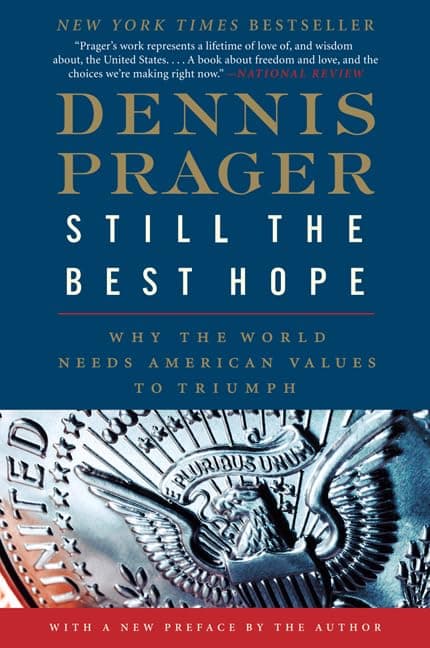
Still the Best Hope is a meticulously researched, nearly 400-page book by Dennis Prager that dissects the world’s dominant ideologies—Leftism, Islamism, and Americanism—arguing that American values of liberty, faith, and unity offer the best path forward. With a 4.8-star rating from 886 readers, this used copy in good condition provides a compelling, well-documented conservative perspective essential for understanding today’s ideological crossroads.
| Best Sellers Rank | #116,669 in Books ( See Top 100 in Books ) #146 in Political Commentary & Opinion #208 in Political Conservatism & Liberalism #446 in History & Theory of Politics |
| Customer Reviews | 4.8 out of 5 stars 886 Reviews |
N**O
The Case for America
Dennis Prager has provided a tour de force for conservative thought. First of all, before reviewing the book that was written, it is important to debunk the reviews about the book that was not written. (For those want a review of the real book, please skip down 3 paragraphs.) The 1-star reviewer below "Shade" clearly has not even purchased, let alone read, this book. This is easily proved by his question and statement: "why won't Prager tell you that the original intention of E Pluribus Unum was to indicate that out of many states (the original thirteen) one nation could be forged (with a central, federal government)? Instead he chooses to interpret this phrase from some singular conservative perspective, insisting that his is the only true and proper interpretation." But on page 373 Prager wrote, "At first the pluribus in E Pluribus Unum referred to the thirteen original colonies - and the motto was adopted in order to help forge these many colonies into unum, one nation." This is typical of those who attack Prager. They consistently attribute things to him he did not say or simply make something up, which anyone who actually listens to or reads him knows is untrue. But truth is obviously not as high a value as smearing a thoughtful conservative who changes minds and hearts every single day. "Shade" has provided yet another example proving one of Prager's main theses in section 1 of his book - the Left would rather demonize the Right than tell the truth. One more example of Shade's distortion: "In Prager's simplistic reductio ad absurdum there are only three, that's right THREE, philosophies in all the world." Prager never even suggested these are the only three "philosophies in all the world." In fact, you only have to get to page 16, still in the introduction, to see in bold letters, "Is there a Fourth - the Chinese - Alternative?" Prager then discusses their ideology as a model but dismisses it as a viable option for global hegemony. The reviewer shows his own simplistic reductio ad abdurdum by falsely assuming that viable hegemonic ideologies are the same as any ideology. Prager does not discuss anarchy, for example, since it is not a viable hegemonic ideology. Shade also fails to provide another possible global alternative that does not fall under the three Prager deconstructs. Now for the 2-star review: "It's ironic how Prager routinely criticizes the left for its narcissism, and then he turns around and writes a book about how wonderful the U.S. empire is." At least this reviewer got half of it right - Prager does consistently point out how much better Leftists think they are than conservatives, morally, intellectually, etc. Prager wrote a 400 page book and spent only 80 on the American value system, let alone the US. The other 310 pages are not about the US, so arguing that he wrote a book about the US Empire is absurd and, as with the above, demonstrates that the reviewer did not read the book and is more interested in smearing a thoughtful conservative than in truth. One more: "Prager is often critical of the government, but doesn't take on that aspect of big government that causes so much suffering around the world, the military industrial complex." Prager discusses this on pages 49-51. He also discusses and debunks the Chris Hedges work (pointing out that those like him) castigates intolerance, but seems entirely unaware of the intolerance of his own rhetoric and positions regarding Christians in the US (see page 131). Finally, he discusses the role of the US military in that very context on pages 382-387. Here he argues that the US has been - despite it's moral blemishes which he discusses on pages 380-383 - the least oppressive, least authoritarian, and most benign world superpower in human history and has liberated, among others, the Japanese, Chinese, Germans, South Koreans, Kuwaitis, and Iraqis, respectively. The fact that Japan, Germany, and South Korea have been able to turn into such wonderful societies while US troops have continued to "occupy" suggests how different the US "Empire" has been from every single other global power in recorded history. The US also leads the world in charitable giving and is the first place people all over the world look to when natural disasters or human-inflicted evils happen. Just as those in Haiti regarding the former and Kuwait regarding the latter. A final example to prove the reviewer never read the book nor likely listened to his show: "Most people who like Prager's views aren't interested in exploring alternative views." The whole point of the book is to explore alternative views and his shortest section is on the one he advocates. The book Prager did write is about the three most viable ideological systems in the world today - what he calls Leftism, Islamism, and Americanism. He provides a wonderful appendix at the end of the book listing the American and Leftist positions to major issues such as "the state," "primary source of evil," "family ideal," "individual's income," "place of religion in America," etc. Prager's thesis is that the best hope for a better world is embodied in the American value system, which is synonymous with conservatism. Prager devotes over half of the book to Leftism, precisely defining it, articulating what the ideology contains, why it is attractive to hundreds of millions of people, and its moral record during the 20th century. Leftism for Prager is embodied in the social democratic parties of Western Europe and the Democratic Party in the US. Ultimately he concludes that Leftism and all of its satellite ideologies - feminism, environmentalism, secularism, moral relativism, etc. - morally and economically bankrupt those who adhere to it. Prager contends that although its advocates use moral rhetoric and are well-intentioned, the policies they espouse produce selfishness, apathy, and, as seen in Western Europe's birth-rate, a staggering ennui. To support his case he looks not only to the obvious failures of 20th century far Left in the former Soviet Union, China, Cuba, Laos, and North Korea, but the seemingly successful cases like France, Germany, and Spain. Though he admits these are decent countries that have relatively more liberty than most of the rest of the world, their preoccupation with economic equality and state-sponsored benefits has economically and morally bankrupted an entire continent. He claims that most people in these countries do not recognize true evil - communism, Islamism, Terrorism - and instead choose to fight lesser or quasi-evils like climate change, second hand smoke, or onomastic notions of "intolerance." Prager also shows how ideas from the Left pervade our most influential institutions - the university, primary and secondary schools, many churches and other religious institutions, Hollywood, and almost all media outlets - talk radio and Fox News excluded. His deconstruction of the language that the media uses in presenting what otherwise seems like "just the news" is particularly revealing. For example, he shows how AP reports frequently choose to use terms like "sectarian violence" to describe Islamic terror while carefully avoiding the terms "Muslim, Islamic," etc. - be it violence against Christians, Jews, or fellow Muslims. They do this, Prager notes, while carefully not ascribing Islamic influences to terrorism committed by those like Nidal Hassan who screamed "Allahu Akbar," before shooting 13 innocents, was a card-carrying member of "Soldier of Allah," and raised repeated red flags about his Islamist sympathies. Finally, Prager contends that Leftism's preoccupation with having others (the state) provide for even the able-bodied citizen has, and will continue to, wear away at the fabrics of what was once a dynamic European culture. In short, they have produced a culture that stresses individual benefits but collective (and therefore no meaningful) responsibility. Next Prager analyzes Islamism, which he defines as a political form of violent Islam that is embodied in Hamas, Hezbollah, and Al Qaeda. He never seriously considers the US as possibly moving toward Islamism, but does implicitly suggest that it poses a real threat to the African continent, the Middle-East where it already dominates in many areas, and even Southern and Western Europe. He indirectly suggests that the latter could fall victim to Islamism due to their Leftist commitment to multiculturalism, inability to recognize true evil and assimilate foreigners, and their quasi-pacifism. Prager, a scholar at the Middle-East Institute at the Columbia University School of International Affairs, is critical of Islamism, but takes pains to distinguish it from other forms of peaceful Islam that are practiced peacefully throughout the world. That said, he is also careful to note that the number of peaceful adherents to Islam is irrelevant to the threat of Islamism. He cites the relatively few Nazi supporters there were in Germany in 1932 or committed communists in the Soviet Union or China as evidence to suggest that it is not the presence of a peaceful majority that matters, but the hegemonic influence of the threatening minority and the way the majority responds to that threat, that are important. For example, only 7-10% of the Islamic world supports Islamism, but that minority is still no less a threat. Finally, Prager holds out hope for the Muslim world by concluding that Islam - though it is in a low moral, intellectual, social, and economic state today, with its honor killings, intolerance of other religions, and obsession with de-legitimizing and destroying Israel - can have a bright future. He compares the medieval Christian world, which had many of the same characteristics - religious bigotry, little emphasis on liberty, etc. - to show how reformation is possible. He insists that the only way that it is possible, however, is if the Left, through organizations like CAIR, stop stymieing all criticism toward Islam and Muslims themselves unite in large numbers to condemn violence in their name. Here, as with the world in general, he believes that American Muslims hold out the best hope for Muslims elsewhere. Prager's last section, though brief, is on Americanism. Here he articulates, better than any writer I know of, the case for conservatism and American values. He insists that American values are, as inscribed on our coinage, E Pluribus Unum, In God We Trust, and, most important, Liberty. Prager contrasts these values with the Leftist values of Multiculturalism, Secularism, and Equality. Though not all Leftists disdain liberty and not all Rightists disdain equality, he carefully demonstrates where each differs. He outlines 11 total American values in addition to these three pillars, showing how reason, for example, is critically important in any culture, but is insufficient by itself. He also argues for the sanctity of human life, the distinction between animals and humans, the difference between nature and, as Jefferson would put it, Natures God, and the limits of using material wealth as the supreme value the way the Left does. Prager insists that these values are not specific to America and can be adopted by any country, using Uruguay and as an example. He draws an important distinction here - other nations may retain their own cultures while simultaneously adopting these values. Finally, Prager tackles the typical charges that Islamists and those on the Left make against America. Claims of "American Imperialism" are presented in context with comparable global powers to demonstrate how benign (despite sometimes overstepping bounds) the US has been over the last 100 years. He also presents a particularly compelling case for why America - even if one believes it is not a net force for good in the world - is better than any non-utopian alternative; namely, China, Russia, Iran, Turkey, Western Europe, and the UN. Though Dennis Prager has few moderate ideological positions (he is as ideologically pure a conservative as exists), his presentation is as calm, fair, and clear as anyone writing today of any persuasion. All Americans should read this book. Even if one detests the Right, this is as lucid an explanation of conservative thought as exists. We owe it to ourselves to read the best of those with whom we differ. This book qualifies as the best. Thoughtful moderates and liberals - though few Leftists - will find the text to be well-reasoned and the conclusions insightful, even if they disagree on certain matters. For others, it will change the way they view the world. The book is almost 400 pages, contains 350 endnotes, and at least another 100 in-text references.
C**N
Truthful insight into modern reality and the last, best hope
Truly a vital book for our times, and a book that is absolutely mandatory for anyone who has only recently awakened to the harsh realities of the REAL world. In this extremely detailed and thoroughly researched tome, Mr. Prager defines the three prominent philosophies that divide our world into ideological factions: leftism, islam, and the American Trinity (Liberty, In God we trust, and E Pluribus Unum). The fates of many nations will be defined by the choices of their people. We find ourselves in a particularly volatile and increasingly unstable world, and no one is going to make the transition unscathed. Europe and the middle-east have clearly chosen what paths they want to follow, ...and will pay the consequences. America is experiencing an ideological rift even more divisive than that of the 1850s. The alternate ideology poses an existential threat to the nation's very existance, its already pushing Europe toward the abyss, probably irretrievably so. Europe, despite pretentions to "enlightenment", has actually learned nothing in the past seventy years or so , and will repeat the errors of their grandparents' generation, the seeds have been sown. It will be much bloodier the third time around... There was a time in my early youth, when I believed much of the drivel which is "liberalism/leftism/progressivism". Real-world experience and thorough research enlightened me. Exposure to public school and "popular-culture" initially filled my thought with many things that are NOT really so. Being a book-worm saved me. Reading the biographies of the prominent personalities adored and worshipped by leftists enabled me to realize that none of these exalted characters were even the slightest bit admirable. Most of them were full-blown hypocrites, criminals, and frauds. Of all the poseurs and losers I encountered wearing T-shirts bearing the likeness of Che Guevara, ...NOT ONE of the them actually KNEW anything about him (beyond the minimal mandatory hype). They sang platitudes to this vile being, and dutifully "drank the coolaid". The thought of actually going to the library and researching him was out of the question for his disciples. I attended miscelleneous leftist organizations and events, ...just to see what they were REALLY about. I came to realize that I did not like the sort of people drawn to such groups, and came to detest more and more of their toxic propaganda and deceptive rantings. One popular piece of propaganda: "islam is the religion of peace". I have BEEN to islamic countries, I've interacted with the populace very closely. Actual muslims will TELL you that this is one of the most laughable and ridiculous misperceptions that Westerners are propagating about their culture! They will even point out to you the various surahs in which mohomaed implores his followers to wage WAR on non-muslims (ESPECIALLY Jews). The REALITY versus the propaganda, and ALL the FACTS to back it up, are well supplied in Mr. Prager's book. America: It IS the LAST BEST hope in the world. All the anti-American lies are debunked within. Supposedly, America is "an inheritantly racist nation". Really? WHY are there MORE people than ever, from every possible racial group, ...clamoring to become citizens of America? Far more Africans have WILLFULLY immigrated to America, ...than the numbers of those Africans brought here as slaves. By the way, an enormous number of slaves who were originally sent to America, ...were European people. ANYONE can become an American. A citizen of such nations as the United States, Canada, or Australia can move back to the land of his or her ancestral origin, however many generations removed. You will never truly be Irish, Russian, Japanese, Indian, etc., ...no matter how fluently you speak the language of the old country. You did not grow up in that culture IN that culture's geographic boundaries. On the other hand, anyone from the most exotic and remote corner of the globe, ...can become a full-fledged American. Its acceptance of an ideologie, an ideologie which certain elements inside America have been trying to extinguish at all costs. In truth, nothing of the content in this book surprised me, I've encountered it all before. I read this book, and I see all the truth and facts that I discovered independantly over several years of reading and personal experience. This book is a priceless gem of logical argument, factual reporting, and rational thought. Thank you Mr. Prager for this most excellent book!
H**N
America, "The Territory Ahead of the Rest"
"THE TERRITORY AHEAD OF THE REST": Dennis Prager's STILL THE BEST HOPE contains a comprehensive description of "opponents" of America as a clear, much needed account of mistaken objections and dangerous challenges today. Prager's descriptions of Leftism parallels what he explains daily on his radio show. His new book is well worth the time to read carefully and contemplate more deeply. Yet, the first two Parts, though accurate, are too long. The Leftist would never read such a long account of their beliefs. Accordingly, I would recommend starting this book with Part III: America and its Unique Values which is an advocacy of the concept of America, a topic which stands on its own. And, so it must, and does. Prager establishes his fundamental purpose: to seek "a way to end most evil" (p. 1) Also, he succinctly recognizes that the USA "is not merely a geographical location"; rather, it is the "idea of America" that is the key to any successful advocacy of America (p.311). He frequently identifies the basic problem that, as recognized by the Founding Fathers, "People are not basically good." (p.322) At this point, I suggest that Prager is following the most important homespun, classic definition of America - the last lines of Mark Twain's Huckeberry Finn, "...if I'd `a" knowed what a trouble it was to make a book, I wouldn't "a" tackled it, and I ain't a-going to no more. But I recon I got to light out for THE TERRITORY AHEAD OF THE REST[i.e. America], because Aunt Sally [i.e, the opponents.] she's going to adopt me and sivilize me, and I can't stand it. I been there before." [i.e, past and present failed ideologies.] Additions could be made to Part III of Prager's book on other aspects of the American idea. For example, the phrases on the USA Great Seal (also on one dollar bills), "Anuit Coeptis" and "Novus Ordo Seculorum" (with the eye of the Creator) should definitely be added to Prager's "Trinity". Much more also needs to be said about the Declaration of Independence, and its "Life, Liberty and the pursuit of Happiness", especially on how a citizen should act in the proper "pursuit of Happiness". Most importantly, there needs to be a detailed discussion of how both that 1776 Declaration and the 1787 Constitution were a reflection of the importance of establishing a proper secular rule of law in the affairs of mankind, based on the foundation of a Creator's law. Americans respect the rule of law. These concepts should be added to further explain "the territory ahead of the rest", America. In summary, this fine book is an excellent starting point to further explore genius of USA values. Some further questions to be addressed include: How can the idea of America restrain evil? How can the USA Constitution principles help today to control human conduct which is not basically good? How can freedom to pursue religious beliefs today facilitate human potential to become good - and to choose good government? As only humans commit evil, how can government today confront the human tendency to "exploit perceived advantage to the maximum, regardless of the constraints of morality, ethics, religion and secular law"? We can urge Dennis Prager, a sincere and thoughtful advocate, to continue this topic with a focus on Mark Twain's the "territory ahead of the rest".... "the passage towards America", and an exploration of how today to save still the best hope of the America Idea, its principles, for those who live in the USA as well as those who will never set foot in the geographical USA.
R**E
Extraordinary Moral Thinking Applied to Geopolitics, Religion, Ethical Thinking
Just an EXCELLENT book, full of anecdotal examples and sourced six ways from Sunday. Even though I didn't agree with a few non-PC claims here and there, I was usually persuaded, and in cases where I wasn't, the overall conclusions and themes were spot on. Extraordinarily thought-provoking for someone who has studied geopolitics for over 40 years. I'd highly recommend to Democrat/Liberal/Progressives if you are open-minded and willing to consider others POV. This book is not about Democrat vs. Republican et al, or Islamists vs. Judea-Christians et al, religious vs. aethist/agnostic per se - it's about the values that have made America so successful economically, spiritually, morally.... particularly including the freedom of speech and religion that are a hallmark of tolerance, but at the same time should not be an excuse/rationale for "tolerating" evil regardless of from where it emanates. I haven't read a clearer analysis of the Left anywhere, and Mr. Prager has numerous examples to support all of his generalizations and conclusions. Moreover, although written over a decade ago, it is even more relevant today, and is uncanny in quasi-predicting (without intending to do so) the Israel-Palestine conflict, the support of the students, young and some of the left. A brilliant job of understanding how reasonable people can come up with entirely different conclusions, and especially different views of what the "facts" are, while still presenting the correct facts and appropriate moral/ethical conclusions. Highly recommended.
P**.
A must-read for both open-minded liberals and conservatives alike
If you're a Democrat/Liberal/Progressive and consider yourself open-minded, then this amazing book is for you. I haven't read a clearer analysis of the Left anywhere, and Mr. Prager has numerous examples to support all of his generalizations and conclusions. He's not a bomb-thrower. This book is not about Democrat vs. Republican - it's about the values people hold. He is very thoughtful and even gentle in his approach and gives credit to those on the Left for generally having deeply good intentions in wanting to make the world a better place, but, in his opinion, the ideas on the Left are misguided for numerous reasons (for which he gives ample examples, with footnotes to back them up.) If you're open-minded and subscribe to reason, thoughtfulness and nuance, it may just change the way you feel about things with regard to what the Left is really about and how incompatible Leftist views are with liberty and American values. If you read this book and can refute the case Mr. Prager makes with logic, wisdom, and numerous examples like he provides, then I (and probably Mr. Prager himself) would be interested in reading such a book because it would truly change the way I look at the world. Are you willing to read something that just might change your life? I hope so. If you're a conservative, then this amazing book is for you, too. It is a fact-based, insightful look at the Left, Islamism, and American values with a style that is a joy to read. Mr. Prager makes the case for conservative values with numerous examples that give you the information you need to rebut the nice-sounding, bumper-sticker-slogan mentality of the Left with wisdom and thoughtfulness. He even has a section on bumper stickers such as "War is not the Answer" and how un-nuanced such a statement is. He makes an excellent case for why traditional American values are needed in the world, and he gives us hope that, if we stand strong and stand together, our vision and values can prevail and America can reverse its course of becoming a more European / socialist / equality-of-outcome valued country. Mr. Prager doesn't say America is perfect. In fact, he says that it can be improved, and he wants it to be improved. But so far, it's the very best system humans have come up with, and it certainly doesn't need to be "fundamentally transformed" as some would wish it to be. He makes a very good case that the world would be a far worse place if America had never existed - mistakes and all - and that it will be a far worse place if, as he calls it, the American Trinity of "E Pluribus Unum," "Liberty," and "In God We Trust" is forgotten or traded in for another value system. Truly a great book with the wisdom and clarity to change hearts and minds.
H**D
PLEASE ACTIVATE FOOTNOTE CAPABILITY ON KINDLE VERSION
As I believe the star-rating should only be based on the content and quality of the author's erudition, arguments and efficacy in conveying them, and not on the technical outcomes of the actual printing, I am giving the book five stars. Dennis does all the above. What I most liked about this book was how it clearly delineates "leftism" as a all-pervasive religion or faith base system onto itself, much like orthodox Judaism, Christianity or Islam. Having a background in Middle Eastern studies, the section on Islam was less revelatory for me, personally...but, as Dennis says in his introduction, the weight/focus of the book is on the "left," which is why I bought the book...and, am enthusiastically recommending it to others. The last part of the book, in which Dennis presents the Judeo-Christian/American value system, is nothing less then profound, and reads like a well-written and deeply contemplative philosophical work, without the pretentiousness that one can easy get carried away with when writing on such matters. This part of the book is succinct, yet comprehensive, and shows more than any other part of the book Dennis' gift of clear thinking, and his ability to express this thinking in highly readable prose. Unfortunately, I do not agree with Dennis' concluding remarks, that any country and culture can embrace American values, which seem to me to be the outcome of a unique symbiosis of Reformation/Evangelical Christian and Enlightenment values that occurred at the right time in history, among a certain group of people (Anglo-Christians) who acted as the catalyst for a chain reaction that we are seeing fizzle out. All the succeeding waves of immigrants adopted those values, regardless of what ethnicity/religion they were, as long as the vanguard...the devout Christians dominated the culture and values. This is no longer the case, as American Christians, due to too many of them fully embracing the corrupt pop-culture and its values, have ceased to play a leading role in the national culture and its values, other than militantly supporting a few "favorite causes," such as fighting abortion and gay marriage. The real influence was in their schools of higher learning...all the ivy leagues, which have long ceased to train up the best and brightest in "American values." There is ZERO chance of any country in the Islamic world, and very little chance of any of the Catholic countries (Dennis cites Honduras for a case in point) of Latin America or Europe embracing these values, as they were never part of their cultural (not racial) DNA. Because they are part of our American (as well as Canadian, British, Austrian, New Zealand) cultural DNA, we can always hope for a "revival" of those values in the lands where they were born and took root. Dennis, I assume that you occasionally are reading your reviews, as the book has just been published...therefore, I need to bring to your attention a defect with the Kindle Edition. The footnotes are not activated, i.e. I am not able to reference, by clicking on the footnote number, the actual note. There are notes that are non-numbered, and catalogued with an "asterisk," which can be referred to, as they are activated...but, the bulk of the notes, which are those catalogued by numbers, are inactive...please bring this to the attention to Amazon, so that they fix and update the Kindle Version (I am reading it on an iPad via the Kindle App for iPad). Because the Kindle version is only $3 less than the hard-bound copy, I expect the reading experience to be unblemished by this type of error. Thank you.
K**.
The dissection of leftism is alone worth the price of admission
The book is divided into three section: Leftism, Islamism, and America. The section on leftism is the best dissection of American liberalism I've read to date and is alone worth the price of admission. Were this the only section of the book it would deserve ten stars. I found the section on Islam to be at once a respectful and forthright examination of the shortcomings of Islam and a call for it to rise above them. The section detailing America's values is all pretty rudimentary stuff for any thinking conservative; however Prager's articulation is both useful and beneficial. My one (rather small) complaint about the book is Prager's less than accurate wording on some key philosophical concepts. (1) He conflates the terms "irrational" and "non-rational", attributing both to religion. True religion has aspects of the non-rational (beyond reason), but not the irrational (contrary to reason). (2) Prager calls God the "author" of the moral law--true in part but it denotes a certain arbitrariness to the moral law. More properly, God is the ground of the moral law. Goodness, Justice, et al are what they are not because of some arbitrary divine dictate, but because they are rooted in God's nature, in God who IS Goodness, Justice, et al. (3) Prager calls the heart the "generator of emotions". However, in classic Christian (i.e. Catholic) theology the heart is the root and center of the human person. "Keep your heart with all vigilance, for from it flow the springs of life" (Proverbs 4:23). With the heart we make the fundamental choice for good or evil. As such, the heart is more properly related to the will than the emotions. (4) Prager calls reason amoral and says that it is just as readily employed for evil as for good. How can this be if reason reflects the order of the universe in which there is a moral law? This flies in the face of Catholic natural law theology. Evil may appear rational IF its premises are granted, but at root it is contrary to reason. (5) Prager says that good and evil are "polar opposites". Evil is not a thing. If it were, then God would be responsible for creating it. Evil is a privation, or a subtraction, from good, as darkness is not the opposite of light, but merely the absence of light. (6) Prager says that God exists entirely outside nature. However, God is BOTH transcendent to and immanent in creation. He is the source and ground of all being. As such He sustains all of creation at every instance of its existence. (7) Prager says that nature has "no intrinsic value", but in the Bible (the Torah) which Prager quotes freely, God calls creation "good". All throughout the Bible, the majesty of creation is seen as pointing to God's existence and power. Again, these are minor quibbles. They are merely minor statements in support of more major themes in which Prager's basic gist is right on target. If you want an incisive dissection of the essence of leftism/American liberalism that is both pithy and comprehensive, do not hesitate to procure this book.
K**T
Karl in CT
In this magnificent book (2012), Dennis Prager clearly exposes the mayor challenges that confront us in remaining a united ("E Pluribus Unum") and prosperous nation and a bastion of freedom for the rest of the world. In the last decade and a half, and beyond our wildest imagination, we have witnessed many of those challenges come to fruition in the form of: 1) the Left's protracted efforts to fundamentally transform the US, thereby destroying the American values that have been its underpinnings since the Declaration of Independence; 2) the Left's passive acquiescence in allowing Putin's Russia to invade Georgia in 2008 and then launch a full-scale invasion of Ukraine in 2022; and 3) the Left's support of the Iran-backed terrorist group Hamas that launched the deadliest attack in Israel's history. Let's not forget Abraham Lincoln's warning in 1858: "A house divided against itself, cannot stand."
TrustPilot
1天前
1 个月前