
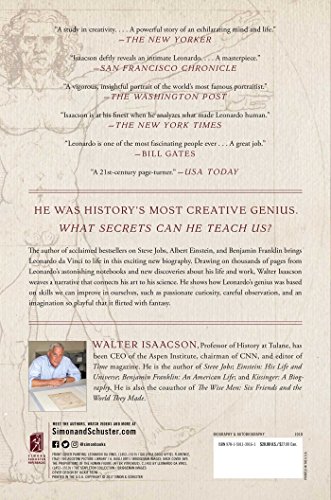
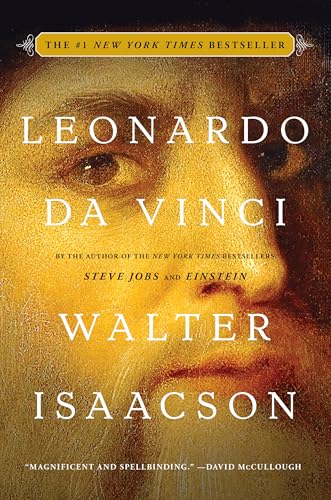

desertcart.com: Leonardo da Vinci: 0001501139169: Isaacson, Walter: Books Review: An excellent biography that will also help you think more like Leonardo - I didn’t buy this book because I was fascinated by Leonardo. I bought it because several people whose opinions I value said it was a great book and because the other books I’ve read by Walter Isaacson were excellent. I’m glad I bought it and read it. Before I started reading, I thought I knew the basics. Leonardo was the painter of perhaps the two most famous paintings in history: The Last Supper and the Mona Lisa. I had that right. But most of the rest of what I thought I knew turned out to be either wrong or incomplete. The man certainly was a creative genius, but a lot of the things that I’d read about him, like that bit about the “first helicopter,” turned out to be wrong. I didn’t know how much he did beyond painting and how deep he went on so many topics. Leonardo was certainly the prototype of the Renaissance Man, and looking back, we can see that he was born at the right time for someone with broad interests and many talents. Leonardo was born in 1452 and died in 1519. That gave him a long, productive life of 67 years. He was a bastard, which wasn’t a problem in Florence when he was born and may even have given him some advantages. He didn’t get a lot of formal schooling, which meant that he started to learn on his own and developed methods that worked for him. He started out in Florence, where he was apprenticed to an excellent master, and learned the craft of painting. But early in his life, he moved to Milan. That turned out to be a good thing, too. Florence was more artistic, but Milan had a much more diverse culture of people interested in the sciences. And it was in the sciences and engineering that Leonardo would do a lot of work I knew nothing about and now shake my head at, in wonder. Leonardo’s work in science included the development of thinking on perspective. I always thought perspective was a kind of geometric thing about painting. But it turns out that he developed three views of perspective. One was the standard vanishing point thing, but the others were the way color changes as distance increases, and the way that we lose detail on things the further they are away. He made contributions to anatomy by doing dissections of cadavers of both humans and animals. He certainly learned from his dissections, and he also captured what he observed in drawings and notes. He may have made even more contributions to engineering. He did a lot of military engineering, and a lot that revolves around water flows, including water systems for cities and diverting rivers. By the time I got to the end of the book, it seemed like Leonardo had done some work in almost any area of human knowledge. Not all of that work was great, or groundbreaking, but an awful lot of it was. So, the question is, how did he do it? That’s where I got my biggest takeaways from the book. Leonardo was very smart. Okay, we got that out of the way. Most of the people we call geniuses are very smart. But there are an awful lot of very smart people who aren’t geniuses. What really separates geniuses from the rest of the pack is what they do, not raw brainpower. The good news is that we have a pretty good idea of what Leonardo did. Isaacson developed his book primarily from the 7,000+ pages we have from Leonardo’s notebooks. That’s a lot, but it’s probably only about a quarter of the total he created. Here’s what Leonardo did to produce the quantity of quality insight and production that characterized his life. Leonardo captured his ideas. Early in his life, he developed a habit of walking around with a notebook that he used to jot down observations and make quick sketches. He even developed a shorthand that would help him recreate things he’d seen when he got back to his studio and wanted to draw them in detail. Leonardo was an acute observer who trained himself to be better. It helped that he was also a facile drawer. But the main driver of his close observations was curiosity. He developed his own process for observing things. It began with what Isaacson calls “marching orders.” Leonardo described what he needed to do to learn or properly observe something. Then he would go and observe. Leonardo learned by experimenting. Besides observing, Leonardo was an avid experimenter and he recorded both the experiments and what he learned from them. Leonardo got ideas and sharpened ideas through his reading. The printing press was invented the year Leonardo was born. By the time he was 40, books were increasingly common, and an autodidact like Leonardo could learn and get ideas from books. Leonardo had many friendships and collaborators over the years. This was not the lone genius retiring to his studio and producing bursts of insight. This is a man who went out into the world to observe, made careful observations, and then hone his understanding with reading, discussion, and experiment. Isaacson includes a final chapter in the book about things you can learn from Leonardo, and it’s a chapter worth reading. But there’s a statement of Isaacson’s near the beginning of the book that sums up the takeaway for me. “His genius was of the type we can understand, even take lessons from. It was based on skills we can aspire to improve in ourselves, such as curiosity and intense observation.” And, I would add, experiment and collaboration. Before you read the book straight through, read that final chapter about what you can learn from Leonardo. It will give you a frame for learning as you go. In A Nutshell This is a thorough and well-written biography of one of history’s most fascinating individuals. You’ll enjoy the read. You’ll learn a lot. With a little effort, you can improve the way you see the world and develop some discipline so that you can be more like Leonardo than you are today. Review: The Quest to Understand what Makes Some People Geniuses - Walter Isaacson is on a quest. To understand his Leonardo Da Vinci you have to understand something of why he choose to write a biography about him at all, after writing biographies of Steve Jobs and Albert Einstein. Thankfully, Isaacson is explicit about what interests him in these personages and so there is no need for reading between the lines. What Isaacson wants to understand is what makes some men and women people of genius. Not the silly way genius is portrayed in the movie Amadeus, in which it is simply some innate talent, but the character traits which enable rare individuals with the capacity to permanently change the world with the mere power of their mind. With that goal in mind, one is ready to appreciate Isaacson’s Leonardo Da Vinci. The book begins discussing his early achievements in art and the investigation of nature within the first forty pages, fairly quickly for a 525 page tome. And the book is dominated by appreciations of his work, both artistic and scientific (to use a modern distinction unrecognized by Leonardo). Along the way there is a wonderful resonance between Isaacson describing the characteristics of Leonardo that led to his peculiar type of genius and then seeing that genus instantiated in a particular unpublished treatise on anatomy or in a work of art such as the Mona Lisa. If you are interested in this quest, in both seeing what led to Leonardo being a genius, and then seeing that genius expressed in his creative work, you will love Isaacson’s Da Vinci. Many biographers prefer to dwell on a lengthy account of the culture and history of the time and focus on the personal life of their subject. Others choose to try to psychoanalyze their subject and allow the reader to understand the subconscious drives which led to their accomplishments. None of that is to be found in Isaacson’s work. Though a summary doesn’t do the book justice, Isaacson sees Leonardo as unusually perceptive of the world around him, with an insatiable curiosity, a proper understanding of how to balance theory and experiment and a disdain for doctrines handed on by the past. These traits, and others, led him to understand the effect of light in creating the illusion of three dimensions in painting, which muscles are used to smile, how men and women might one day be able to fly and all the many other prescient things expressed in his art and notebooks. If there is anything to criticize, it is that Isaacson is almost universally positive, almost effusively, about Leonardo. But this is because the book focuses mostly on the factors that led to this genius and the actual fruits of his intellect. Admittedly, it is hard to be critical of those aspects of Leonardo’s life. One final point to make to potential readers: Isaacson writes in clear and simple English. Though the book is 525 pages long I read it in less than a day. If he had chosen to adopt the tone of many academics this would have been a far less pleasurable, and longer, read. Isaacson set out to determine both what made Leonardo a genius and why he is considered one. While every reader can form their own opinion as to whether he was successful, I think both the importance of the quest and its achievement in the case of Leonardo will be doubted by few readers of this book.


| Best Sellers Rank | #6,880 in Books ( See Top 100 in Books ) #1 in Historical Italy Biographies #2 in Biographies of Artists, Architects & Photographers (Books) #5 in Scientist Biographies |
| Customer Reviews | 4.5 4.5 out of 5 stars (11,076) |
| Dimensions | 6.13 x 1.5 x 9.25 inches |
| Edition | Unabridged |
| ISBN-10 | 1501139169 |
| ISBN-13 | 978-1501139161 |
| Item Weight | 1.92 pounds |
| Language | English |
| Print length | 624 pages |
| Publication date | October 2, 2018 |
| Publisher | Simon & Schuster |
W**K
An excellent biography that will also help you think more like Leonardo
I didn’t buy this book because I was fascinated by Leonardo. I bought it because several people whose opinions I value said it was a great book and because the other books I’ve read by Walter Isaacson were excellent. I’m glad I bought it and read it. Before I started reading, I thought I knew the basics. Leonardo was the painter of perhaps the two most famous paintings in history: The Last Supper and the Mona Lisa. I had that right. But most of the rest of what I thought I knew turned out to be either wrong or incomplete. The man certainly was a creative genius, but a lot of the things that I’d read about him, like that bit about the “first helicopter,” turned out to be wrong. I didn’t know how much he did beyond painting and how deep he went on so many topics. Leonardo was certainly the prototype of the Renaissance Man, and looking back, we can see that he was born at the right time for someone with broad interests and many talents. Leonardo was born in 1452 and died in 1519. That gave him a long, productive life of 67 years. He was a bastard, which wasn’t a problem in Florence when he was born and may even have given him some advantages. He didn’t get a lot of formal schooling, which meant that he started to learn on his own and developed methods that worked for him. He started out in Florence, where he was apprenticed to an excellent master, and learned the craft of painting. But early in his life, he moved to Milan. That turned out to be a good thing, too. Florence was more artistic, but Milan had a much more diverse culture of people interested in the sciences. And it was in the sciences and engineering that Leonardo would do a lot of work I knew nothing about and now shake my head at, in wonder. Leonardo’s work in science included the development of thinking on perspective. I always thought perspective was a kind of geometric thing about painting. But it turns out that he developed three views of perspective. One was the standard vanishing point thing, but the others were the way color changes as distance increases, and the way that we lose detail on things the further they are away. He made contributions to anatomy by doing dissections of cadavers of both humans and animals. He certainly learned from his dissections, and he also captured what he observed in drawings and notes. He may have made even more contributions to engineering. He did a lot of military engineering, and a lot that revolves around water flows, including water systems for cities and diverting rivers. By the time I got to the end of the book, it seemed like Leonardo had done some work in almost any area of human knowledge. Not all of that work was great, or groundbreaking, but an awful lot of it was. So, the question is, how did he do it? That’s where I got my biggest takeaways from the book. Leonardo was very smart. Okay, we got that out of the way. Most of the people we call geniuses are very smart. But there are an awful lot of very smart people who aren’t geniuses. What really separates geniuses from the rest of the pack is what they do, not raw brainpower. The good news is that we have a pretty good idea of what Leonardo did. Isaacson developed his book primarily from the 7,000+ pages we have from Leonardo’s notebooks. That’s a lot, but it’s probably only about a quarter of the total he created. Here’s what Leonardo did to produce the quantity of quality insight and production that characterized his life. Leonardo captured his ideas. Early in his life, he developed a habit of walking around with a notebook that he used to jot down observations and make quick sketches. He even developed a shorthand that would help him recreate things he’d seen when he got back to his studio and wanted to draw them in detail. Leonardo was an acute observer who trained himself to be better. It helped that he was also a facile drawer. But the main driver of his close observations was curiosity. He developed his own process for observing things. It began with what Isaacson calls “marching orders.” Leonardo described what he needed to do to learn or properly observe something. Then he would go and observe. Leonardo learned by experimenting. Besides observing, Leonardo was an avid experimenter and he recorded both the experiments and what he learned from them. Leonardo got ideas and sharpened ideas through his reading. The printing press was invented the year Leonardo was born. By the time he was 40, books were increasingly common, and an autodidact like Leonardo could learn and get ideas from books. Leonardo had many friendships and collaborators over the years. This was not the lone genius retiring to his studio and producing bursts of insight. This is a man who went out into the world to observe, made careful observations, and then hone his understanding with reading, discussion, and experiment. Isaacson includes a final chapter in the book about things you can learn from Leonardo, and it’s a chapter worth reading. But there’s a statement of Isaacson’s near the beginning of the book that sums up the takeaway for me. “His genius was of the type we can understand, even take lessons from. It was based on skills we can aspire to improve in ourselves, such as curiosity and intense observation.” And, I would add, experiment and collaboration. Before you read the book straight through, read that final chapter about what you can learn from Leonardo. It will give you a frame for learning as you go. In A Nutshell This is a thorough and well-written biography of one of history’s most fascinating individuals. You’ll enjoy the read. You’ll learn a lot. With a little effort, you can improve the way you see the world and develop some discipline so that you can be more like Leonardo than you are today.
A**S
The Quest to Understand what Makes Some People Geniuses
Walter Isaacson is on a quest. To understand his Leonardo Da Vinci you have to understand something of why he choose to write a biography about him at all, after writing biographies of Steve Jobs and Albert Einstein. Thankfully, Isaacson is explicit about what interests him in these personages and so there is no need for reading between the lines. What Isaacson wants to understand is what makes some men and women people of genius. Not the silly way genius is portrayed in the movie Amadeus, in which it is simply some innate talent, but the character traits which enable rare individuals with the capacity to permanently change the world with the mere power of their mind. With that goal in mind, one is ready to appreciate Isaacson’s Leonardo Da Vinci. The book begins discussing his early achievements in art and the investigation of nature within the first forty pages, fairly quickly for a 525 page tome. And the book is dominated by appreciations of his work, both artistic and scientific (to use a modern distinction unrecognized by Leonardo). Along the way there is a wonderful resonance between Isaacson describing the characteristics of Leonardo that led to his peculiar type of genius and then seeing that genus instantiated in a particular unpublished treatise on anatomy or in a work of art such as the Mona Lisa. If you are interested in this quest, in both seeing what led to Leonardo being a genius, and then seeing that genius expressed in his creative work, you will love Isaacson’s Da Vinci. Many biographers prefer to dwell on a lengthy account of the culture and history of the time and focus on the personal life of their subject. Others choose to try to psychoanalyze their subject and allow the reader to understand the subconscious drives which led to their accomplishments. None of that is to be found in Isaacson’s work. Though a summary doesn’t do the book justice, Isaacson sees Leonardo as unusually perceptive of the world around him, with an insatiable curiosity, a proper understanding of how to balance theory and experiment and a disdain for doctrines handed on by the past. These traits, and others, led him to understand the effect of light in creating the illusion of three dimensions in painting, which muscles are used to smile, how men and women might one day be able to fly and all the many other prescient things expressed in his art and notebooks. If there is anything to criticize, it is that Isaacson is almost universally positive, almost effusively, about Leonardo. But this is because the book focuses mostly on the factors that led to this genius and the actual fruits of his intellect. Admittedly, it is hard to be critical of those aspects of Leonardo’s life. One final point to make to potential readers: Isaacson writes in clear and simple English. Though the book is 525 pages long I read it in less than a day. If he had chosen to adopt the tone of many academics this would have been a far less pleasurable, and longer, read. Isaacson set out to determine both what made Leonardo a genius and why he is considered one. While every reader can form their own opinion as to whether he was successful, I think both the importance of the quest and its achievement in the case of Leonardo will be doubted by few readers of this book.
D**D
Well researched and written
A well researched and fascinating look at what may be one of the top minds in history. Well worth reading.
C**N
Un regalo para una persona amante de Leonardo que no decepcionó lo más mínimo. Es un libro denso pero que no se hace pesado, con muchas ilustraciones variadas. Una gran biografía.
J**K
著者Walter Issacsonの力量が冴えた伝記。ダビンチの芸術家そして科学者としての才能をフルに発揮し両者の接点が傑作モナリザ。それも素晴らしいが伴侶(美少年)サライをモデルにしたJohn the Baptistの妖しげな官能美もダビンチの裏面を如実に示している。惜しむらくはルイ14世皇帝妃によって葬られた、禁断のLeda and the swan、見たかった。ダビンチが開発した遠近法、透視図法などの説明や、静止している絵画に動き、更には息吹きを吹き込む技法を分かり易く説明しているのは著者Issacsonの力量です。15世紀末のイタリア目の前に投影させ、ダビンチを通じてルネッサンスの鼓動を感じさせるのは主題と著者の完全なる合体です。
S**L
La presentación es increíble, la calidad del papel y fotografías son igualmente de excelente calidad para el precio y el estilo-género del libro (al no ser especializado un libro de arte, si no una biografía, es un buen detalle la calidad del papel como si fuera uno de los primeros) El contenido es amplio y contado de una manera muy digerible que permite adentrarse en la mente de Leonardo al hacer las obras que el libro describe, definitivamente un libro indispensable si te apasiona o interesa la vida, obras o narrativas de Leonardo.
L**H
Très bon livre
L**A
You can tell when someone writes a book out of love for the subject. Now, that is the case here. Isaacson is everything but dry or academic. I read the book twice and did not run out of excitement. It might not be hundred percent accurate or authentic, but it is a book that represents a delightful journey into the mind of mental giant. A book that does not try to be more than what it is. The 500 pages feel like a gentle breeze if you thoroughly immerse yourself in it, do not be scared of its size. Well done...