We remain fully operational. Our teams are working around the clock to ensure your deliveries continue safely.

下载应用程序




🏅 Discover the true story behind the legend—don’t miss the biography that’s reshaping history!
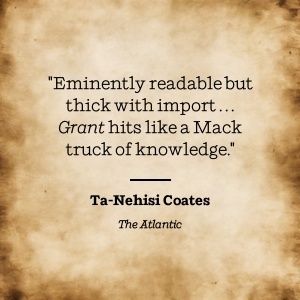
Ron Chernow’s 'Grant' is a definitive, critically acclaimed biography that ranks among the top Civil War and presidential histories. With over 1,200 pages of detailed research and a 4.8-star rating from more than 14,700 readers, it offers a nuanced portrait of Ulysses S. Grant’s military genius, personal struggles, and presidential impact, making it essential reading for history enthusiasts and professionals alike.



| Best Sellers Rank | #6,831 in Books ( See Top 100 in Books ) #4 in American Civil War Biographies (Books) #5 in U.S. Civil War History #10 in US Presidents |
| Customer Reviews | 4.8 4.8 out of 5 stars (14,758) |
| Dimensions | 6.06 x 2.44 x 9.19 inches |
| Edition | Reprint |
| ISBN-10 | 0143110632 |
| ISBN-13 | 978-0143110637 |
| Item Weight | 3.05 pounds |
| Language | English |
| Print length | 1104 pages |
| Publication date | September 25, 2018 |
| Publisher | Penguin Books |
T**A
Excellent Biograph of a 19th Century Leader Deserving of More Respect
As I was reading Ron Chernow's biography of Grant, two themes kept recurring. 1) Kipling's poem, 'If', a tribute to 19th Century stoicism and the admirable (per Kipling) qualities that one SHOULD have. No question that Grant possessed a number of the qualities in Kipling's poem. On the battlefield, he was known to be 'cool as a cucumber', a guy who saw opportunity where others didn't, and one who could turn near disaster into victory, as Grant did at Shiloh. 'If you can keep your head about you when all others are losing theirs and blaming it on you...' 'If you can meet with Triumph and Disaster and treat those two imposters just the same...' 'If you can talk with crowds and keep your virtue, or walk with Kings, nor lose the common touch...' Kipling was supposedly writing the poem as a tribute to a 19th Century British politician, but could have easily been writing a tribute to Grant. Grant's life alternated between triumph and near disaster. Certainly as President and during his world tour after the presidency, he DID walk with kings, yet maintained his common touch. 2) 'Fool me once, shame on you...fool me twice, shame on me!' Sadly, Grant's ventures into the business world were unsuccessful, largely due to his personal gullibility. He was either too tenderhearted to be a bill collector, or too gullible to see the dishonesty in others. From his first venture after the Mexican War, seemingly a sure thing, except he let his business partner, a scoundrel, abscond with the profits and capital, to his post-Presidential foray into Wall Street, where his business partner, Ferdinand Ward, was found guilty of running a Ponzi Scheme, Grant had a spectacular string of experiences where he was left duped. Perhaps his biggest personal triumph from this last disaster was finishing his memoirs, literally finishing them on his death bed within days of his passing. The proceeds from these memoirs ensured his family's financial security, and preserved Grant's memory as a national hero in the public consciousness. The best description of Grant came from his fellow general and friend, William Tecumseh Sherman: "Grant is a mystery, even unto himself.' Ron Chernow does a fine job of helping explain this mystery, and it all appears to be tied to the individuals who were in Grant's life at different times during his life's journey. Grant probably never would have pursued a military career had his father not used some connections to get him into West Point, and even that was against Grant's personal wishes. During the Mexican War, Grant found his calling---not that he LIKED combat, but, somehow, he was good at it. He could be decisive, and exhibit incredible bravery, even risking his own life in the heat of battle. Unfortunately, his battle with alcohol in peace time cost him a career in the regular army, and caused him to resign in 1854, lest he be court martialed by his commanding officer, a martinet. After a string of unsuccessful business ventures over the next six years, Grant was once again saved by his father who took him into the family business, a tannery and leather goods store, where Grant could finally have a near middle class existence in Galena, Illinois, working along side his younger brothers. The Civil War was the game changer in Grant's life. The regular army wanted nothing to do with him at the outset given the rumors of his alcoholism, but the Illinois Volunteers were more than happy to have him in a senior position, as someone who knew a thing or two about war, and training soldiers. Here, the key people in his life were Elihu Washburne, the local Congressman, who would be Grant's supporter throughout the war, and John Rawlins, a local attorney, who became Grant's aid. Rawlins, in particular, could communicate with Grant as nobody else could, warning him of his responsibilities to the Army and the Republic and exhorting him to stay away from the bottle. As fellow military commanders, William Tecumseh Sherman and Philip Sheridan could be trusted to carry out Grant's battle plans. In late summer, 1864, when the war in Virginia was being fought to a stalemate and President Lincoln was alerting his cabinet to the likelihood that his administration may not get re-elected as the country was tired after three plus years of war, it was Sherman's taking of Atlanta, and Sheridan's classic ride from Winchester to Cedar Creek, rallying the troops and turning defeat into victory, that assured the public that the Confederate Army was truly on the ropes, and ensured Lincoln's re-election. Much can probably also be said that the Lincoln that we American citizens idolize, the Lincoln portrayed by Daniel Day-Lewis, the Lincoln of the five dollar bill and Lincoln Memorial, probably would not have attained this status had it not been for Grant's prosecution of the war and victories at Fort Henry, Fort Donelson, Shiloh, Vicksburg (probably his greatest military campaign), Chattanooga and Appomattox. Likewise, Grant probably doesn't get his status as head of the Army without Lincoln's support. Not to take anything away from Grant however: his bulldog tenacity on the battlefield resulted in key Union Army victories, and his personal belief of always moving forward and never retreating were key elements of his military success. Not bad for a guy who didn't even want to go to West Point, and supposedly detested the sight of blood. Also, his personal trait of magnanimity at Appomattox, where he wouldn't even let the Union Army celebrate in front of the defeated Confederate Army, and his commitment to ensuring that Lee's Army had adequate rations, could keep their horses, and were properly paroled upon surrender are testament to his conviction that once victory was achieved, the peace also needed to be won as well. Much has been written about Grant's Presidential administration as one of corruption, but, again, this is a function of some of the cabinet members and advisors with whom he surrounded himself. Chernow shows how passionately Grant worked to make advances for African Americans, Native Americans, appointed the first Jewish diplomats, and genuinely wanted peace between the Northern and Southern states. In retrospect, Grant had done a workmanlike job in a very precarious time in the country, and took action to keep peace, tackle corruption and keep the economy under control, during a time when the country was experiencing the effects of the Industrial Revolution. Mr. Chernow highlights a number of facts about Grant's life. He clearly had an issue with alcohol, and the fact that there is literally nothing further about this occurring in Grant's life after the Civil War is testament to his triumph over the bottle. Likely helping Grant in this battle is his beloved wife, Julia, who seemed to understand him, and to whom Grant was extremely devoted and did not want to disappoint. She was his biggest supporter and stood by him during the worst of times (after his resignation from the Army in 1854) and the best of times, through his victories in the Civil War and his presidency. Finally, at the end of his life, the key person behind the memoirs and their financial success was Mark Twain, who took control of this publication, after another publisher attempted to get Grant to sign a contract that would have given him near nothing from the publication itself. There have been some excellent biographies written about Grant, by William McFeeley, Joan Waugh, and Jean Edward Smith. Mr. Chernow's appears to be the most comprehensive, and insightful. It his highly unlikely that 'Grant: the Musical' will ever come to Broadway (unlike Chernow's biography of Alexander Hamilton which became Lin-Manuel Miranda's inspiration for the Tony-award winning production), but it is hoped that a good biography of Grant comes to the silver screen with an accurate and insightful portrayal of this important American.
K**U
6 stars ! A NYT 2017 notable. A Great book
Having read Ron Chernow's biographies of Washington, Hamilton, and now Grant, I am committed to reading Chernow's next irrespective of who the subject is. "Grant" is terrific. It is an enjoyable book, very readable with amazing insights into the character and challenges that Grant faced throughout his life. It is not a love letter; it is balanced - critical, sympathetic and admiring. "Grant" is incredibly well-researched and yet does not bog the reader down with every little fact, piece of data, and anecdote that Chernow discovered. Rather he shares information to tell his story. "Grant" is 959 pages, 43 chapters, four Parts. Some maps and photos; I wish there had been more. I found that 25 pages a day was just the right pace for me, and I looked forward each day to savoring the next 25. In my own mind I thought of the book as having five parts: the Early years, the Civil War years, the four years before his Presidency, the two terms as President, and his final years. Obviously, the second and fourth parts (Civil War, Presidency) form the biggest chunks of the story and together they make an interesting comment on Grant's life and accomplishments. Here is a man who made tremendous contributions to his country in two roles, one in saving the Union as the General of the U.S. Army in the Civil War, and secondly as President of the US in eight of the most difficult years of our country's history. Reflect back on our 45 Presidents and you will not find many who can make the same claim, not even Lincoln. EARLY YEARS So you think you know Grant? Then you probably realize he fought in the Mexican War, had a drinking problem, and was a store clerk when the Civil War started. But you may not realize Grant never really wanted to go to West Point; his father pressured him and even sealed the deal with a last minute favor from a Congressman. Grant was not a top student at West Point, nor mid-range for that matter. He was best at horsemanship and he earned widespread recognition from classmates for those skills. Many of his schoolmates became fellow in the Mexican War then surfaced again in the Civil War. Grant was a much better student in the battlefield - he studied and understood his fellow officers and came to learn their strengths and weaknesses, more importantly how they were likely to act alongside him or facing him. Much of Grant's war experience in Mexico was as a quartermaster, and he had to learn to provision for his Army, in a foreign country no less, especially how to maintain supply lines. This experience proved to be invaluable training for the War to come. Grant's drinking became a big issue during the War. There were many stories, some exaggerations, some lies. Chernow makes the point that for the most part Grant was an occasional drinker, someone who may go months without a drink, then binge for two or three days. And someone who had difficulty refusing a drink, someone who once started wouldn't stop. My initial reaction to the extensive emphasis on the drinking was that it was overdone. But it is a critical part of Grant's history and in following this story the reader must learn to deal with it. In this first section, there is a lot of personal history as well. Naturally there is a fair amount about wife Julia, the children and the difficulty in earning money for everyone's upkeep. But what I particularly enjoyed were the anecdotes about Grant's father, the abolitionist, and Grant's father-in-law, the slave owner. Interesting that although he detested his son-in-law, Col Dent accepted President and Mrs. Grant's offer to live with them in the White House and remained fiercely loyal to the Confederacy during his years there. CIVIL WAR YEARS I have been a casual student of the Civil War; I have read several books, watched video courses and programs, and visited battlefields (Bull Run, Fredericksburg, Antietam, Gettysburg - I have resided in Virginia for the past 35 years). Almost all of the focus has been battles fought in the East. I have found that most Civil War treatments pay very little attention to what was going on in the "West" (essentially along the Mississippi and states along its eastern bank) except to position those battles as Grant's stepping stone to eventual leadership of the Union army. In "Grant" Chernow details these battles magnificently - Fort Henry, Fort Donelson, Shiloh, Vicksburg, Chattanooga. Throughout Grant is portrayed as action oriented, ready to attack. Yet calm, steady, reflective - the battles have been planned to the nth degree. Occasionally, Union forces took a first battle day licking, but always were prepared to do the unexpected. On day two his army would regroup quickly and attack early the next day. Grant was a winner and he was fiercely loyal to Lincoln, and quickly becomes a Lincoln favorite. With his early string of victories U. S. Grant becomes Unconditional Surrender Grant. The only terms are his, but they are unexpectedly fair and gracious - all the way to and including Appomattox. Meanwhile Grant continues to also battle his drinking problem and jealous fellow officers over whom Grant is being promoted. Ultimately Grant is given responsibility for the whole of the Union Army and moves eastward. He immediately meets with Sherman and Sheridan to develop a multi-prong attack on Confederate forces from Virginia to Georgia. Grant begins his push against lee driving Lee southward away from Northern Virginia and Washington DC toward Richmond. I have read and studied several accounts of this portion of the War and none have been as riveting and exciting as Chernow's account. For me, this was the most exciting and enjoyable part of the book. RECONSTRUCTION BEGINS One of the biggest surprises for me in "Grant" was to learn of the marked improvements Grant made to the welfare of African-Americans. The biggest contributions began during the War years when newly freed slaves marched behind the Union Army following victories; Grant permitted this to ensure their safety and continuing freedom. He later created African-American fighting units; this was strongly opposed by many in the military as well as the government, especially in arming these soldiers with guns and rifles. During the early reconstruction years incredible numbers of blacks were slaughtered in southern states out of hatred and fear of ultimate voting power. Although he was subsequently criticized for doing too little, too late, Grant dispatched troops to those states with the most violence, especially Louisiana. Eventually, the KKK was disbanded (only to resurface years later). Grant, became a huge hero, idolized in the press, particularly in the victorious North, but he was respected in the South as well especially for his humane treatment of the Confederate forces at Appomattox. This created big problems for President Andrew Johnson, of course, as he saw Grant only in terms of a likely opponent in the next election. Forgive the pun, but their relationship quickly went South....as did Johnson's career. Lots of good history here, particularly about how horrible was the violence directed at African Americans during this time, how Grant was among the first whites to look at the black man as an equal, and how Grant slowly evolved from a military man to a political one. PRESIDENT GRANT Concerning Grant's presidency, Chernow quotes fellow historian Richard N. Current: "...he made a greater effort to secure the constitutional rights of blacks than did any President between Lincoln and Lyndon B. Johnson." Per Chernow, "Current... also saw Grant as the most underrated American President". Yet Grant certainly had his ups and downs as President. While he had many first term accomplishments - suppressing the Klan, reducing the post-war, swollen national debt, initiating reform of civil service and reducing the graft associated with contracts for Indian trading posts, settling a touchy ship sinking issue with England, appointing many blacks, Jews, Indians and women to government positions, and contributing to a general sense of peace and prosperity. He also had some black marks including charges of cronyism in his hiring and clumsy efforts to annex Santo Domingo. Nevertheless he was elected to a second consecutive term, the only president to do so between Andrew Jackson and Teddy Roosevelt. There were a number of scandals in his second term dealing with schemes to cheat the government of tax revenues, e.g. the Whiskey Ring. Grant never profited from these crimes but he was slow to accept that close friends had manipulated him to obtain critical positions. But once he understood the full depth of these crimes and certain individuals' guilt he quickly disassociated himself from them and demanded justice. In the midst of these scandals, a five year depression began in 1873, resulting in high unemployment and blame assessed by the press and opposition. Grant's popularity took a significant hit for the rest of his term. FINAL YEARS At the conclusion of his second term, tired and bitterly disappointed in the direction that the new administration of President Rutherford B. Hayes, Grant decided on a world tour, a tour that would last more than two years. He was feted in seemingly all the capitals of Europe and Asian. His hosts were the Who's Who of International government and diplomacy of the mid nineteenth century: Gladstone, Disraeli, Queen Victoria, Garibaldi, King Leopold II, French President MacMahon, Pope Leo XIII, KIng of Greece, King Umberto I, von Bismarck, Czar Alexander II, Prince Kung of China. It was fascinating to read the many anecdotes of personal meetings and subsequent opinions from both sides, most favorable, but some not. And the public worshipped him. For example, as Grant departed England at Newcastle 150,000 came to the docks to see him. Mostly working people, cheering wildly. Grant had never been a comfortable speaker. As President, he would scratch out his own comments and read them in an almost inaudible monotone. Incredibly, his skills improved significantly on his tour, though he never grew to enjoy the experience. Once he returned home he gave considerable thought to his future, particularly his finances. In those days, the President did not receive a pension. Grant had some investments yet once again, he was swindled, this time by a young financial wizard who used Grant's name to build an enormous pyramid which eventually collapsed; Grant lost everything. About this time, Grant was diagnosed with throat cancer, perhaps not surprising since he smoked up to two dozen cigars a day, and often chewed on an unlit one for hours. To provide income for his wife after his passing Grant agreed to write his memoirs, published by Mark Twain. Sales were expected to be huge and door to door salesman canvassed for orders. It became a race against the clock; it was close. Grant won. An excellent book. The New York Times had the good sense to put it on their 2017 recently released 100 notables list. I have read others by Chernow, all have been very, very good. I will read whatever he writes next.
V**T
Excellent ouvrage clair et bien documenté, j'ai appris des masses de choses sur ce général et président assez méconnu.
M**C
The whole story materialises in Mr. Grant’s portrait on the cover: what a successful man despite all the inner and outer tensions! The whole book has been so valuable for my own reflections. Thank you so much Mr Grant & Mr Chernow.
F**E
Extraordinario! Si leyeron las memorias de Grant, este libro está visto desde la versión de muchas otras personas, principalmente corrrespondencia de allegados. Este libro lleva a Grant a niveles muy superiores a los que el mismo se clasificaba. Sin duda fue quien dio continuidad a los peoyectos de Lincoln.
V**R
Good so far ..
R**X
Good biography very thorough and a great read.
TrustPilot
3 周前
2 周前