We remain fully operational. Our teams are working around the clock to ensure your deliveries continue safely.

下载应用程序



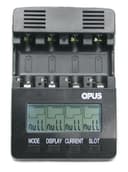

🔌 Power up smarter, last longer — never get caught powerless again!
The OPUS BT-C2400 is a professional-grade smart battery charger and analyzer featuring four independent channels for AA and AAA NiMH/NiCd batteries. It offers adjustable charging currents up to 1400mA, a backlit LCD for detailed battery metrics, and multiple modes including charge, discharge, refresh, and test. Designed for precision and longevity, it can revive older batteries and is powered via 12V DC with a car adapter included, making it ideal for professionals who rely on consistent, optimized battery performance.
| ASIN | B00MYQ8IYS |
| Amperage | 1400 Milliamps |
| Brand | OPUS |
| Connector Type Used on Cable | DC power jack |
| Current Rating | 1400 Milliamps |
| Customer Reviews | 4.7 4.7 out of 5 stars (711) |
| Input Voltage | 240 Volts |
| Item Weight | 0.5 Pounds |
| Manufacturer | Opus |
| Mfr Part Number | BT-C2400 |
| Model Number | BT-C2400-US |
| Number of Ports | 4 |
| Output Voltage | 12 Volts (DC) |
| UPC | 727908590708 |
| Unit Count | 1.0 Count |
B**2
4 indepent charge bays, handles most battery types, "smart" charging, what's NOT to like.
I use rechargeable batteries often with photography, and when I do a shoot (paid or not) I need to count on my power being rock solid. Batteries have a finite lifespan, and their performance degrades over time.NiCads develop memory, and using an "unmatched" or poor performing battery with a group of good batteries not only damages your good batteries, it reduces your overall performance to that of the weakest battery in the group. I own several of these units, and not only do they let me group my batteries by performance and capacity, they charge my batteries in the best way to keep them lasting a long time. I could write a book on proper charging techniques, but I'll let you do that research elsewhere. The quick hint - use a lower charge current if you want your batteries to last a long time, and don't run a full discharge/test on your batteries all the time because your are effectively consuming recharge cycles from your battery when you do so. Regardless of your charger choice - be sure to use a "smart" charger if you plan to keep your batteries around for a while. Here's my review" Pros: 1. 4 independent charge bays. This means that each battery is charged independently according to its characteristics. Charging 2 batteries together can overcharge a good battery while an older battery struggles to get the correct voltage and current to charge it. 2. Adjustable current levels. If you need a battery quickly, you can bump the current, if you have time to charge slower, you can increase your battery life with a reduced charge current. 3. Ability to measure true mAh of each battery. This is great when you want to match your batteries. I match mine by physical age and measured mAh. I have batteries that still perform well and should have been retired years ago. 4. NiMH or NiCd? - no problem. This charger does them all. Older NiCd's can in many cases be "refreshed" by repeated charge/discharge cycles. I've done it with this charger. 5. Cost - I bought my first unit at $50, as I write this $30 is the going rate. Cons: 1. The manual is pretty poor, but still gets the point across. 2. Calculated mAh rates are not consistent between units. I have 2 units, and whenever I buy a new set of batteries I run a full charge/discharge test to insure that none of my batteries are back, and to match groups of batteries together. Between each unit, I consistently see a reported difference of aprox 15-30 mAh. between units. Is this is big deal? - NO, just remember that your measurements aren't exact, but they are WAY better than using a "non" smart charger. 3. making selections and reading total current is sometimes quick. When you plug in a battery, or several batteries, you can select what option to perform and also at what current. At some point in time, this option gets locked in to prevent you from changing the "smart charge" cycle. Most of the time, I'm quick enough choosing what I want, occasionally I need to reset a battery to allow me to change a setting. In a nutshell, I absolutely recommend these units for your charging needs. Thanks for reading. I hope this helps
R**C
Which Smart Charger? Either this or the Maha C9000.
** Received September 28, 2015 from Amazon Fulfillment with 2.2 firmware. ** This charger is awesome. It operates more similarly to LaCrosse chargers than the Maha C9000. I have two rechargeable battery intensive hobbies... one is small scale RC Car racing, and the other is photography. I'm constantly charging batteries for one of the two things and as of receiving this one I now own three smart chargers: This one, the Maha C9000, and the Maha C801D. The C801D is a very basic smart charger in comparison and I primarily use it when I need to charge several batteries at once rather than when I want to try to condition and restore a cell so this will mainly be a review in comparison to the C9000. The tl;dr version is, both the Maha C9000 and this Opus BT-C2400 have their strong points and for people that have a need to charge a lot of batteries, I can recommend both for different situations. Get this one if you'll ever be using older batteries as it has a better chance of restoring them. Get the Maha C9000 if you don't use old batteries and have the need to charge cells quicker. ----- The main point I really like about that BT-C2400 charger is that it wont give up on your old batteries that have seen better days. The Maha C9000 does a check when you insert a battery and if it detects too much resistance, it displays "HIGH" and refuses to charge a cell. The BT-C2400 however will attempt to charge the cell to try to restore it (it states in the manual that it will probably charge at a reduced rate to what you select if it detects really high resistance). I was able to restore some power to some old cells that had sat around since 2010. Though the resistance is too high for them to be used for RC racing, they can be used for slower drain items like remotes / controllers / tablet pens. The main point for the Maha C9000 is the ability to charge on all 4 slots at up to 2000 mAh where you're limited to half of that with the Opus (70% of it if you're only charging two batteries on the outer slots). If you need to charge something faster and still want the monitoring functions of a smart charger, the C9000 is the better option. I also like the break in mode of the C9000 for a fresh pack of batteries. You can use the refresh function similarly with the Opus, but even though you have to push more buttons on the Maha I like the break in interface more for it. If you're going to be working with older cells and want to try to restore them to get some use out of them, I'd go for this one over the C9000. The cost is lower and it will service older batteries without a problem where the Maha C9000 might refuse them. If you'll be working with newer batteries mostly and value the higher charge rate, the Maha C9000 is still a tried and tested smart charger and works really well. The Opus BT-3400 is another option, but it does the same thing as this one except it supports other types of batteries. It's really only worth the extra money if you think you'll be using lithium rechargeables. My hobbies only involve NiMH so it wasn't worth the extra $20 to step up. The final alternative is the LaCrosse chargers. I used to own their BC-700 but it just died on me at random so I don't have the best impression of longevity for LaCrosse chargers. Currently, the BC-700 is overpriced for what it does. The Opus BT-C2400 does everything the BC-700 does and more... in fact it's more comparable to the higher end BC-1000 in charging speed while still winning on features and price. To it's credit though, the BC-1000 does come with a case, two sets of batteries, and adapters so that offsets the price difference. At this point, I don't think I could seriously recommend any of the LaCrosse BC-700 at all. The BT-C2400 is simply better and costs less to boot. The BC-1000 should only be an option if you need the adapters to C or D, or if you really really need the smaller footprint of the LaCrosse charger (you don't). So I can really only recommend the Opus or the Maha right now. If you have the money, both have their positive points and I'd get one of each. For everyone else though, unless the faster charging speed is really necessary for you, this is probably the most well rounded smart charger on the market. It's also refreshing to see that they are always updating hardware and firmware so I think they are likely to stand behind their product longer.
I**.
Tiene la función para descargar a 0% es muy útil para una carga full y las pilas que duraban con poca carga, parece ser que las repara
A**N
The product manual is a bit daunting, but well written. Once the features are understood, I found that pressing buttons was a good way to find out how to select the modes and achieve the desired result. The LCD display is illuminated and clear, showing the progress of the selected operation. Robust product.
A**R
So far it's good,been using from past 15 day's.
S**S
I have couple of dozen solar garden lights. I now can check the condition of the battery before replacing them. It is interesting to see by analyzing mAh, the actual capacity of batteries compared with their advertised capacity. This is now my "go to" charger I gave away my other chargers.