We remain fully operational. Our teams are working around the clock to ensure your deliveries continue safely.

下载应用程序


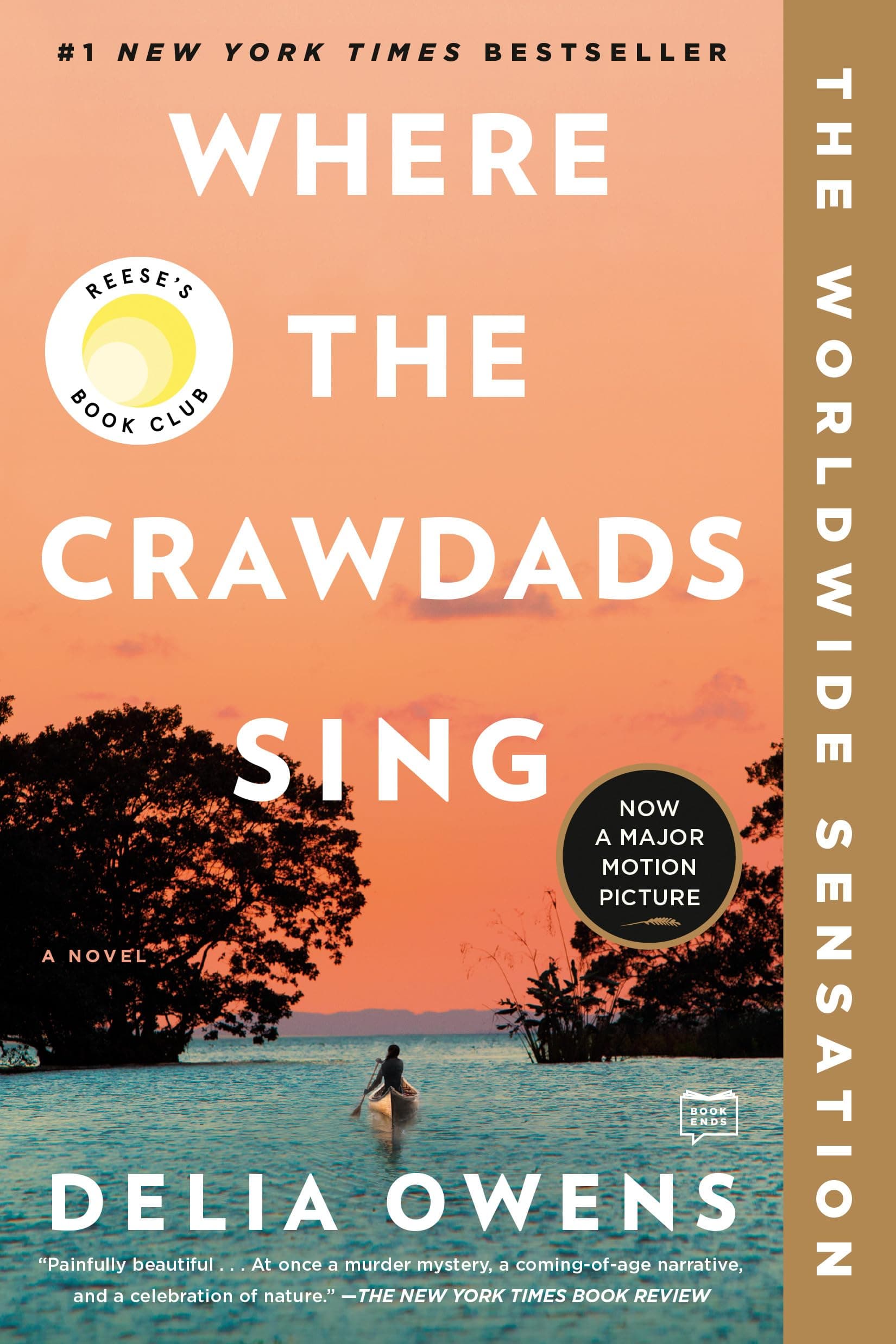
Where the Crawdads Sing: Reese's Book Club - Kindle edition by Owens, Delia. Download it once and read it on your Kindle device, PC, phones or tablets. Use features like bookmarks, note taking and highlighting while reading Where the Crawdads Sing: Reese's Book Club. Review: Singing the highest possible praise for Where the Crawdads Sing! - The Australian media broadcaster ABC through ABC Radio National, is currently asking readers for their choices for the top 100 Books of the 21st Century. Hundreds if not thousands of votes have already been received and avid readers are sharing their picks on The ABC Book Club facebook page. Having seen countless numbers of readers selecting Wherer the Crawdads Sing, I decided to buy it and am so very, very glad I did. It is beautifully written and a fabulous story about a young girl's unfortunate, dysfunctional family and her strength and perseverance in overcoming immense odds to not only reach adulthood, but become a shining example of never giving up. With a strong emphasis on preserving and appreciating the beautiful harmony of the environment, it gives an insight into the balance required for all lifeforms - humans included - in marsh/swamp/sea environments. The main characters are wonderfully crafted and they come to life throughout the book - which really was a page turner and hard to put down! I am feeling quite bereft since finishing it - it was such a thoroughly enjoyable, engaging book. It will be a very hard act to follow. Am hoping that Delia Owens writes more novels - I am very tempted to read her non-fiction books about her life as a wildlife scientist Can highly recommend it - would love to add it to my list of best 100 books of the 21st century - in fact I reckon I'd place it in the top 20! Review: A solid five star read - Count me among the thousands of readers who think ‘Where the Crawdads Sing’ is a wonderful tale and a joy to read. Kya is such a delightful character. Abandoned by her mother at the age of six, she is both sweet and resourceful. Her father is the impetus for the abandonment, a wounded veteran of WW2, he tries to drown his problems in drunken rages. Kya’s Ma can’t take the abuse he dishes out anymore, and she leaves their home, a shack in coastal Carolina, behind. Eventually all the siblings also take off, one by one, for parts unknown and Kya must deal with her drunken Pa in the wild marshland. Basically, the little girl learns to fend for herself, growing up with the animals and birds as her tutors and playmates. She becomes known around town as the Marsh Girl. I enjoyed Part 1, where Kya slowly matures into a teenage woman. This is a little better than Part 2, where Kya has to endure the cruel prejudices and indifference of the townspeople. Both parts contain excellent writing, painting pictures of the environment with remarkable prose. But this book is much more than pretty words. The plot is captivating, drawing me in and pushing me forward to chapter after chapter with a curiosity for what will happen next. Kya finds love with Tate, only to be deserted by another that she cares for. She later finds love again, this time with Chase. But this time she is rejected in a different way, and she endures an atrocity that is both confusing and heartbreaking to her innocent mind. One of the best characters is Jumpin, proprietor of the wharf boat dock and friend to Kya when she was rejected by everyone else. Later, Kya tells Jumpin some of what Chase had done to her, and I thought he would come to her aid in Part 2. Perplexing. But the small holes in this story are easily overlooked. A solid five star read should induce emotions from the reader and in the best books the characters should make a real connection. ‘Where the Crawdads Sing’ is populated by some of the most endearing characters that I have known.


| Best Sellers Rank | #8,546 in Kindle Store ( See Top 100 in Kindle Store ) #41 in Mystery, Thriller & Suspense Literary Fiction #81 in Historical Literary Fiction #105 in Literary Fiction (Books) |
P**D
Singing the highest possible praise for Where the Crawdads Sing!
The Australian media broadcaster ABC through ABC Radio National, is currently asking readers for their choices for the top 100 Books of the 21st Century. Hundreds if not thousands of votes have already been received and avid readers are sharing their picks on The ABC Book Club facebook page. Having seen countless numbers of readers selecting Wherer the Crawdads Sing, I decided to buy it and am so very, very glad I did. It is beautifully written and a fabulous story about a young girl's unfortunate, dysfunctional family and her strength and perseverance in overcoming immense odds to not only reach adulthood, but become a shining example of never giving up. With a strong emphasis on preserving and appreciating the beautiful harmony of the environment, it gives an insight into the balance required for all lifeforms - humans included - in marsh/swamp/sea environments. The main characters are wonderfully crafted and they come to life throughout the book - which really was a page turner and hard to put down! I am feeling quite bereft since finishing it - it was such a thoroughly enjoyable, engaging book. It will be a very hard act to follow. Am hoping that Delia Owens writes more novels - I am very tempted to read her non-fiction books about her life as a wildlife scientist Can highly recommend it - would love to add it to my list of best 100 books of the 21st century - in fact I reckon I'd place it in the top 20!
M**H
A solid five star read
Count me among the thousands of readers who think ‘Where the Crawdads Sing’ is a wonderful tale and a joy to read. Kya is such a delightful character. Abandoned by her mother at the age of six, she is both sweet and resourceful. Her father is the impetus for the abandonment, a wounded veteran of WW2, he tries to drown his problems in drunken rages. Kya’s Ma can’t take the abuse he dishes out anymore, and she leaves their home, a shack in coastal Carolina, behind. Eventually all the siblings also take off, one by one, for parts unknown and Kya must deal with her drunken Pa in the wild marshland. Basically, the little girl learns to fend for herself, growing up with the animals and birds as her tutors and playmates. She becomes known around town as the Marsh Girl. I enjoyed Part 1, where Kya slowly matures into a teenage woman. This is a little better than Part 2, where Kya has to endure the cruel prejudices and indifference of the townspeople. Both parts contain excellent writing, painting pictures of the environment with remarkable prose. But this book is much more than pretty words. The plot is captivating, drawing me in and pushing me forward to chapter after chapter with a curiosity for what will happen next. Kya finds love with Tate, only to be deserted by another that she cares for. She later finds love again, this time with Chase. But this time she is rejected in a different way, and she endures an atrocity that is both confusing and heartbreaking to her innocent mind. One of the best characters is Jumpin, proprietor of the wharf boat dock and friend to Kya when she was rejected by everyone else. Later, Kya tells Jumpin some of what Chase had done to her, and I thought he would come to her aid in Part 2. Perplexing. But the small holes in this story are easily overlooked. A solid five star read should induce emotions from the reader and in the best books the characters should make a real connection. ‘Where the Crawdads Sing’ is populated by some of the most endearing characters that I have known.
F**Y
Excellent, Compelling Writing, An Great Debut Novel
This is a really great debut novel by Delia Owens. What I liked most about this fine novel is the writing style. The author's style is picturesque and has a flow to it. It is clearly written, but is not a light read. It is the kind of book I needed to give my full attention. The story involves two separate time lines that slowly weave together. The protagonist is a young lady who has a difficult childhood and who learns to cope with life on her own terms. As I stated above the writing is often exquisite. Although very good, the story itself is not quite as good as the writing. But the writing is so great that for the story to be as great as the writing would make this one of the greatest novels ever written. I would not go that far. But the book overall is excellent. As is often the case I listened to the audiobook while simultaneously reading the book on Kindle. The narrator is Cassandra Campbell. The audiobook is as excellent, and is worthy of the writing. I have what I refer to as a "flawed inner narrator". As such the audiobook was really worth the extra expense to me. **** Above, I have tried to avoid references to the story, one may wish to skip the below until after reading the book. **** If one has already decided to read the book, one may wish to skip this part. I will try to remain vague. There were parts of this story the seemed unlikely to me. When one parent departs and goes to her family, they seem to make no attempt to find her children. As a grandfather, this is unthinkable to me. Supposedly there were some threats. That would mean nothing to me. There is also a violent felony mystery within the story. As a retired detective, there were parts of that episode that I found completely outside my personal experience. I am not saying the matter could not be resolved, but they did not even come close. It is not that really amateur hour police work never occurs, it does. But a case that weak does not go to trial, especially with the potential penalty involved. It was more like a civil trial than a criminal trial. I suppose those were the parts of the story that were most unrealistic to me and bothered me the most. It is the WRITING that I found most compelling. And most of the story is really quite good. ***** End of discussion of the story itself. ***** In summary, I felt this is a really great reading experience. I am so glad that I had a chance to read this book. I absolutely intend to read her next novel should there be one. As I compose this review there is no second novel of which I am aware. Should there be one, I will seek a copy immediately. Thank You...
S**K
Gorgeous Sumptuous & Sensual Language
Before I started reading the novel, “Where the Crawdads Sing,” I looked up exactly what crawdads were, only to find out that Crawdads are just another name for crayfish and having spent time in New Orleans, I knew all about crayfish. “Crayfish are freshwater crustaceans resembling small lobsters (to which they are related). They are also known as crawfish, crawdads, freshwater lobsters, mountain lobsters, mudbugs, or yabbies. Taxonomically, they are members of the superfamilies Astacoidea and Parastacoidea. They breathe through feather-like gills.” Perhaps more than you needed to know? Next I wanted to know something about the author, Delia Owens, beyond what I’d learned from the CBS Sunday Morning piece about her, on March 17, 2019. She was the co-author, along with her then husband, Mark Owens, of three non-fiction books, “Cry of the Kalahari”, “The Eye of the Elephant: An Epic Adventure in the African Wilderness” and “Secrets of the Savanna: Twenty-three Years in the African Wilderness Unraveling the Mysteries of Elephants and People.” The Owens lived as young wildlife scientists in Africa for over two decades. This experience of isolation and delving into the minute details of animals and their behaviors, would later be the germ that grew into her first novel, “Where the Crawdads Sing.” Delia Owen’s early life was also influential in her later writing. She was born in Southern Georgia and her family spent some of every summer in the mountains of North Carolina (the novel takes place in rural North Carolina from1952 through early 1970’s). Owens says that her mother would often encourage her, “to explore far into the oak forests, telling her, Go way out yonder where the crawdads sing.” She also taught her how to avoid stepping on snakes and to not be afraid of any critters. Along with the isolation, the oneness with all of nature surrounding her, would come to embody Owens’ protagonist, Kya, in “Where the Crawdads Sing.” The first main element in the story is the descriptive Language, describing the natural surroundings of the pristine coastal marshland of North Carolina. “Marsh is a space of light, where grass grows in water, and water flows into the sky.” “Swamp water is still and dark, having swallowed the light in its muddy throat.” “Life decays and reeks and returns to the rotted duff; a poignant wallow of death begetting life.” “Light lingered after the sun, as it does, some of it pooling in the room, so that for a brief moment the lumpy beds and piles of old clothes took on more shape and color than the trees.” “The darkness held an odor of sweetness, the earthy breath of frogs and salamanders who’d made it through one more stinky-hot day. The marsh snuggled in closer with a low fog, and she slept.” “syrupy sand” I could easily write this entire review by simply using the copious examples of the gorgeous, sumptuous and sensual language of he novel. For me, it is this ability of the author that makes the difference in rating it with three stars or four (occasionally five) stars. If I love the language, I generally love the book. The novel offered not only stunning language, but also a pretty good mystery, that for me became increasingly more intriguing as the book progressed nearer to the end. Some people, when they read mysteries are very good at solving them. I am not one of those people. Consequently, I was thrown for a loop. I am not a mystery reader in general, but I liked this one. “Where the Crawdads Sing” is about a girl, Kya, who the small community living in Barkley Cove, not far from the marshland, like to besmirch by referring to her as “the marsh girl.” She lives with her family, consisting of Ma who is loving, but besieged by her often violent husband, Pa, brother Justin, two older brothers and two older sisters. Ma flees her abusive husband when Kya is only 5 and one by one, all the others also leave the rickety shack which is their home, leaving Kya all by herself at the age of 6. She slowly learns how to survive alone in the marshland wilderness and by so doing, she comes to understand and appreciate the marshland with all its creatures living and breathing within it. I will summarize the story line through the use of quotes taken from it: “Maybe it was mean country, but not an inch was lean. Layers of life—squiggly sand crabs, mud-waddling crayfish, waterfowl, fish, shrimp, oysters, fatted deer, and plump geese—were piled on the land or in the water. A man who didn’t mind scrabbling for supper would never starve.” “When light from the quarter moon finally touched the shack, she crawled into her porch bed—a lumpy mattress on the floor with real sheets covered in little blue roses that Ma had got at a yard sale—alone at night for the first time in her life.” “For the first time ever Kya walked alone toward the village of Barkley Cove to buy groceries—this little piggy went to market. She plodded through deep sand or black mud for four miles until the bay glistened ahead, the hamlet on its shore. Everglades surrounded the town, mixing their salty haze with that of the ocean, which swelled in high tide on the other side of Main Street. Together the marsh and sea separated the village from the rest of the world.” “So the only intersection in town was Main, Broad, and the Atlantic Ocean.” “Mostly, the village seemed tired of arguing with the elements, and simply sagged.” “Barkley Cove was quite literally a backwater town, bits scattered here and there among the estuaries and reeds like an egret’s nest flung by the wind.” “She’d never gone to Colored Town, but knew where it was and figured she could find Jumpin’ and Mabel’s place once she got there.” “CHASE ANDREWS, you get back here! All three of you boys.” They pedaled a few more yards, then thought better of it and returned to the woman, Miss Pansy Price, saleslady in fabric and notions.” “We’re sorry, Miss Pansy, we didn’t see ya ’cause that girl over yonder got in the way.” Chase, tanned with dark hair, pointed at Kya, who had stepped back and stood half inside a myrtle shrub. “Never mind her. You cain’t go blamin’ yo’ sins on somebody else, not even swamp trash.” “It’s my birthday,” she told the bird.” “But Jackson mostly ignored crimes committed in the swamp. Why interrupt rats killing rats?” “Kya never went back to school a day in her life.” “Months passed, winter easing gently into place, as southern winters do. The sun, warm as a blanket, wrapped Kya’s shoulders, coaxing her deeper into the marsh. Sometimes she heard night-sounds she didn’t know or jumped from lightning too close, but whenever she stumbled, it was the land that caught her. Until at last, at some unclaimed moment, the heart-pain seeped away like water into sand. Still there, but deep. Kya laid her hand upon the breathing, wet earth, and the marsh became her mother.” “Sheriff Ed Jackson” “Deputy Joe Purdue” “Well, obviously, on the surface, it looks like an accident: he fell from the tower and was killed.” “Saltwater marsh, some say, can eat a cement block for breakfast, and not even the sheriff’s bunker-style office could keep it at bay. Watermarks, outlined with salt crystals, waved across the lower walls, and black mildew spread like blood vessels toward the ceiling. Tiny dark mushrooms hunkered in the corners.” “They sipped until the sun, as golden and syrupy as the bourbon, slipped into the sea.” “Hey, Kya. Sorry I couldn’t get here sooner. Had to help my dad, but we’ll get you reading in no time.” “Hey, Tate.” “Let’s sit here.” He pointed to an oak knee in deep shade of the lagoon. From the rucksack he pulled out a thin, faded book of the alphabet and a lined writing pad. With a careful slow hand, he formed the letters between the lines, a A, b B, asking her to do the same, patient with her tongue-between-lips effort. As she wrote, he said the letters out loud. Softly, slowly. She remembered some of the letters from Jodie and Ma but didn’t know much at all about putting them into proper words. After only minutes, he said, “See, you can already write a word.” “Slowly, she unraveled each word of the sentence: “‘ There are some who can live without wild things, and some who cannot.’” “Oh,” she said. “Oh.” “You can read, Kya. There will never be a time again when you can’t read.” “It ain’t just that.” She spoke almost in a whisper. “I wadn’t aware that words could hold so much. I didn’t know a sentence could be so full.” He smiled. “That’s a very good sentence. Not all words hold that much.” “Learning to read was the most fun she’d ever had.” “Jumpin’ said the Social Services are lookin’ for me. I’m scared they’ll pull me in like a trout, put me in a foster home or sump’m.” “Well, we better hide way out there where the crawdads sing. I pity any foster parents who take you on.” Tate’s whole face smiled. “What d’ya mean, where the crawdads sing? Ma used to say that.” Kya remembered Ma always encouraging her to explore the marsh: “Go as far as you can—way out yonder where the crawdads sing.” “Just means far in the bush where critters are wild, still behaving like critters. Now, you got any ideas where we can meet?” The story goes on. There is love. There is loss. There is what seems to most folks to be a crime. There are scenes from a compelling courtroom trial. That’s all I’ll tell. You must read “Where the Crawdads Sing” for yourself to fill in the gaps and to temporarily live in a world of the marshland in rich poetry and language. Though the scenes in the courtroom take a marked turn from this rich detail of language and poetry, it makes up for it by putting you inside an interesting and ultimately surprising courtroom drama. Where the Crawdads Sing is one of those books that is so good, one wonders where Delia Owens can go from here?
D**N
Metaphysical Values
What I liked most about this book is the depictions of believably real (though fictional) characters challenged by real-life issues, with the characters' basic motivations well described and integrated into a story of how the characters succeed or fail against their challenges, and why. I believe the philosophical term for literature of this kind is "metaphysical values." (I haven't seen the movie so far but probably will see it eventually. Meanwhile, the various trailers that I've seen seem to indicate that the novel's main spirit may have been badly mangled in the movie, possibly to emphasize issues such as racial prejudice and other forms of bias against those who are "different," and other contemporary concerns. From various critical reviews on this website, it also appears that the story itself may have greatly misrepresented what North Carolina was actually like in the 1950s, 60s, and 70s. But I don't see geographical or historical accuracy as necessarily essential to a fictional story concretizing important metaphysical values.) At the end of the novel, in the Q&A with the author (pp. 376-377), there is a very concise description of what the book is about. The story follows the life of a young girl named "Kya" living mostly alone in fictional marshlands in North Carolina from age 6 to her death from natural causes (unexpected heart failure) at age 64. It's a story of how she survives with minimal help from anyone else. A child of 6 wouldn't have been able to survive alone for long without significant knowledge and experience gained from interaction with other humans, and she did receive minimal interaction with her mother, brother, father, brother's friend Tate (later Kya's first lover and eventual husband after a fateful 2nd love with Chase Andrews), and a married (black) couple in the nearby fictional town of Barkley Cove. Tate and Chase both disappoint Kya deeply, Chase so strongly that Kya becomes the prime suspect when Chase is found dead, apparently murdered. (Chase lied to her about potentially marrying her, and he even tried to rape her, causing her to fear that Chase would keep trying again and again by force.) Before Tate leaves her while he goes to college, she learns to read with Tate's help. He also gives her many old books to read, mostly on life science. She apparently never receives access to any books in literature, history, philosophy, or other general humanities subjects. She remains forever shy and defensive toward most other people despite becoming highly adept at studying the wild animals and plants in the marsh, writing books of her own on her observations, becoming successful as a published author, and painting vivid sketches of what she observed. Along the way, she also learns to count beyond 29 and to count money and make change, again with help from Tate and others. At her trial for the murder of Chase, the prosecution presents serious evidence against her, but the evidence isn't quite strong enough to obtain a guilty verdict from the jury (beyond reasonable doubt). She has an especially good alibi, although it has weaknesses that leave room to doubt her innocence. Since there are also reasonable doubts about her guilt, the jury verdict is "not guilty." One key piece of evidence, a "shell necklace," remains missing until the very last page of the story, shortly after Kya's death, when Tate (whom she had married by then) finds it. For those who want to be surprised, I won't say more about the details of the ending. Kya certainly would have had to be incredibly resourceful and daring, perhaps far larger than real life, to have been able to construct such a convincing alibi, if she actually was the murderer. The symbolic parallel to the mating rituals of fireflies provides a strong hint about Kya's mental state. The events of the story are mainly just the backdrop. The story's main focus is on how Kya felt and how she learned so much about nature and life sciences from her own direct observations and from books that she read, without ever attending school at any level for more than one deeply unpleasant day at age 6. Despite how little she learned about humanities subjects and how to deal with other people, the story depicts her as focused on the reality that she was exposed to, and on how she used her natural intellectual capacity to make sense of it as best she could. She certainly functioned on a reality-is-real premise, though without explicitly identifying that premise or comprehending its higher implications for human living; she also felt her emotions without any explicit appeal to any greater mysticism or other-worldly perspective. (Kya shows no superstitiousness or religious worship of natural phenomena.) But the story doesn't attempt to delve further than that into issues of values, why man needs them, and how best to choose and pursue one's values. With access to books, Kya surely would have had the opportunity to do such deeper reading in real life, even if she remained otherwise isolated from most other people throughout her life. She had Tate, along with the two adult townspeople, her publisher, and to some extent her brother Jodie -- all of whom provided emotional support to her during her trial. She is a heroine of sorts, though a severely stunted and crippled one, especially emotionally toward others. The author describes the story as "primarily about self-reliance, survival and how isolation affects human behavior. Since our species is a social mammal, we have strong genetic tendencies to belong to a group of tightly bonded family and friends." (P. 376.) What "genetic tendencies" does this refer to? How much personal choice do humans have? Man has a non-automatic rational faculty on which he needs to depend for his survival. But he also needs a lot of help from others, especially family, along the way as he proceeds from the stage of a newborn infant to adult life. Without such help in childhood, the stunted growth that may hinder a child's development and readiness for adult living should not be surprising. A more heroic kind of story might explore more fully how much more a person can learn about life from books, and how events might unfold as such a person strives to apply such learnings in practice. Kya certainly makes a valiant and largely successful effort, which, for me, makes Crawdads excellent as far as it goes.
B**E
5🌟
i loved this book so much, set in the marshes of north carolina, it’s the story of kya clark, the “marsh girl,” who’s left to fend for herself after her family abandons her. kya’s connection with the wild around her is so beautifully written, and the way she grows up alone in nature is both heartbreaking and inspiring. i have to admit, when i first started reading, i struggled a bit with the dialect. but after doing a little research on the accents of that time and place, i found myself slipping right into it, which made the reading experience even richer. owens does such a beautiful job of pulling you into the setting and era. what i loved most is how delia owens weaves together kya’s coming-of-age story with a mystery that keeps you hooked. it’s a mystery thriller but also a tender coming-of-age story, with a deep love for nature interwoven throughout. the themes of survival, resilience, and the deep bond between humans and nature really resonated with me. reading about kya’s journey felt like a rollercoaster of emotions. i cried (ugly cried!!!), i smiled, and my heart ached for her. it’s impossible not to root for kya as she overcomes so much hardship. the romance in the story adds a tender, sweet layer that feels so genuine. it really got to me. (oh, tate❤️) there’s a quiet strength in kya that i found incredibly empowering, almost like reading a memoir of surviving against all odds. if you’re looking for a book that’s beautifully written and emotionally gripping, you have to read where the crawdads sing. it’s perfect for anyone who loves stories about overcoming adversity with a blend of mystery and romance. this book has definitely earned a spot in my top favorites. and yes, i watched the movie too—it was amazing—but seriously, the book is always better! 🥹 🌟🌟🌟🌟🌟 IG: @britsbookchat
K**L
Where the Crawdads Sing is well worth staying up all night to read.
Where the Crawdads Sing is well worth staying up all night to read. The midnight fireworks marked a significant moment in the book which definitely would be a spoiler! Kya is abandoned by her mother and siblings who leave her at age six with an abusive drunk. As marsh-dwellers, she and her family live as total outsiders from the world of small-town Bible Belt North Carolina in the mid-1950s. Once her protectors leave her, Kya's world becomes darker and more dangerous. She stays on the good side of her father long enough to learn to fish before he goes off the wagon and disappears for good. Kya learns to feed and clothe herself with the loving help of a Black swamp storekeeper and his wife. She avoids the truant officers until she is 8 when she is put into a class far above her skills with students who bully and disdain. It is her first and last day of school. She prevents authorities from learning she is alone because she is terrified she will be removed from the marshland that is her entire world. She is alone but she learns how to avoid loneliness. Yet she yearns for a family again, for her mother's songs and art and gaiety—when it was safe to laugh and play. She misses the last brother she remembers well, who abandoned her with her sullen and explosive father. When not struggling to feed herself and to earn money for gas for the boat and staples for the household, Kya builds her collections: exotic feathers, shells, nests, butterflies. She draws and paints and studies the habits of insects, of birds, of marsh animals. She learns the tides, the currents outside the lagoon, the weather. But she knows little of people except that they are unkind if not cruel, often dangerous—never trustworthy. After all, if her own family has abandoned her, who can she trust? Then she meets Tate, who also loves the marshland, who appreciates her flock of gulls, who is a collector of marsh artifacts and creatures. Slowly she learns to trust him, allows him to teach her what he knows, accepts the books that he uses to teach her to read. Kya grows into the world Tate offers, a world of knowledge and art and possibilities. Kya is just beginning to realize what love might be—could be—when Tate leaves for college. And like all the others, he does not return. It is when she is most financially and physically secure that Kya becomes the most vulnerable. She meets Chase and the life and career she has built as an author and naturalist fall apart, to the cruel delight of the town who have been waiting for years to see the Marsh Girl finally get her comeuppance. I recommend Where the Crawdads Sing to readers who enjoy solid character development, rich description, and learning of new places and information without feeling "taught." Delia Owens imparts knowledge lovingly—no didactics. Kya's observations widen your world as they widen hers. Kya's growth as a whole person is gradual as she learns to trust, learns to love, learns to widen her circle. Her journey is long and hazardous, but those who travel the road with her are enriched and enlightened by Kya's losses, her gains, and her redemption as a human experiencing a wider and highly challenging world. This is not a book a reader will regret choosing. You will be willing to read away the night, even on New Year's Eve.
C**S
A ten star plus book
I loved this extraordinary book. Ms. Owens draws pictures with words that rivals paintbrush on canvas. In fact, the book is one long canvas of beautifully written words, page after page. One can feel Kya's isolation and pain, smell the marsh grasses and palmettos all while sneaking peeks at Big Red. I grew up with the adage "different strokes for different folks" so not everyone will enjoy WHERE THE CRAWDADS SING. Unfortunately, it is a tragedy that reading the classics (in addition to more entertaining "beach reads") is no longer a requirement or is not as strong as it once was. Reading many voices and genres contributes to an appreciation that staring at text messages won't necessarily satisfy. To be clear this is fiction and fiction always, always requires some suspending of belief. In this book, there are no car chases or major escape scenes or near misses for the detective or blown up cars so if action-packed is what one enjoys, then this book doubtless would not suit those readers. On the other hand consider this small literary passage from WHERE THE CRAWDADS SING: "She stared at dust motes, dancing silently in one direction as though following some dreamy leader. When they hit the shadows, they vanished. Without the sun they are nothing." I've seen dust motes many a time so I marvel that an author can give such personality to them! Of course, most of the beautiful words revolve around the marsh and its inhabitants, Kya, her family, her loneliness and her feelings and the townspeople not dust motes. However, that snippet is classic to how well written this book is all throughout. Of note Asheville is not as close to the coast as some other North Carolina cities but Asheville is surrounded by mountains, an attraction held out to Kya (a full day trip she is told), plus her paternal grandparents reportedly lived there (not a spoiler). The mystery is handled perfectly. But that mystery is only one element of the book. It is so much more than that. Kya is not the first young child (real or imagined) who had to (has to) survive against many odds: in Kya's instance, the erratic Monday money for food while still a child just to name one. Other discussion points such as whether or not it's fire flies or lightning bugs is so beside the point IMO since it depends on where one grew up. We called them lightning bugs but out of town relatives called them fire flies. They are the same insect and very entertaining to watch. Kya tells us much about these insects that I did not know and this information fit into the story. (BTW, there is a great show in the Smokies put on by lightning bugs (fire flies) during their mating season. People actually take chairs and go watch!) Aside from quibbles about southernisms (LOL) some have, the book holds one's attention from beginning to end. The ending was perfect. It suited the book I believe. This book has earned its 5-star rating and I hope Ms. Owens writes another book soon. Finally, the descriptions of the marsh itself and its many inhabitants, including Kya, is worth the price of the book yet the reader gets all these bonuses: a mystery, human survival, human relations contrasted with extraordinary naturalist behavior and descriptions and an aching heart for all the Kya's of the world. Highly recommended for those who like a great story interwoven amongst beautiful, haunting words. I won't remember that blown up car in a beach read beyond next week even though the book was fun to read but WHERE THE CRAWDADS SING will live with me (and other readers) for a very long time. An extraordinary book!
TrustPilot
2 周前
1 个月前