We remain fully operational. Our teams are working around the clock to ensure your deliveries continue safely.

下载应用程序


Buy anything from 5,000+ international stores. One checkout price. No surprise fees. Join 2M+ shoppers on Desertcart.
Desertcart purchases this item on your behalf and handles shipping, customs, and support to Taiwan.
⚡ Elevate Your Voltage Game — Power Up Like a Pro!
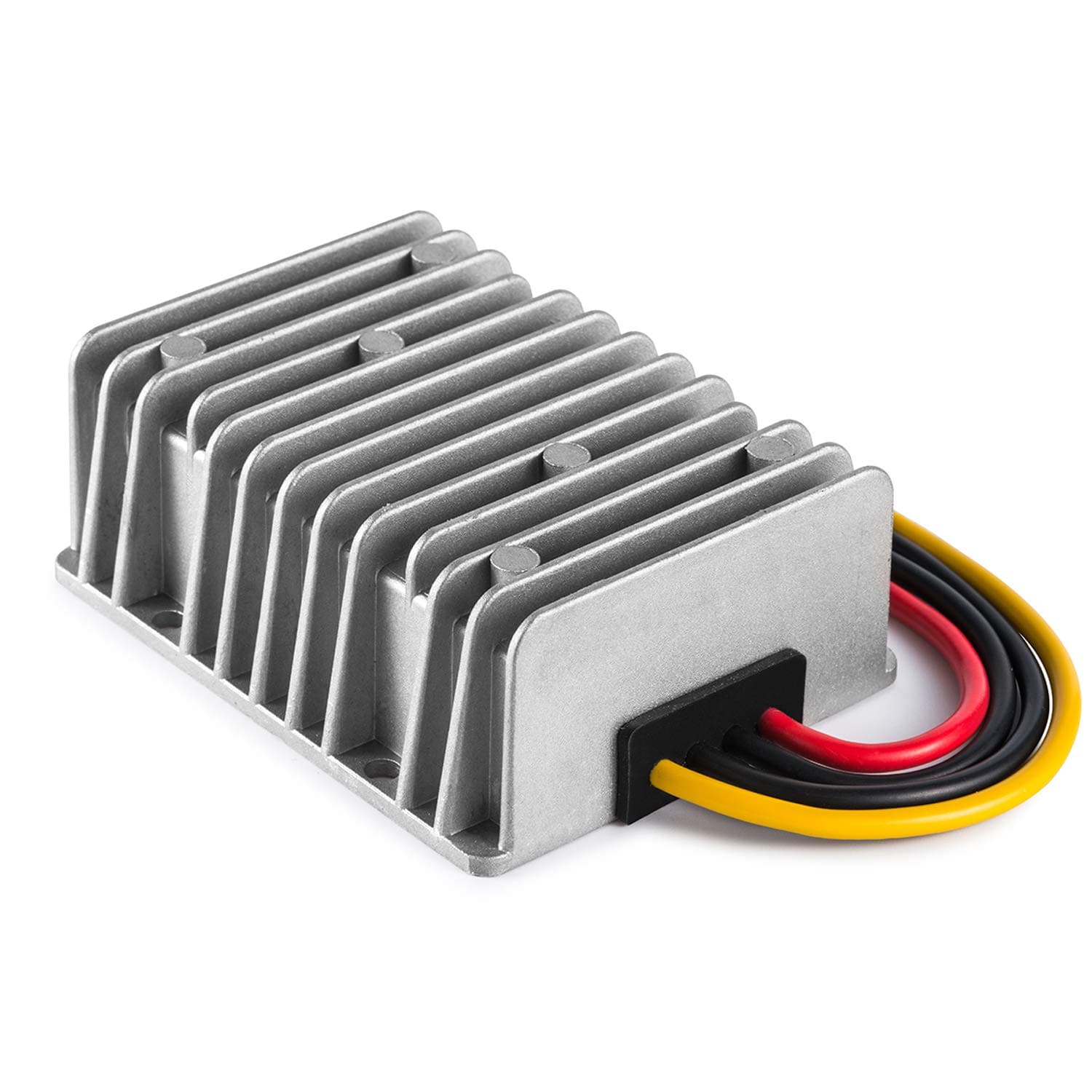
This Waterproof DC/DC Converter efficiently steps up 12V input to a stable 24V output at 20A and 480W max power. Engineered with an IP68-rated aluminum shell and silicone gel encapsulation, it guarantees full waterproof protection for rugged environments. Featuring five intelligent safety protections and auto-recovery, it ensures reliable, long-lasting performance with up to 96% conversion efficiency. Ideal for powering 24V devices across vehicles, boats, and electric bikes, this compact module delivers professional-grade voltage boosting wherever you need it.
| ASIN | B081K6PRX3 |
| Best Sellers Rank | #103,906 in Tools & Home Improvement ( See Top 100 in Tools & Home Improvement ) #386 in Power Converters |
| Brand | MGGi |
| Color | Aluminum |
| Customer Reviews | 4.4 4.4 out of 5 stars (164) |
| Input Voltage | 12 Volts |
| Item Dimensions | 4 x 3.2 x 1.5 inches |
| Manufacturer | XingHua |
| Mfr Part Number | MG20191116 |
| Model Number | 308075960886 |
| Output Voltage | 24 Volts |
| UPC | 308075960886 |
| Unit Count | 1.0 Count |
| Warranty Description | 1 Year |
S**R
Good for step up.
Worked well, does not work well if you swap the voltage around. I used it to step up the voltage in a spare lithium battery that was 12 volts so it could power my Bluetti which only accepted a minimum of 16 volts. Wired some standard solar MC4 connectors to it but you can use different ones.
J**S
Worked when I tested it.
I bought this to try and charge a power station faster from a 12 volt source. It works. Seems to give about 184 watts into the power station at 24 volts at 8.8 amps. There is a loss in the conversion. By my math the converter is 94% efficient. I lose another 6% from the charge controller when plugged in. I was getting 205 watts out of the battery, 194 watts out this converter measured by a watt meter, and seeing 184 watts on the display. So, a total of about 89% efficient when all is said and done due to loses on converting and the charge controller. Will charge faster than the regular 12 volt input. It also allows me to add a 12 volt battery to the power station and double the watt hours for the power station. I tested it overnight and it took about 956 watts total out of the battery to keep the power station at 100% over a 8 hour period.
B**N
Update: works but check your amperage
***Updates further down*** I purchased this device because I acquired 24v ARB Twin Compressor gently used. Problem was, my Jeep is a 12v system so obviously that won't work. There was very little help on the subject until I came across a short thread on a forum that addressed exactly my problem and referenced a device almost identical to this one here. I took the gamble and gave it a try and voila! I know can use this very expensive compressor on my Jeep! I was so thrilled to see it power on and run! I have not full completed my install to where eI can really test this thing in the real world environment to see if it can handle a long duty cycle, but first test run was a success! I ran this test last week so at this date, 4/26/2021, it appears to be a success, I will come back and update once final install has been completed! Update 9/21/21: this item works to step the voltage up to 24v. But amperage limited me from using this for my application. The unit powered on fine and tested fine. But I’m real world application, under load, it could not draw enough power due to amperage limitations. Check the amperage draw of your device before purchase. Otherwise, it’s legitimate.
S**I
Geeat Value
Does what it says. Easy to connect up. Does not get too hot after running for 3 hours. Good value for the money,
C**S
Did not work with Starlink
I read multiple articles this will power a Starlink satellite system. Starlink router would power on, but apparently not enough amps to power up the dish. Did not return as I had cut the wires and added connectors.
H**Y
UPDATE: IT WORKS! BUT NOT TO SPECS!
Update to my previous review. I found the positive input wire not making contact inside WEGO connector. It works ok now. It does takes an input of about 19amps @ 12volts (230watts), then converts it to output 9amps @ 24volts (220watts). I thought that it was 20amps output @ 24volts to make 480watts? I'm still trying to figure out how to get the 480watts out of it. I will try paralleling 2 12volt batteries to see if that helps. Although, the LFP battery's BMS is rated at 50amps output, so why it seems to pull ONLY 20amps of 12volts power to convert an output of 24volts @ 9amps output doesn't add up! It would need to pull 40amps to convert 12volts to 24volts @ 20amps output. What's up with that MGGi?
A**R
12vdc input to 24vdc output
Needed a 12vdc to 24vdc step up transformer to run a 24vdc wiper motor on an M998 HMMWV that has been converted to 12vdc. Worked perfectly, seems pretty Rugged and weather resistant.
A**R
Works great
I use if for converting power from 2 x 12v batteries via charge controllers to 24v for a gate opener. So far working well.
A**R
This is a good product. Heavy gauge +12V wiring, runs acceptably cool under 200W load, and is efficient. Calculating watts consumed vs watts output, it is near 95% efficient at the 200W load. Would absolutely buy again.
F**S
Utiliser dans un camper pour recharger une power station Bluetti , qui nécessite du DC >16v. Filage de bonne dimension aucune surchauffe.
U**C
I use this to up the input voltage on my Ecoflow while driving for a quicker charge. Works perfectly!
A**R
Problem fix. Finally found the package. Somebody in the house stored it for me and did not told me. All good. Thank You!
TrustPilot
1 个月前
2 个月前