We remain fully operational. Our teams are working around the clock to ensure your deliveries continue safely.

下载应用程序




🎧 Elevate your audio game—never miss a beat or a meeting!
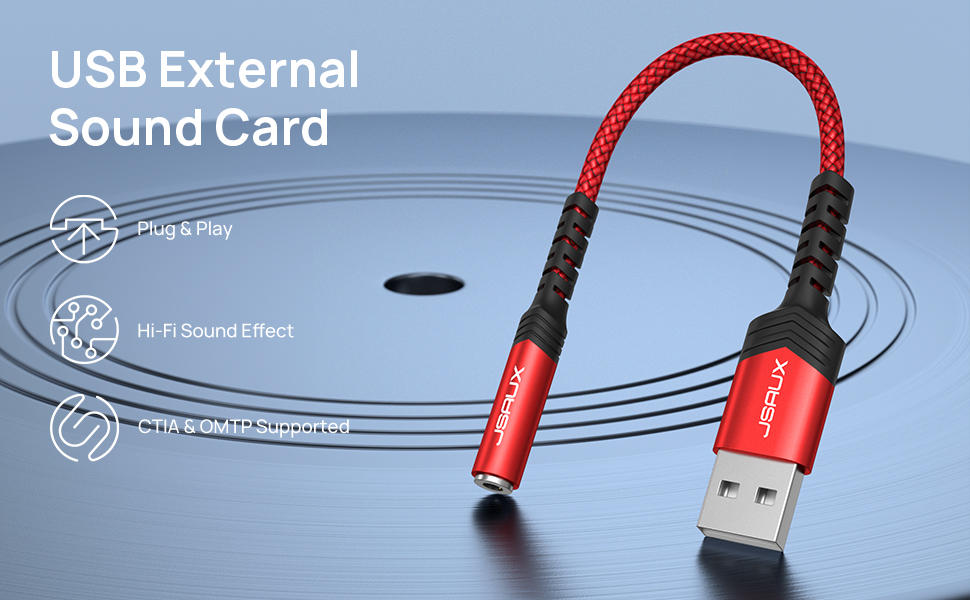
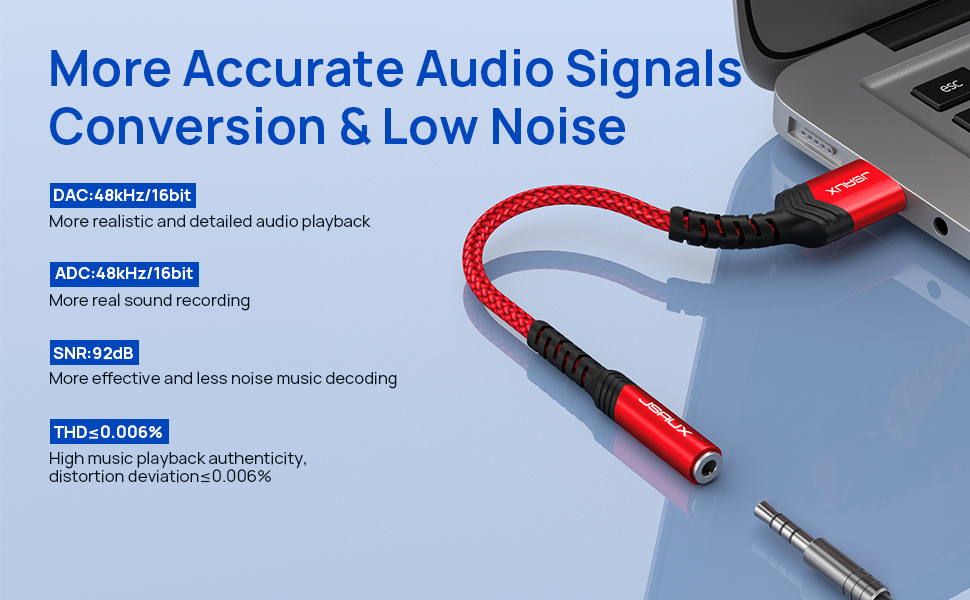
The JSAUX USB to 3.5mm Jack Audio Adapter is a compact, plug-and-play external sound card that converts USB ports into high-fidelity 3.5mm TRRS audio jacks. Supporting 48kHz@16bit stereo sound with smart chip decoding, it delivers clear, low-noise audio for headphones and headsets across a wide range of devices including PCs, Macs, PS4, Linux, and more. Its durable aluminum housing and nylon braided cable ensure long-lasting use, making it an essential accessory for professionals seeking reliable, high-quality audio connectivity without driver hassles.


| ASIN | B0885WGX89 |
| Audio Output Mode | Stereo |
| Best Sellers Rank | #20 in External Sound Cards |
| Brand | JSAUX |
| Compatible Devices | PC |
| Customer Reviews | 4.3 out of 5 stars 1,961 Reviews |
| Hardware Connectivity | Headphone, USB |
| Hardware Interface | Headphone, USB |
| Hardware Platform | Gaming Consoles, Headphones, Laptops, PC, Speakers |
| Item Weight | 0.01 Kilograms |
| Manufacturer | JSAUX |
| Maximum Sample Rate | 96 KHz |
| Mfr Part Number | JSAUNZUA2AUXFRDZ6F |
| Model Number | JSAUX_xxxx |
| Platform | Android, Linux, Mac OS X, PlayStation 4, Windows 10 |
| Surround Sound Channel Configuration | 4 |
| Unit Count | 1.0 Count |
M**E
It works.
The audio port on my desktop work computer failed, and this worked perfectly to get my earbuds working again. Sounds just as good as the audio port did.
R**I
Solves Win11 Audio Problem for 3.5mm
Upgraded to win11, Lenovo P52, Sennheiser H280 cans connected via 3.5mm jack to laptop, had wow and flutter but more aggravating was that audio volume would abruptly go to "11" for tens of milliseconds to seconds then drop back to normal volume. Risk of hearing damage if this happens a lot, these are quality cans. Audiophiles would cringe at the wow and flutter which is truthfully irritating but I could tolerate it. Lots of fix suggestions out there, consumes a lot of time experimenting, helped to some degree but I did not reach a working solution and Microsoft and/or Lenovo has yet to come up with a driver solution. However-- found that USB headphones work fine, it is just the audio driver to 3.5mm output. So tried this solution, USB to 3.5mm to Sennheiser HD280. Problem solved without wasting a lot of time fiddling with arcane Win controls, or tolerating ear blasting audio, or using inferior USB headphones. Pros: -- seems well constructed, flexible -- solves Win11/Lenovo driver problem, the primary objective of this purchase Cons: -- not gold plated like the Sennheiser plug, so that there is sometimes noise when connector is moved. Might have long term degradation (loss of a channel for instance). If you have the Win11 3.5mm audio problem, this is the easiest solution without spending hours searching out and experimenting with Win audio controls. Sure, it costs a few dollars, but what is your time worth?
K**N
Solved my "No Audio Output Device is installed" on my older Windows 10 laptop.
I'm very happy with this JSAUX USB to 3.5mm jack audio adapter. I got an older laptop from my son so my 10-year-old could play a network game with me and my wife. However, the laptop said "No Audio Output Device is installed, which makes gameplay a problem. My son suggested an adapter like this, but I was skeptical about it working. I ordered this JSAUX item because I already own a couple of JSAUX cables and was impressed with the quality. This one is no exception and, most importantly, when I plugged it in it was recognized right away and the sound is working. My son explained that the USB controller will recognize an audio output like this and will output the audio as if I had an audio card. So, for only $8 this device solved a problem that would have taken me hours to try to figure out.
J**N
Update: Some hiss but the price is great.
UPDATE: I raised the rating to 4 stars as the seller went out of their way to contact me and correct the situation and I have used it some more to test. The hiss isn't as bad as I thought at normal volume levels; only at very high levels. I would purchase it again. No issues with drivers on Debian 13 (Trixie) running on a Raspberry Pi 500+. Likewise with Windows 10. Plug it in and it works. The only reason for two stars is that it has an awful hiss on the audio output. It was there on the Pi and on the Windows 10 Intel box. The ear buds/mic set up is my daily driver for years; Skull Candy from when they were producing good quality ear buds. Never an issue with the set so the hiss has to be from the JSAUX USB adapter. I guess it was poor filtering or something with the design. If I had to use them everyday for long periods, it would probably give me a headache. Since it is for my Zoom & Discord backup machine (the Pi), I can live with it at such a low price.
M**Y
Music Supreme
I looked over nearly all of the similar devices and most seemed to have too many sound quality issues reported. I was not going to be convinced by number of bits or higher price. One reviewer here (Stephen J. Boone) helped the most, but others counted. So I got it and the sound is perfection on my Sennheiser headphones. I recently purchased Neumi BS5 speakers and a Aiyima A07 mini amp for my 2019 iMac - and I couldn’t be happier with that purchase either. My headphone port is on the back of the monitor and I have it feeding into the amp. I could use the jsaux device to feed the amp (which I did) but I’m dedicating it to my headphones for easy access. I use VLC for my music app and block Apple’s Music app (with noTunes (GitHub download)) because virtually nothing it does is what I want and it is nasty, rigid, uncustomizable. I also just bought a (SmartQ H302) USB 3 hub which came the same time as the jsaux device. I have the jsaux audio adapter plugged in to the USB hub. The hub (and the iMac) will use USB 3.1 but the jsaux device is shown to run at USB 2 speeds (which is good). The jsaux device can be bought with a USB A connector ($10) or a USB C connector ($15), so there is no need for me to waste a USB C/Thunderbolt port or $5 (and both my USB C ports are already in use). Regardless, either method is obviously using USB 2 throughput. Below is system information which shows both the jsaux device (China) and my new USB hub use Realtek chips (Taiwan). [Update: I liked it so much that I bought a second one as backup so now I have both the grey and the red (both type USB A). I'm listening to the second one now and it's producing beautiful sound just like the first one. I noticed two new reviews came in in the last week and they are negative. One refers to using it with a Mac Mini - all kinds of crazy stuff going on. Don't know what to make of that. The other complains about the microphone aspect (which seems to be a customary complaint with almost every brand that I can remember reading reviews for). I haven't tested the mic functionality and I may never care. But I have a large mic - the kind with a fat plug although I should have the necessary mini adapter - but it's buried in a stuffed audio equipment box so I'm in no hurry try it. The built-in mic on my iMac is in the middle on the bottom edge of the screen and could be improved on so an external mic could be important some day. With two of the jsaux audio adapters plugged into my USB hub, they are indistinguishable in the Sound preference pane, both are only named: TX-Hifi Type_C Audio. I have to guess the right one to select. In system report->hardware->USB, they show as identical too (no surprise) but in ->hardware->Audio, TX-Hifi Type_C Audio is displayed three times when two of these are plugged-in - take out one of them and only one gets displayed - an Apple bug there.] % system_profiler SPUSBDataType USB 3.1 Bus: Host Controller Driver: AppleIntelCNLUSBXHCI PCI Device ID: 0xa36d PCI Revision ID: 0x0010 PCI Vendor ID: 0x8086 4-Port USB 3.0 Hub: Product ID: 0x0411 Vendor ID: 0x0bda (Realtek Semiconductor Corp.) Version: 1.04 Speed: Up to 5 Gb/s Manufacturer: Generic Location ID: 0x14a00000 / 5 Current Available (mA): 900 Current Required (mA): 0 Extra Operating Current (mA): 0 4-Port USB 2.0 Hub: Product ID: 0x5411 Vendor ID: 0x0bda (Realtek Semiconductor Corp.) Version: 1.04 Speed: Up to 480 Mb/s Manufacturer: Generic Location ID: 0x14700000 / 4 Current Available (mA): 500 Current Required (mA): 0 Extra Operating Current (mA): 00 ... TX-Hifi Type_C Audio: ... Product ID: 0x4c07 ... Vendor ID: 0x0bda (Realtek Semiconductor Corp.) ... Version: 0.01 ... Speed: Up to 480 Mb/s ... Manufacturer: Generic ... Location ID: 0x14710000 / 8 ... Current Available (mA): 500 ... Current Required (mA): 100 ... Extra Operating Current (mA): 0 system report -> hardware ->audio Devices: Built-in Microphone: Default Input Device: Yes Input Channels: 2 Manufacturer: Apple Inc. Current SampleRate: 48000 Transport: Built-in Input Source: Internal Microphone Built-in Output: Default System Output Device: Yes Manufacturer: Apple Inc. Output Channels: 2 Current SampleRate: 48000 Transport: Built-in Output Source: Headphones TX-Hifi Type_C Audio: Default Output Device: Yes Manufacturer: Generic Output Channels: 2 Current SampleRate: 48000 Transport: USB Output Source: Default
J**L
[UPDATED] Caused A Critical Error Event 41
UPDATE [2025-03-16]: I've been experiencing the event 41 critical error reboot every few days for the last several months, but after many MANY different tests, updates, and reinstallations*, I think I found the culprit thanks to an old-school techie who heard me complaining at our weekly trivia game, and said "I'm willing to bet anything it has something to do with one of your USB devices or ports." Sure enough, after removing my JSAUX USB to 3.5mm Jack (also my cheapest knockoff device), I haven't experienced this issue in over a week. Prior to now the longest gap between critical errors was less than 3 days. *I updated the MB firmware, reinstalled all of my most used software (mostly Adobe stuff), did a clean install of Windows, unplugged and re-plugged every internal piece of hardware, even replaced several SATA and PCIe cords, etc. etc. etc. [----PREVIOUS REVIEW----] It worked well for a few months, but then it stopped connecting with either audio channel, and I had to pull my headphones plug part way out in order to get a complete signal. Sadly, I only unplugged and replugged it a dozen times before this happened. My headphones mostly lived at my desk plugged into this JSAUX device. Now, I have to adjust it like a teenager trying to get the airline's free headset to work. In fairness, the Chinese (based in Shenzhen) electronics company with the made-up name for Amazon had no intention of existing longer than 6 months. Next time they need to plan their product's obsolescence just a few months longer. That being said, there is an 18 month warranty policy. I'm about to try it. Will update with their response if any [emailed their support staff 2023-11-26] UPDATE: They got back to me right away, and offered me a new item. It arrived in a couple of days, and so far so good. I'm still skeptical of how long it will last, but any company that is willing to honor their warranty with very little hassle or delay should be given supported more than the companies that don't so I up'd my rating.
A**R
Turns a wired (4 pole plug) headset into a full USB headset
This adapter converts a wired (4 pole plug) headset into a full USB headset. This is useful for those of us that already own the wired headset and want to use it on a computer via USB. In my case I already owned the wired headset I was using with my XBox (plugged into one of the console's game controllers), but I also wanted a headset for use with my computer (on zoom meetings). I considered buying a 2nd (USB this time) headset for that purpose, but this adapter was much cheaper than a full headset, and also had the advantage of less clutter on my desk than a 2nd headset would bring. So I decided to get this adapter and give it a try. The adapter just arrived, but so far the results have been pretty much what I expected. In particular, my chromebook (computer) automatically saw the headset (via this adapter) as two new audio devices (i.e. the microphone and speakers on the headset). So it was trivial to select the headset speakers and microphone in my test zoom session. I was also able to select the headset as my main audio output device, and then watch a YouTube video via those private listening "speakers". All of this was accomplished simply by plugging this adapter into a USB hub that was connected to my chromebook. So yes, this device does appear to correctly convert a wired headset into a full USB headset. Now, I did test this adapter (with the headset hooked up to it) with my XBox, but this did not work. However, since XBox lacks audio drivers for USB devices this "failure" was expected (and the "fault" of the XBox, not this adapter). As a result, I will have to unplug my headset from this adapter and move it to one of my game controllers on those few occasions when I want the headset with my Xbox. However this should be very fast to do, and most times I'll probably just leave the headset plugged into this adapter (since I expect to have more need of the headset on my computer, than I'll need it on my XBox).
A**N
Maybe?
Pros: works right out the box with my raspberry pi 5 without any setup. Cons: annoying constant buzzing noise interference and the USB part of it with the metal casing gets insanely hot, too hot to unplug with my bare hands. I'm wondering if it's a one off and mine is defective.