We remain fully operational. Our teams are working around the clock to ensure your deliveries continue safely.

下载应用程序


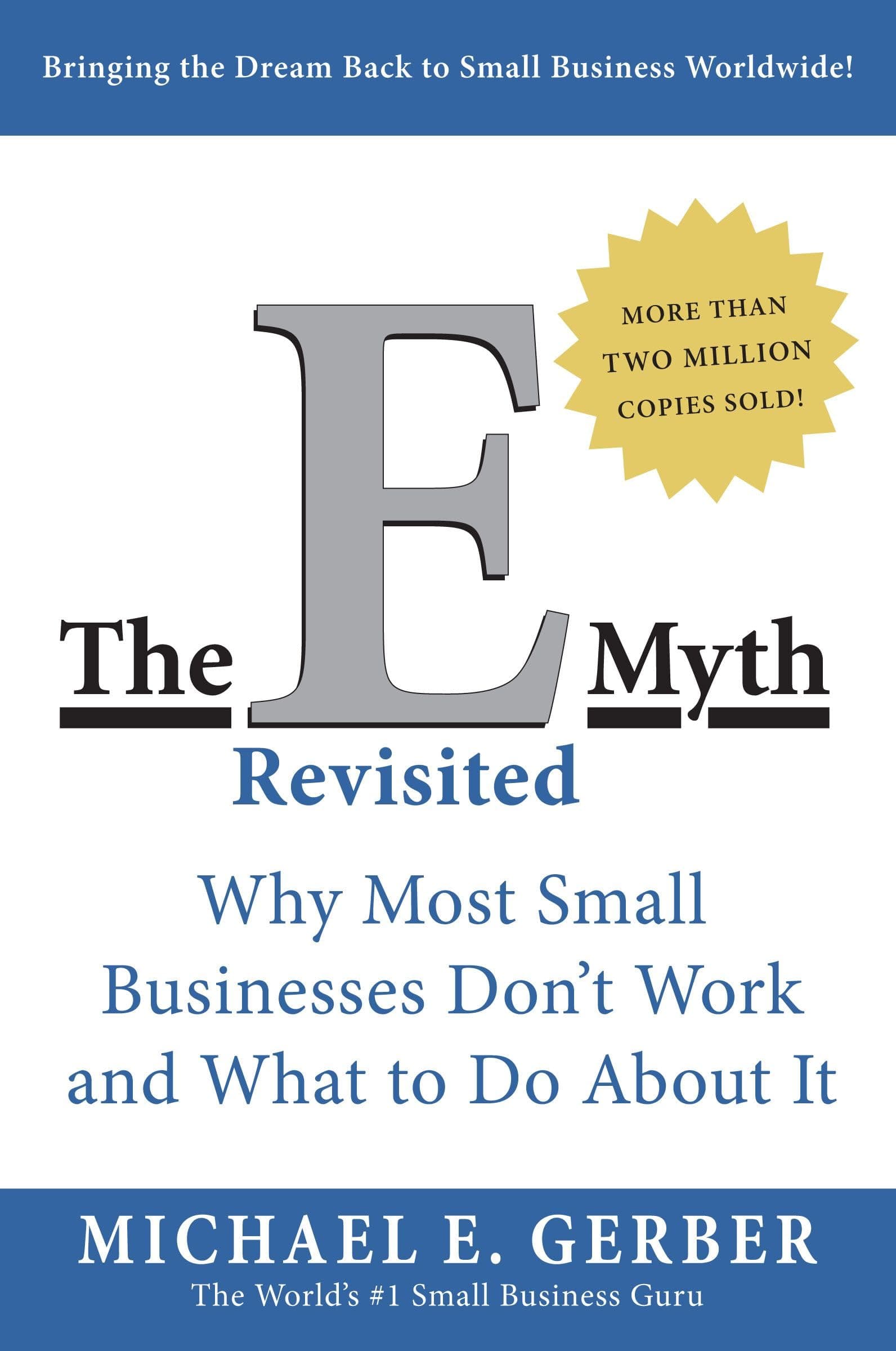



The E-Myth Revisited: Why Most Small Businesses Don't Work and What to Do About It : Gerber, Michael E.: desertcart.ae: Books Review: Great Business Book - The concept has helped me change how i see things to be successful in business. would definitely adopt the lesson learned from this book Review: Cover book is torn - Cover book is torn


| ASIN | 0887307280 |
| Best Sellers Rank | #6,357 in Books ( See Top 100 in Books ) #6 in Work-Life Balance in Business #8 in Business Research & Development #16 in Self-Help for Memory Improvement |
| Customer reviews | 4.7 4.7 out of 5 stars (6,745) |
| Dimensions | 13.49 x 1.65 x 20.32 cm |
| Edition | 3rd revised edition |
| ISBN-10 | 9780887307287 |
| ISBN-13 | 978-0887307287 |
| Item weight | 294 g |
| Language | English |
| Print length | 288 pages |
| Publication date | 29 March 2001 |
| Publisher | Harper Business |
R**O
Great Business Book
The concept has helped me change how i see things to be successful in business. would definitely adopt the lesson learned from this book
I**C
Cover book is torn
Cover book is torn
B**E
This book isn't just a guide to starting a business. It has much more that applies to other aspects of your life.
M**E
On April 8, 1999, I discovered a book that changed the way I view business; a book that helped me to realize that running a successful architecture firm required so much more than designing great architecture. It taught me that inside the owner of every small firm exists a battle among The Entrepreneur, The Manager and The Technician, and that if we don’t attend to the needs of each, our firms are destined for failure. The E-Myth Revisited: Why Most Small Businesses Don’t Work and What to Do About It inspired me to build Fivecat Studio as a Franchise Prototype, even though we knew selling our business systems as a franchise was never a planned goal. The systems we created for the firm have allowed us to thrive and have given us the freedom we need to balance the requirements of our firm with the responsibilities of our family. It is the book that inspired me to begin to work “on my business, rather than in my business.” This book, written by Michael E. Gerber, had a major influence in the success of our firm and continues to guide many of our business decisions to this day. Fivecat Studio has been in business for 15 years. Annmarie and I experienced the startup pains of “infancy”, the hard earned success of “adolescence” and recently, with our return to the home studio and the launch of our new virtual business model, we are surprisingly “getting small again”. As I re-read the words of this inspirational how-to guide for successful small business, it is shocking to me how accurate Mr. Gerber is as he describes the different stages of the typical small business. As I read it, I can follow the path of Fivecat Studio through good decisions and bad, through ups and downs and I can see the next steps we need to take. I’ve read The E-Myth so many times that I have lost count. A quick peek at my Amazon order history documents that I have given this book to no fewer than 10 friends and acquaintances as a gift from one business owner to another, struggling to find a life of fulfillment and freedom. Michael Gerber breaks his book into three sections. In Part I, The E-Myth and the American Small Business, he defines the E-Myth as the Entrepreneurial Myth and discusses how most small businesses are the result of an Entrepreneurial Seizure. He says, “The technician suffering from an Entrepreneurial Seizure takes the work he loves to do and turns it into a job.” Does that sound familiar? How many architects do you know who have launched their own firms, with dreams of “doing it better” than their former employer and found themselves way over their heads in all the responsibilities of running a small business? Gerber describes the three phases of business; Infancy, Adolescence and Maturity. He explains why it is so important to build a Mature company from the start. “A Mature company is founded on a broader perspective, an entrepreneurial perspective, a more intelligent point of view. About building a business that works not because of you but without you. And because it starts that way, it is more likely to continue that way. And therein the true difference between an Adolescent company, where everything is left up to chance, and a Mature company, where there is a vision against which the present is shaped.” “Successful companies don’t end up as Mature companies. They start that way.” In Part II, The Turn-Key Revolution: A New View of Business, Mr. Gerber introduces the concept of the Franchise Prototype and the concept of “working on your business, not in it.” He encourages us to create systems which allow for predictable results and happy clients. “The system runs the business. The people run the system. The system integrates all the elements required to make a business work. It transforms a business into an organism, driven by integrity of its parts, all working in concert toward a realized objective. And, with its Prototype as its progenitor, it works like nothing else before it.” Many architects I know, including Annmarie at first, reject the thought of building systems for their firms. They feel that the routines and consistency of such will limit their creativity, that they will lose their flexibility to create amazing works of architecture. When, in fact, systems will do just the opposite. When everything else required to run a successful business is set to run on “autopilot”, an architect will actually have more time and flexibility to be an architect. Gerber continues, “Great businesses are not built by extraordinary people, but by ordinary people doing extraordinary things. But for ordinary people to do extraordinary things, a system – ‘a way of doing things’ – is absolutely essential in order to compensate for the disparity between the skills your people have and the skills your business needs if it is to produce consistent results.” This is also the section where some readers become frustrated with Gerber’s example of McDonald’s as a model for small business success. I know, as an architect, it is difficult to see the connection between the home of the Big Mac and our aspiring high-end residential design firms. Please trust me and read the book to the end. You will not regret learning the lessons he teaches using the examples of this successful business franchise. Here is some of what Gerber says about McDonald’s; “It delivers exactly what we have come to expect of it every single time. So that’s why I look upon McDonalds as a model for every small business. Because it can do in its more than 14,000 stores what most of can’t do in one! And to me, that’s what integrity is all about. It’s about doing what you say you will do, and, if you can’t, learning how. If that’s the measure of an incredible business – and I believe it is – then there is no more incredible business than McDonalds. Who among us small business owners can say we do things as well?” Part III, Building a Small Business That Works is a step by step, how-to guide for a successful small business. He leads us through a fully developed Business Development Program and describes the many strategies required for small business success. The E-Myth Revisited is not only your answer to building a successful small business, it’s also very entertaining. Gerber structures the information around a narrative about a woman named Sarah struggling with her small business named All About Pies. Many readers will see ourselves in Sarah as she evolves from frustrated Technician into a successful small business owner. When I posted recently that The E-Myth was my favorite business book of all time, many from the Entrepreneur Architect Community reached out and asked me why. In short… If you take action to implement the lessons Michael Gerber teaches, The E-Myth Revisited will take your firm to places you only imagined. I know it will work for you, because it has already worked for me.
G**R
This is a great book for people running small businesses. It shows you how a lot of people start a business after working a full-time job and feeling they could do better by striking out on their own, but then face a lot of unexpected problems unrelated to their craft. It teaches you how to resolve this and how to work on your business instead of in your business, and how every business requires at least three roles, even if you are a solopreneur - the technician, the manager and the entrepreneur. This will not teach you how to manage money, get leads or acquire customers, but I would recommend this book to anyone who needs clarity on how to run their business more efficiently and with less stress, particularly people who are starting or running a business for the first time. It will show you how to properly think about it and give you a guide on the tasks you need to do to optimize it.
T**D
Ce n'est pas parce qu'on crée sa boîte qu'on a forcément l'envergure d'un entrepreneur. C'est même souvent le contraire. Ce livre en explique les raisons et décrit des principes très clairs pour qui veut passer du stade d'artisan ou freelance à celui de manager d'une PME. Si vous avez envie de créer votre petit business parce que vous avez un talent particulier, lisez d'abord ce livre. Si vous avez déjà créé votre petite entreprise et que les journées s'allongent à l'infinie, il est grand temps de lire ce livre. Pour les autres, lisez aussi ce livre car les principes qu'il contient peuvent également être appliqués au sein de grosses entreprises. J'ai lu la version anglaise mais comme je n'arrête pas de le prêter, je me suis racheté la version française.
D**E
A must in any entrepreneur or anybody who is looking to start a business.