We remain fully operational. Our teams are working around the clock to ensure your deliveries continue safely.

下载应用程序


🏌️♀️ Swing into Success with Every Shot!
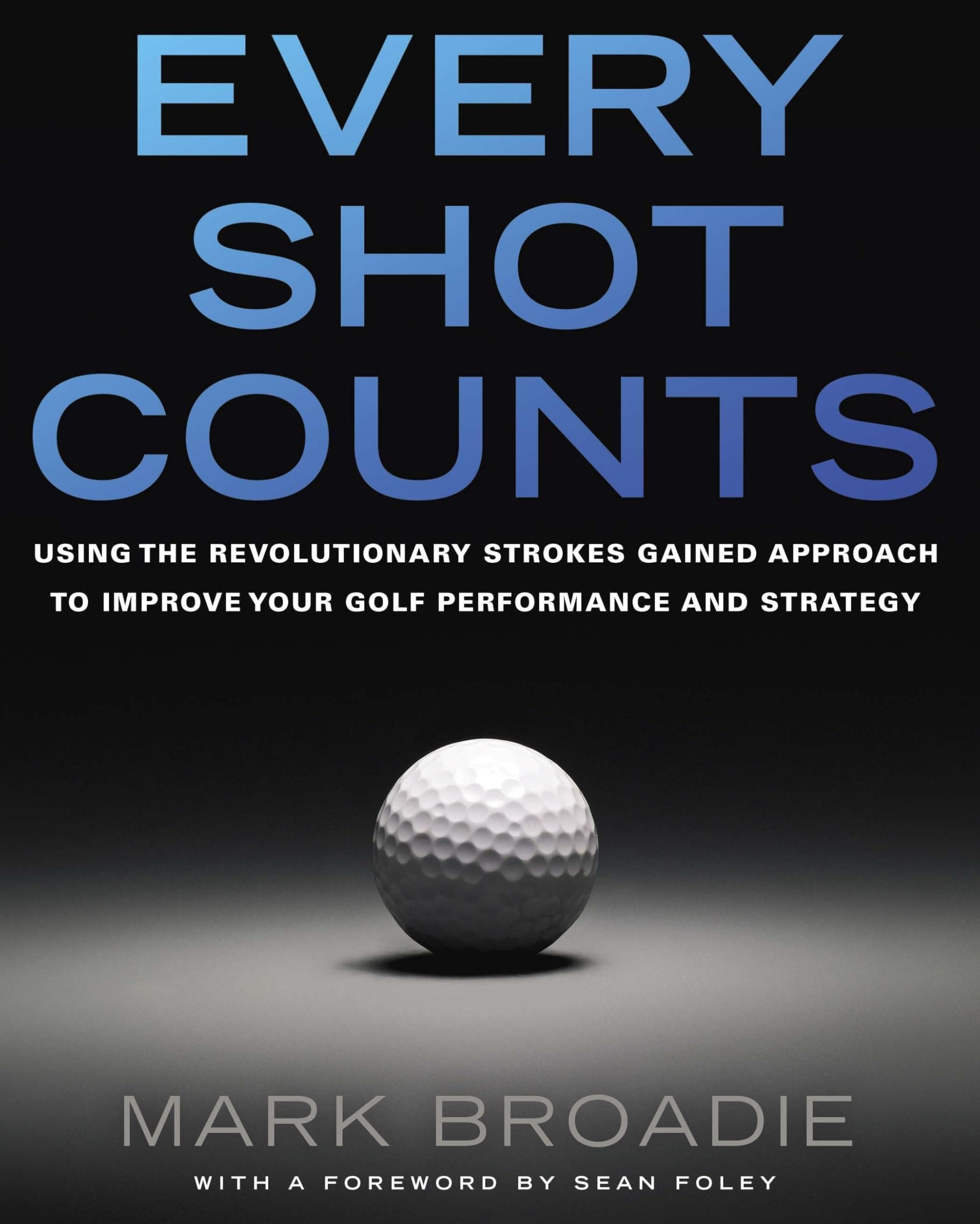
Every Shot Counts introduces the innovative strokes gained approach, providing golfers with actionable insights and strategies to improve their performance on the course. This book is essential for anyone looking to enhance their game through data-driven analysis and strategic thinking.
| ASIN | 1592407501 |
| Best Sellers Rank | #20,682 in Books ( See Top 100 in Books ) #9 in Golf (Books) #10 in Sports Encyclopedias #11 in Sports Reference (Books) |
| Customer Reviews | 4.5 4.5 out of 5 stars (1,369) |
| Dimensions | 7.63 x 0.88 x 9.41 inches |
| Edition | Illustrated |
| ISBN-10 | 9781592407507 |
| ISBN-13 | 978-1592407507 |
| Item Weight | 1.65 pounds |
| Language | English |
| Print length | 288 pages |
| Publication date | March 6, 2014 |
| Publisher | Avery |
W**A
A Landmark Achievement in the Study of Golf
Mr. Broadie has combined sophisticated data analysis with the PGA's state-of-the-art shot tracking database (Shotlink) to finally solve nearly all the age-old dilemmas in golf. It is a fascinating work, and heralds a new era in golf statistics, analytics, and ramifications to strategy. Without either (the analysis) and the data (shotlink) these truths would have continued to be hidden. What kind of mysteries are being solved here? Only all the important ones, like: *Why traditional golf statistics (GIR, driving distance average, Fairways-in-Regulation) can't rank players or predict winners. *Why calculating "averages" is incomplete at best. *What's more important, driving or putting? *How should we reconcile counting stokes (per hole), vs. inches (putts), vs. yards (drives) *What should you practice? *Where should you aim? *Why are the best players in the world the best? When Mr. Broadie matches the data to his formulas, the names that rise to the top are the who's-who of golf: Woods, Els, Donald, Lefty, Rory, and the rest. There's a reason these guys are all household names and it is NOT their GIR, FIR, or Average Drive. The "Shots Gained" statistic explains it all, for every shot, drives, approach, even pitches and putts. The entire game is laid bare, finally. I would not doubt that Mr. Broadie already has a sequel in the works (he should!) because the contents of this book could be applied to much deeper golf questions. This edition had to get all the easy targets out of the way, but they are whoppers. I can now see how every other golf book in history has fallen short. Nobody has had shot data like this in the history of golf, along with the skills to properly analyze it. It is not an exaggeration to say that 95% of golf books are now obsolete -- and now factually proven wrong. Right now it is spring, and my email box is full of ads and promotions that read (actual quotes: "How to Score Low! Did you know the pro's average 290 yards... blah blah" and "... master the short game with our wedges! ... drop the score on your scorecard!) ... I can now see the holes in these statistics (even the real ones) from a mile away. I know what to practice now, and it isn't 30-yard pitch shots and 30-foot putts anymore! ** Criticisms ** Very, very few. Almost all the information in this book is illuminating for golfers of all skill levels. Mr. Broadie takes extra pains to make his statistics relevant to 80, 90, and 100-golfers. I found the chapter on putting to be a bit tedious, for not much new insight. Many putting methods have covered these topics in detail over the years, and while Mr. Broadie's statistics confirm many of the truisms, they don't really add a lot of new insight. Those who haven't put in much study in the putting arena might find it helpful though. I found it quite comparable to the AimPoint school of putting technique, but without the specificity of the AimPoint charts (which is also used in PGA broadcasts to reveal putting lines, and is heavily physics based). I definitely wanted more strategic analysis on game-type situations (fodder for the sequel, perhaps!). A fascinating study on how to play holes with OB on one side is very useful. I wanted to see strategies for going to tight pins, long par 3s or short par 3's, fairway bunkers, and similar. Like I said, there is still plenty of room for a sequel. I don't often gush about products or books, but honestly I have read a lot of golf books, hang out on golf forums, and read all the magazines. This is the best golf book I have ever read. No joke.
S**N
Shots Gained Putting (and other parts of the game): Every Shot Counts
Really a cool book! I'm a statistician by trade and had wondered what this "Strokes Gained Putting" stat was that was constantly being referred to on the TV broadcasts. The book makes it clear and also explains the other elements of the game (driving, approaches, short game) and the stats created for them. i suspect that the TV guys don't use them because it isn't simple to understand (either they don't know how to explain it or are afraid that their audience would be confused if they tried). The content in this book has forced me to look at what parts of my game need work, shown me how to improve those and enlightened me on this new stat. For those of you that are statistically inclined, the author has used pretty sophisticated statistics to develop the stats and has rigorously verified the results. I especially like the components of variation theme used to describe a round of golf (the author uses Dynamic Programming in lieu of COV).
B**.
good stats
This is an interesting and accurate explanation of the newer, more useful and accurate golf statistics, versus the less accurate one that have long been in use on the PGA Tour. SInce all of the information comes from PGA tour play, the use of the statistics is perhaps not as meaningful to amateur golfers, who are not so accurate or long as the pros. The reader must make these interpretations for himself, though the authors do touch on it. The main point is that all shots are nearly evenly important, putting no more than others. I enjoyed it, its a quick read, and I learned some interesting ways to think about golf strategy, which shots are most important, and how to assess the success of shots.
M**M
Must read!
This book is an absolute must read for any serious golfer looking to understand the game better, and improve. While it does not give you any tips about how to swing the golf club, it definitely gives you a wealth of information about what goes into lowering your score on the golf course. In addition, some of the short game and putting statistics were eye-opening. As an avid devotee of data driven thinking, and an Arccos user, reading this book and the Four foundations of Golf really brought it all together for me, helping me drop about 10 strokes in my index over 4 years.
E**X
Scientific approach to golf
Because the PGA measures EVERY shot in EVERY tournament by EVERY pro, there is a data base of many millions of shots. Mark Broadie takes advantage of this data to analyzing each type of shot, from the tee, from the fairway, from bunkers, and on the green. He created the now universally used concept of "shots gained." We amateurs can use this information to focus on the parts of our game that will yield the greatest score improvements. I love data, so I've absorbed nearly every chapter of this book. And I love playing golf, so each round is a chance to think about ways to improve each aspect of my game. For example: In putting, I try to end the put in the hole of course, but if I miss, I want to be just beyond the hole on the high side of the break (most amateurs are short and low). I want to aim my drives away from the worst hazards and not always down the middle of the fairway. So using the concept of "What you measure you can manage," I now measure the hole score, plus putts, plus GIR+1 (for me, much more satisfying than GIR, or Greens in Regulation), Fairways hit, and bad shots. Just by thinking about these few variables, I've been able to lower my index by five strokes.
V**R
Read This If You Play Golf
Best golf book because it's scientifically based.
A**.
La dimostrazione - basata su dati reali - di quanto possano incidere putt o driving distance sui risultati di pro e amatori. A dispetto di tante "leggende metropolitane". Il testo si basa su simulazioni e analisi dei dati molto complesse e, per quanto l'autore si sforzi di rendere le spiegazioni le più semplici possibili, alcune statistiche vengono fornite senza particolari spiegazioni (e.g. il concetto di "mediana" è fondamentale nell'intero testo). Suggerito a chi abbia un minimo di conoscenza pregressa di fondamenti di statistica.
G**S
Puts everything into perspective and I found myself immediately thinking more strategically on the course. Can recommend to anyone that wants to get better at golf.
T**L
En av de viktigaste golfböckerna som skrivits
A**R
This book explains how to evaluate your shots with a method that makes sense and is based on dynamic programming, a well known technique specially adapted to sequential problems such as the game of golf (familiarity with dynamic programming is not necessary to understand or apply the ideas in the book). It is difficult to improve in any sport without feedback. But in golf the traditional measures of the quality of different aspects of your playing are not precise enough. Take, for example, the number of putts in a round, tradionally measuring how good a putter you are. But a below average number of putts in a round does not necessarily mean that you putted better than average. It could be instead that your shots to the green landed closer to the flag than average, that is, that your putts were easier than average. This book tells you how to properly measure the quality of your playing in either putting, driving, approach, or any other type of shot, which is just an essential feedback that may allow you to better plan your practice, and to lower your scores.
J**H
The author, Mark Broadie, as well as being a keen golfer playing off a handicap of 4 is also Professor of Business at Columbia Business School. He developed the 'Shots Gained' system as utilised by the PGA Tour and television. Broadie has taken the raw data of 4 million golf shots, recorded by the Shotlink system, on the PGA Tour between 2003 and 2012. Shotlink, if you're not familiar with it, records every shot played on the PGA Tour to an accuracy of 1 yard on the fairway and 1 inch on the green. In addition Broadie employed an army of over 200 amateur golfers, of all abilities and ages, and had them record over 100K shots from their own games over a couple of years using the Golfmetrics system that he devised. This data, when analysed has produced some truly surprising results. Broadie, with mathematical modelling, can essentially predict with accuracy (to 2 decimal places) how many shots a golfer of any stated ability will likely take on average to hole out from any given distance, from the fairway, the rough or a hazard. There is a lot of detail in this book and also a lot of statistics, tables and graphics too. However the book is well written and would not overwhelm a reasonably numerate golfer. The book won't necessarily appeal to all golfers but if like me you are a keen scholar of the game and like to really understand which parts of the the game make the difference to your score then this is most definitely the book for you. Some of the findings are truly astounding, particularly with reference to the standard 'received wisdom'. For example it turns out that putting, although an essential skill to score, explains relatively little of the difference between a touring pro golfer and a golfer who say usually takes about 90 shots in a round of golf. The difference is only about 4 shots. A pro golfer takes an average of 29 putts per round and a 90-golfer takes an average of 33.4 putts per round. However this difference is slightly overstated because the amateur golfer will on average be taking his first putt from slightly further from the hole. The truth is that golfers of all standards tend to make most of their short putts (3ft or less) and all golfers miss most of their long putts (say 9ft and longer). If an '80-golfer' were to play a round in the company of Tiger Woods and have Tiger take all his putts for him, he would on average save about 2.2 shots per round. However, if the same 80-golfer had Tiger take all his shots of more than 100 yards from the pin, he would likely save an average of 9.3 shots per round. If you want to know what you should be practicing to lower your score then this book will help ... a lot. I believe this book (and the shots-gained system it describes) is a breakthrough in understanding the game of golf and which skills actually make the most difference to scoring. For the point of analysis the skills of golf are broken into 4 areas, namely driving, approach, short and putting. Shots gained or lost, compared to the field, are analysed for each of these skills. During the period covered by the data Tiger Woods was the best golfer in the world (no surprise) and on average gained almost one shot against-the-field per round played. As you might expect, he was well above average on all 4 skills, however he was exceptionally talented in one particular type of shot. The shots gained in that skill alone contributed 46% to his total shots gained __ almost as much as the other 3 skills put together. If you asked golfers which skill made the greatest difference to Tiger's scoring against the field then I'm sure that most would guess incorrectly. You'll need to read the book to find out. At the time of writing this book is not available on Kindle (although I believe it is on Amazon.com). Personally I'm glad I bought the hard copy of the book as it is very much the sort of book that you'll be flicking back and forth between chapters. With all the colour tables and graphics I'm not sure that it would work quite as well in Kindle format, unless viewed on an iPad or similar. This book will literally change the way you think about golf, how you will practice and, hopefully, how you will play. Highly recommended.