We remain fully operational. Our teams are working around the clock to ensure your deliveries continue safely.

下载应用程序


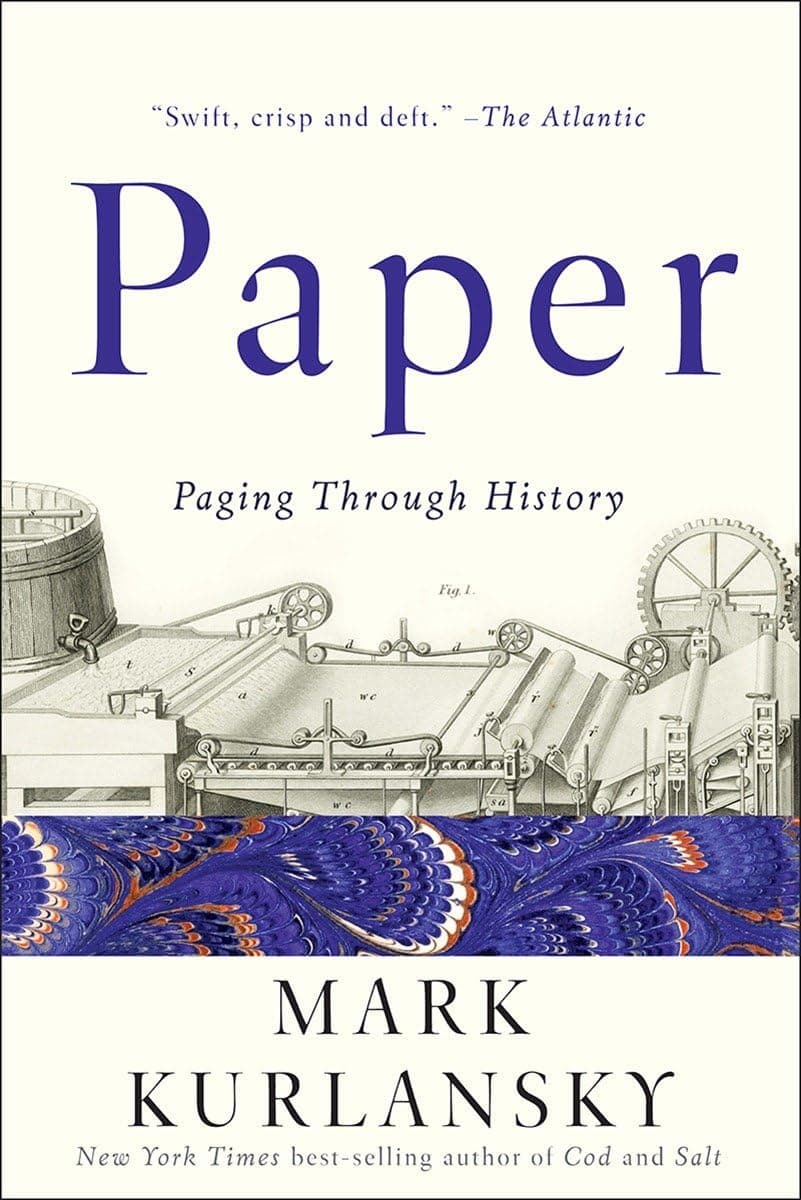
Paper: Paging Through History [Kurlansky, Mark] on desertcart.com. *FREE* shipping on qualifying offers. Paper: Paging Through History Review: Another Magnificent Micro History (not Eurocentric) by Kurlansky with Great Audible Version - I am a huge Mark Kurlansky fan and he should be given the title of King of the micro-history. If you have read and enjoyed his previous books on SALT and COD this will not disappoint. As with his previous books, Kurlansky is not concentrating solely on Eurocentric history. Using paper as a he takes you on a tour of all history from pre-history, to the ancient civilizations like Egypt, the Mayans and into the other Empires, Middle Ages and on to the present. While Paper is the topic, it is a springboard to the history of expression, language, record keeping, and history itself. Kurlansky takes you on a bigger picture history tale that covers Cave writings, marks on sticks, papyrus, bricks, the Library of Alexandria, books, spread and development of language and writing, alphabets and on to modern communication. There is never a dull moment. The book flows wonderfully and the material is covered in just the right amounts. I did occasionally find myself stopping and going off on a wikipedia tangent to find out more information on various topics. This book will appeal to everyone from the armchair historian, history students and even academics. Nothing is "dumbed down" but everything is explained such that a lay person would find it understandable. The audible version is truly fantastic. The narrator, Andrew Garmon has no discernible accent. He has read a number of historical works and is spot-on in pronunciation and tempo. The narrator fits the book well. As much as I like the audible version, I think it is best when purchased together with the book for reference. Review: Good read - This was a good read but i liked Kurlansky's other books Salt, Salmon and especially Cod better than this book.
| Best Sellers Rank | #210,436 in Books ( See Top 100 in Books ) #20 in History of Engineering & Technology #37 in History of Technology #69 in Communication & Media Studies |
| Customer Reviews | 4.4 4.4 out of 5 stars (695) |
| Dimensions | 5.5 x 1.2 x 8.3 inches |
| Edition | Reprint |
| ISBN-10 | 0393353702 |
| ISBN-13 | 978-0393353709 |
| Item Weight | 12.8 ounces |
| Language | English |
| Print length | 416 pages |
| Publication date | May 23, 2017 |
| Publisher | W. W. Norton & Company |
J**R
Another Magnificent Micro History (not Eurocentric) by Kurlansky with Great Audible Version
I am a huge Mark Kurlansky fan and he should be given the title of King of the micro-history. If you have read and enjoyed his previous books on SALT and COD this will not disappoint. As with his previous books, Kurlansky is not concentrating solely on Eurocentric history. Using paper as a he takes you on a tour of all history from pre-history, to the ancient civilizations like Egypt, the Mayans and into the other Empires, Middle Ages and on to the present. While Paper is the topic, it is a springboard to the history of expression, language, record keeping, and history itself. Kurlansky takes you on a bigger picture history tale that covers Cave writings, marks on sticks, papyrus, bricks, the Library of Alexandria, books, spread and development of language and writing, alphabets and on to modern communication. There is never a dull moment. The book flows wonderfully and the material is covered in just the right amounts. I did occasionally find myself stopping and going off on a wikipedia tangent to find out more information on various topics. This book will appeal to everyone from the armchair historian, history students and even academics. Nothing is "dumbed down" but everything is explained such that a lay person would find it understandable. The audible version is truly fantastic. The narrator, Andrew Garmon has no discernible accent. He has read a number of historical works and is spot-on in pronunciation and tempo. The narrator fits the book well. As much as I like the audible version, I think it is best when purchased together with the book for reference.
L**E
Good read
This was a good read but i liked Kurlansky's other books Salt, Salmon and especially Cod better than this book.
D**T
If You Can Read This, Thank Paper
Its invention lost in the mists of time, the humble sheet of paper was once a groundbreaking, world-changing technology. We aren't accustomed to thinking of paper as "high-tech," and yet its use was once a peerless indicator of civilization. Paper lies at the root of record-keeping, and that is the *sine qua non* for complex societies. Mark Kurlansky has superlative talent for presenting history in context, not only of its own time, but how the times and cultures he describe support what came later, what we use today. That expanded context makes a basic technology—making and using paper—come alive as a sophisticated invention. Before paper, and usually long after it, parchment was the quick medium for records. Think about that, Kurlansky bids us—to make a record, we needed only to wait until the animal whose skin we want to use is full grown, has been butchered and skinned, and has had its hide tanned, scraped thin, and bleached. No wonder records were routinely erased from parchment to provide a palimpsest for new writings. Of course, there were older modes of writing, in mediums like fired clay and stone. But until the advent of paper, nothing could be recorded lightly, spur-of-the-moment. No jottings, no idle doodles. No revisable blueprints or scratch engineering diagrams. Gutenberg's invention waited on a disposable medium, and literacy, the expectation that everyone would be able to read and write and freely trade ideas, waited on Gutenberg. As I read, I learned about an invention that had been created over and over, wherever human society advanced far enough to require it. "Real" paper composed of pressed, matted, randomly-oriented plant fibers has had its substitutes: tree bark, crushed and rolled to make it pliable; long stems of papyrus or young bamboo, split and opened to provide a strip of writing surface; silk fabric; thin plates of slate or metal; whole leaves; slats or thin shingles of wood. All were used, along with parchment and stone; but nowhere did reading and writing become part of everyday life until paper was widely available. "If you can read this, thank a teacher," reads a popular bumper sticker. No, this book argues, if you can read it, thank Gutenberg. And for Gutenberg, thank the invention of paper.
N**R
Kurlansky nailed it again
Always enjoy his books. Started with Salt A true researcher with talent for words. I reread his sometimes. Highly recommend
S**Y
I was a tad bit sceptical after reading the reviews, but what the heck? I loved it :)
J**A
Uma ótima visão sobre a história do papel
N**K
Still reading at the moment but, like his other books, very interesting and informative.
D**I
Great read! Love this author.
J**T
Not as easy a read as "Cod" or "Salt", but an informative read nonetheless.