We remain fully operational. Our teams are working around the clock to ensure your deliveries continue safely.

下载应用程序


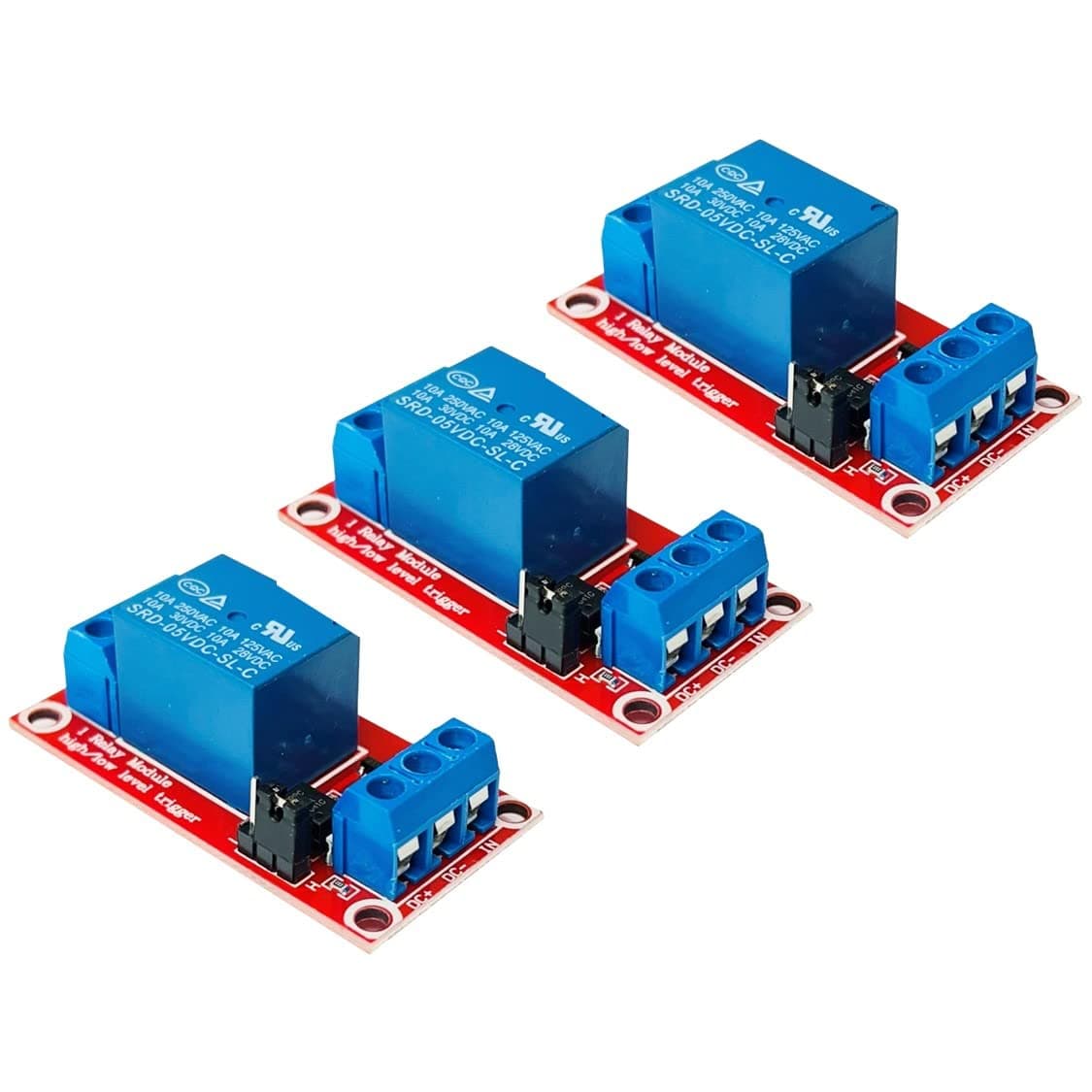
🔌 Empower your smart projects with precision switching—because control is everything.
This 3-piece 5V single-channel relay module set is compatible with Arduino, ESP32, ESP8266, Raspberry Pi, and other 3.3V-5V microcontrollers. Featuring selectable high/low-level triggers, optocoupler isolation for enhanced safety, and terminal blocks for secure wiring, it supports up to 10A load at AC 250V or DC 30V. Dual LED indicators provide real-time status, making it an essential, reliable component for professional-grade IoT and automation projects.
| ASIN | B0B1ZHXXXD |
| Best Sellers Rank | #92,960 in Computers ( See Top 100 in Computers ) #1,433 in Single-Board Computers |
| Item model number | DIY-RELAY-3-5V-1C-LH |
| Manufacturer | DIYables |
| Product Dimensions | 5 x 2.6 x 1.85 cm; 59 g |
J**F
Nice relay set for switching. Easy to set-up and give you plenty of options. Has a single common wire with a NO and NC connection. The relay will switch when the 5v DC input signal goes high. Be careful to observe what voltages your CPU works on. This is a 5V device, some CPUs are 3.3V and don't work well with this product. I'm using these to change the 5v signal of the CPU output and turn on a 24v solenoid valve. These work great.
J**J
Another part for my esp32 projects. I used this to control a little door strike from esp32 via home assistant. Once you understand how to wire for open and not open options, with common, it's not too tricky and works well. I liked I got 3 incase i messed up one, or needed multiple relaying. The terminals that screw down are a plus for quick connecting and disconnecting
K**E
I used these to create a tally system for Sony camera control units and a Tricaster TC-1. Worked great. Kept me from having to build the entire circuit.
G**H
Seem to work fine, but be careful if you are planning to mount them. The holes in the corners of the boards are too close to the terminals for any screw I have been able to find to fit properly. Currently they are just hanging loosely from 1 screw. Might end up clipping the corners off the boards to allow the screws just a little more room for mounting.
A**Y
These supposely contain a flyback diode on the board. However, my Arduino was sometimes resetting after switching the relays off (which control some solenoids). I had to install my own own flyback diode and everything is working well. That might be unique to my situation.
TrustPilot
2 周前
1天前