We remain fully operational. Our teams are working around the clock to ensure your deliveries continue safely.

下载应用程序


Buy anything from 5,000+ international stores. One checkout price. No surprise fees. Join 2M+ shoppers on Desertcart.
Desertcart purchases this item on your behalf and handles shipping, customs, and support to Taiwan.
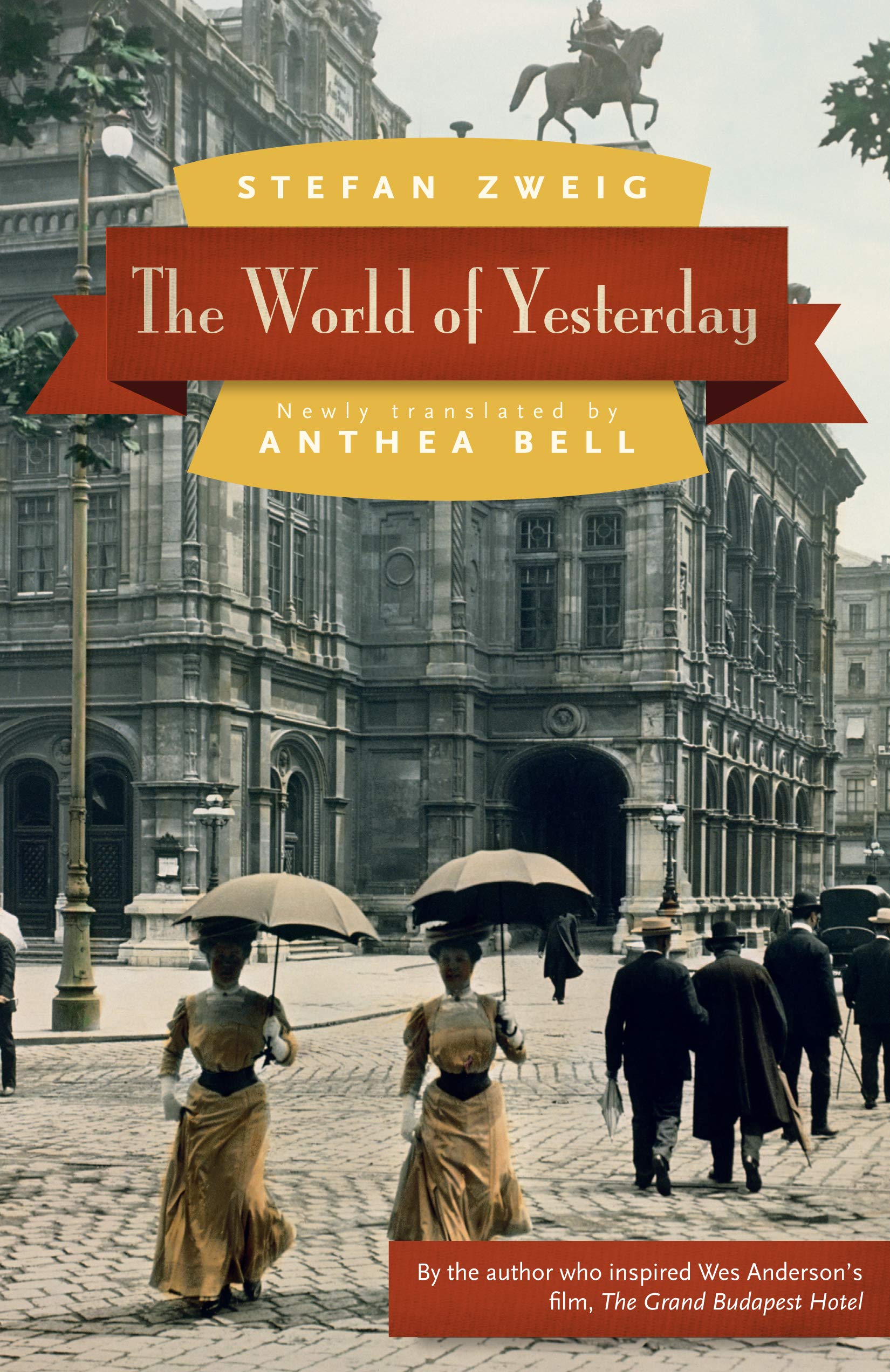
The World of Yesterday [Zweig, Stefan, Bell, Anthea] on desertcart.com. *FREE* shipping on qualifying offers. The World of Yesterday Review: Thank you, Herr Zweig! - This is a wonderful, heartbreaking memoir of, first, Vienna before WWI from the viewpoint of a child; then all of literary Europe between the two world wars from the viewpoint of an increasingly successful writer, and finally of a stateless man in England, witnessing the irrepressible forces of the second world war about to overtake everything. During his adulthood, he also visited Russia, India, Argentina, Brazil, and the US, all largely for literary purposes. Two parts I thought were a bit unintentionally funny: early on he goes on at length about how healthy it was for the sexes to have more freedom to commingle, and he states that when young men and women were kept so separate, and sex was so forbidden outside of marriage, pornography was a terrible problem, debasing both sexes. Well, I'm afraid that the increased commingling of the sexes didn't exactly reduce that particular problem... And again, there was a part where he really goes on and on talking about how one of the main reasons his writing was so successful was that he loved to edit out unnecessary or redundant parts of his initial drafts. But that very section of his book is incredibly repetitive! :) And indeed, several sections are -- as if he couldn't resist coming up with yet one more way of saying the exact same thing. However - I wouldn't let this stop anyone from reading the book. It's delightfully written, and it's about such an important period of time in European history. He had intellectual/literary relationships with many important people, from Strauss to Freud, and if for those recollections alone, the memoir is quite valuable. Review: ‘All the livid steeds of the Apocalypse have stormed through my life –revolution and famine, inflation and terror, epidemics’ - Zweig was one of the most popular writers in the world in the 20’s and 30’s (in multiple languages). After reading this work, I can understand why. I just wish I had found him in my youth! “Before the war I knew the highest degree and form of individual freedom, and later its lowest level in hundreds of years; I have been celebrated and despised, free and unfree, rich and poor. All the livid steeds of the Apocalypse have stormed through my life –revolution and famine, inflation and terror, epidemics and emigration.’’ What does Zweig see as the worst poison? “I have seen the great mass ideologies grow and spread before my eyes –Fascism in Italy, National Socialism in Germany, Bolshevism in Russia, and above all else that arch-plague nationalism which has poisoned the flower of our European culture.’’ This polemic against ‘that arch-plague nationalism’ runs throughout. He spends time and effort presenting the overwhelming impact of this new ‘arch-plague’. “To give witness of this tense, dramatic life of ours, filled with the unexpected, seems to me a duty; for, I repeat, everyone was a witness of this gigantic transformation, everyone was forced to be a witness.’’ Zweig pleads with the reader to accept his ‘witness’ of the ‘gigantic transformation’. What was the change? “In its liberal idealism, the nineteenth century was honestly convinced that it was on the straight and unfailing path toward being the best of all worlds. Earlier eras, with their wars, famines, and revolts, were deprecated as times when mankind was still immature and unenlightened. But now it was merely a matter of decades until the last vestige of evil and violence would finally be conquered, and this faith in an uninterrupted and irresistible “progress” truly had the force of a religion for that generation.’’ ‘Faith in irresistible progress’ was a religion! “One began to believe more in this “progress” than in the Bible, and its gospel appeared ultimate because of the daily new wonders of science and technology. In fact, at the end of this peaceful century, a general advance became more marked, more rapid, more varied. At night the dim street lights of former times were replaced by electric lights, the shops spread their tempting glow from the main streets out to the city limits. Thanks to the telephone one could talk at a distance from person to person. People moved about in horseless carriages with a new rapidity.’’ This new faith produced daily miracles! Who wouldn’t believe this more than the Bible? But . . . What happened? “A certain shadow has never quite disappeared from Europe’s once so bright horizon. Bitterness and distrust of nation for nation and people for people remained like an insidious poison in its maimed body.’’ “In spite of the social and technical progress of this quarter of a century between world war and world war, there is not a single nation in our small world of the West that has not lost immeasurably much of its joie de vivre and its carefree existence. It would take days to describe how confiding, how childishly joyous the Italian people once were, even in the depth of poverty, how they laughed and sang in their trattorie, how wittily they derided the bad government and now they march sullenly with their chins thrust forward and wrath in their hearts. Can one still imagine an Austria so lax and loose in its joviality, so piously confiding in its Imperial master and in the God who made life so comfortable for them?’’ “The Russians, the Germans, the Spaniards, not one of them can remember how much freedom and joy the soulless, voracious bogy of the “State” has sucked from the very marrow of their soul. All peoples feel only that a strange shadow hangs broad and heavy over their lives. But we, who once knew a world of individual freedom, know and can give testimony that Europe once, without a care, enjoyed its kaleidoscopic play of color. And we shudder when we think how overcast, overshadowed, enslaved and enchained our world has become because of its suicidal fury.’’ Wow! No wonder Zweig is abandoned, in this world that lives and dies for (worships) nationalism! I ~ The World of Security II ~ School in the Last Century III ~ Eros Matutinus IV ~ Universitas Vitae V ~ Paris, the City of Eternal Youth VI ~ Bypaths on the Way to Myself VII ~ Beyond Europe VIII ~ Light and Shadow over Europe IX ~ The First Hours of the War of 1914 X ~ The Struggle for Intellectual Brotherhood XI ~ In the Heart of Europe XII ~ Homecoming to Austria XIII ~ Into the World Again XIV ~ Sunset XV ~ Incipit Hitler XVI ~ The Agony of Peace Returning to Austria after the war . . . “Children as young as eleven or twelve went off in organized Wandervögel troops which were well instructed in matters of sex, and traveled about the country as far as Italy and the North Sea. Following the Russian pattern “pupils’ councils” were set up in the schools and these supervised the teachers and upset the curriculum, for it was the intention as well as their will to study only what pleased them.’’ ‘Supervised the teachers’! “They revolted against every legitimated form for the mere pleasure of revolting, even against the order of nature, against the eternal polarity of the sexes. The girls adopted “boyish bobs” so that they were indistinguishable from boys; the young men for their part shaved in an effort to seem girlish; homosexuality and lesbianism became the fashion, not from an inner instinct but by way of protest against the traditional and normal expressions of love.’’ “The general impulse to radical and revolutionary excess manifested itself in art, too, of course. The new painting declared all that Rembrandt, Holbein, and Velasquez had created as finished and done for, and set off on the most fantastic cubistic and surrealistic experiments. The comprehensible element in everything was proscribed, melody in music, resemblance in portraits, intelligibility in language.’’ In the 20’s? Here we are hundred years later and now it describes whole world, not just Austria! Zweig writes in the manner of the nineteenth century German academic. Dense, detailed, filled with metaphors and literary allusions. Not philosophically obscure, nevertheless requires serious concentration and thought. On the other hand, reader can unearth treasures that shallow digging would miss. Compelling! (See also: “1917: Lenin, Wilson, and the Birth of the New World Disorder’’ by Arthur Herman. New book that complements Zweig’s insights.)
| Best Sellers Rank | #30,096 in Books ( See Top 100 in Books ) #60 in Author Biographies #94 in Historical European Biographies (Books) #623 in Memoirs (Books) |
| Customer Reviews | 4.6 4.6 out of 5 stars (1,814) |
| Dimensions | 5.5 x 1.25 x 8.5 inches |
| Edition | Reprint |
| ISBN-10 | 0803226616 |
| ISBN-13 | 978-0803226616 |
| Item Weight | 1.24 pounds |
| Language | English |
| Print length | 472 pages |
| Publication date | May 1, 2013 |
| Publisher | University of Nebraska Press |
B**E
Thank you, Herr Zweig!
This is a wonderful, heartbreaking memoir of, first, Vienna before WWI from the viewpoint of a child; then all of literary Europe between the two world wars from the viewpoint of an increasingly successful writer, and finally of a stateless man in England, witnessing the irrepressible forces of the second world war about to overtake everything. During his adulthood, he also visited Russia, India, Argentina, Brazil, and the US, all largely for literary purposes. Two parts I thought were a bit unintentionally funny: early on he goes on at length about how healthy it was for the sexes to have more freedom to commingle, and he states that when young men and women were kept so separate, and sex was so forbidden outside of marriage, pornography was a terrible problem, debasing both sexes. Well, I'm afraid that the increased commingling of the sexes didn't exactly reduce that particular problem... And again, there was a part where he really goes on and on talking about how one of the main reasons his writing was so successful was that he loved to edit out unnecessary or redundant parts of his initial drafts. But that very section of his book is incredibly repetitive! :) And indeed, several sections are -- as if he couldn't resist coming up with yet one more way of saying the exact same thing. However - I wouldn't let this stop anyone from reading the book. It's delightfully written, and it's about such an important period of time in European history. He had intellectual/literary relationships with many important people, from Strauss to Freud, and if for those recollections alone, the memoir is quite valuable.
C**R
‘All the livid steeds of the Apocalypse have stormed through my life –revolution and famine, inflation and terror, epidemics’
Zweig was one of the most popular writers in the world in the 20’s and 30’s (in multiple languages). After reading this work, I can understand why. I just wish I had found him in my youth! “Before the war I knew the highest degree and form of individual freedom, and later its lowest level in hundreds of years; I have been celebrated and despised, free and unfree, rich and poor. All the livid steeds of the Apocalypse have stormed through my life –revolution and famine, inflation and terror, epidemics and emigration.’’ What does Zweig see as the worst poison? “I have seen the great mass ideologies grow and spread before my eyes –Fascism in Italy, National Socialism in Germany, Bolshevism in Russia, and above all else that arch-plague nationalism which has poisoned the flower of our European culture.’’ This polemic against ‘that arch-plague nationalism’ runs throughout. He spends time and effort presenting the overwhelming impact of this new ‘arch-plague’. “To give witness of this tense, dramatic life of ours, filled with the unexpected, seems to me a duty; for, I repeat, everyone was a witness of this gigantic transformation, everyone was forced to be a witness.’’ Zweig pleads with the reader to accept his ‘witness’ of the ‘gigantic transformation’. What was the change? “In its liberal idealism, the nineteenth century was honestly convinced that it was on the straight and unfailing path toward being the best of all worlds. Earlier eras, with their wars, famines, and revolts, were deprecated as times when mankind was still immature and unenlightened. But now it was merely a matter of decades until the last vestige of evil and violence would finally be conquered, and this faith in an uninterrupted and irresistible “progress” truly had the force of a religion for that generation.’’ ‘Faith in irresistible progress’ was a religion! “One began to believe more in this “progress” than in the Bible, and its gospel appeared ultimate because of the daily new wonders of science and technology. In fact, at the end of this peaceful century, a general advance became more marked, more rapid, more varied. At night the dim street lights of former times were replaced by electric lights, the shops spread their tempting glow from the main streets out to the city limits. Thanks to the telephone one could talk at a distance from person to person. People moved about in horseless carriages with a new rapidity.’’ This new faith produced daily miracles! Who wouldn’t believe this more than the Bible? But . . . What happened? “A certain shadow has never quite disappeared from Europe’s once so bright horizon. Bitterness and distrust of nation for nation and people for people remained like an insidious poison in its maimed body.’’ “In spite of the social and technical progress of this quarter of a century between world war and world war, there is not a single nation in our small world of the West that has not lost immeasurably much of its joie de vivre and its carefree existence. It would take days to describe how confiding, how childishly joyous the Italian people once were, even in the depth of poverty, how they laughed and sang in their trattorie, how wittily they derided the bad government and now they march sullenly with their chins thrust forward and wrath in their hearts. Can one still imagine an Austria so lax and loose in its joviality, so piously confiding in its Imperial master and in the God who made life so comfortable for them?’’ “The Russians, the Germans, the Spaniards, not one of them can remember how much freedom and joy the soulless, voracious bogy of the “State” has sucked from the very marrow of their soul. All peoples feel only that a strange shadow hangs broad and heavy over their lives. But we, who once knew a world of individual freedom, know and can give testimony that Europe once, without a care, enjoyed its kaleidoscopic play of color. And we shudder when we think how overcast, overshadowed, enslaved and enchained our world has become because of its suicidal fury.’’ Wow! No wonder Zweig is abandoned, in this world that lives and dies for (worships) nationalism! I ~ The World of Security II ~ School in the Last Century III ~ Eros Matutinus IV ~ Universitas Vitae V ~ Paris, the City of Eternal Youth VI ~ Bypaths on the Way to Myself VII ~ Beyond Europe VIII ~ Light and Shadow over Europe IX ~ The First Hours of the War of 1914 X ~ The Struggle for Intellectual Brotherhood XI ~ In the Heart of Europe XII ~ Homecoming to Austria XIII ~ Into the World Again XIV ~ Sunset XV ~ Incipit Hitler XVI ~ The Agony of Peace Returning to Austria after the war . . . “Children as young as eleven or twelve went off in organized Wandervögel troops which were well instructed in matters of sex, and traveled about the country as far as Italy and the North Sea. Following the Russian pattern “pupils’ councils” were set up in the schools and these supervised the teachers and upset the curriculum, for it was the intention as well as their will to study only what pleased them.’’ ‘Supervised the teachers’! “They revolted against every legitimated form for the mere pleasure of revolting, even against the order of nature, against the eternal polarity of the sexes. The girls adopted “boyish bobs” so that they were indistinguishable from boys; the young men for their part shaved in an effort to seem girlish; homosexuality and lesbianism became the fashion, not from an inner instinct but by way of protest against the traditional and normal expressions of love.’’ “The general impulse to radical and revolutionary excess manifested itself in art, too, of course. The new painting declared all that Rembrandt, Holbein, and Velasquez had created as finished and done for, and set off on the most fantastic cubistic and surrealistic experiments. The comprehensible element in everything was proscribed, melody in music, resemblance in portraits, intelligibility in language.’’ In the 20’s? Here we are hundred years later and now it describes whole world, not just Austria! Zweig writes in the manner of the nineteenth century German academic. Dense, detailed, filled with metaphors and literary allusions. Not philosophically obscure, nevertheless requires serious concentration and thought. On the other hand, reader can unearth treasures that shallow digging would miss. Compelling! (See also: “1917: Lenin, Wilson, and the Birth of the New World Disorder’’ by Arthur Herman. New book that complements Zweig’s insights.)
E**D
Beautiful Memoir of a Beautiful Time, Tinged With Tragedy
I must admit that I had only heard of Stefan Zwieg, one of the most important writers of his time, from Rod Dreher’s blog, in context of Zwieg’s memoir capturing the grandeur of Europe pre-Great War, the socioeconomic chaos endured by the losers of that conflict, and the lead up to WWII. The book was published in 1942, the year Zweig and his second wife committed suicide in Brazil, by then nationless and stripped of nearly everything. Although these conflicts are foreshadowed throughout the book, it’s about so much more than that. It’s about European civilization at its heights. Any romantic who imagines sitting in Parisian literary salons, listening to opera in Vienna, or meeting great artists in their turn of the century studios will love this book. It’s filled with many slice of life observations about the mores and manners of people living in that time and place. The list of famous writers, poets, musicians and artists Zwieg rubbed elbows with throughout Austria, Switzerland, Italy, France and England is incredible, a who’s who of the time. Ravel, Toscanini, Rodin, Dali, HG Wells, Freud, Thomas Mann, Theodor Herzl, Richard Strauss, Shaw - this list goes on and on - were his peers, friends and acquaintances. This is a lovely book written by a seemingly lovely man devoted to art and culture and most of all, Europe, which one reads with a constant sense of foreboding, given the two calamities which befell the Continent. Barbara Tuchman’s “Proud Tower” is a masterpiece of history if you wish to learn about the socioeconomic conditions which roiled the Belle Epoch. But if one wants a slice of life, an insight into how so many great artists of the time lived and thought, this book is a must-read.
M**D
Fantastic and very moving account of a critical time and place in history. Makes me fear that this time isn’t different and that history unfortunately does in fact repeat….
J**N
I’ve read and greatly enjoyed a couple of Zweig’s novels and, following Clive James' recommendation in an article about Zweig, bought this to take along on a trip to Vienna (which is where he was born in 1881). Zweig, who was one of the most popular and translated writers in the world during the 1920s and 30s, began writing this memoir in 1934 when he left Austria (first for England, later for Brazil) in anticipation of the annexation of Austria into Nazi Germany in 1938. He completed it in Brazil in 1942 and posted the manuscript to his publisher the day before he and his wife committed suicide. The book contains his memories of his life, written - as he points out in his preface - without access to notes, his books or letters from friends: "I have nothing left of my past, then, but what I carry in my head" [p22]. He remembers how the Austrians lived well "with light hearts and minds at ease in old Vienna, and the Germans in the north looked down with some annoyance and scorn at us, their neighbours on the Danube" because they didn't observe "strict principles of order" but instead indulged themselves, "ate well, enjoyed parties and the theatre" [p45]. He describes vividly how he and his schoolfriends immersed themselves in everything that was new in the theatre, literature and art - ignoring the (as they saw it) outmoded writers being taught in their classes in favour of books by new authors like Rilke, Strindberg and Nietzsche which they tracked down assiduously (he tells how he astonished Paul Valery by describing how they'd found and admired his first poems in a small literary journal, eighteen years before they were published in 1916). This enthusiasm for literature stayed with him all his life, and he describes meeting with authors like Rilke, Hofmannsthal and Rolland (I was so engrossed in his story that I kept resorting to Wikipedia to look up many of the names of which I'd never heard - indeed, Zweig notes on p142 that many established critics confuse Verhaeren with Verlaine, "just as they got Rolland mixed up with Rostand"). He says that "Rilke never let anything that was less than perfect leave his hands" and that, after a conversation with him, "you were incapable of any kind of vulgarity for hours, even days" [p165]. Other memorable observations include fashions for women ("It is no legend or exaggeration to say that when women died in old age, their bodies had sometimes never been seen, not even their shoulders or their knees, by anyone except the midwife, their husbands, and the woman who came to lay out the corpse" [p96]), and the observation of Friedrich Hebbel ("Sometimes we have no wine, sometimes we have no goblet") in his discussion about the tension between morality and the state in terms of an individual's freedom [p111]. There's an exact and moving description of the moment when his first essay was accepted for publication in the Neue Freie Presse (like "Napoleon presenting a young sergeant with the cross of the Legion d'Honneur on the battlefield" [p128]) by the editor, Theodor Herzl, the founder of the Zionist organization. Later, when he visits the USA on p212, he describes the country's "wonderful freedom", with no questions about his nationality, religion or origin (he had travelled without a passport). Zweig's theme in this book is remembrance of Europe before WWII, which he views as a golden age, recalling "happy hours [...] sitting on the terrace [of his house on the Kapuzinerberg in Salzberg] and looking out at the beautiful and peaceful landscape, never guessing that directly opposite, on the mountain in Berchtesgaden, a man lived who would destroy it all" [p371]. He contrasts the contempt and mistrust which people felt for their governments in 1939 with the attitudes prior to WWI (which were "childishly naïve and gullible" [p247]) - including doctors who "sang the praises of their new prosthetic limbs so eloquently that you almost felt like having a healthy leg amputated, so as to get it replaced by an artificial limb" [p232]. Going further, he describes the work of his friend Ernst Lissauer who, upon the outbreak of WWI, vented his belief that Britain was to blame in a poem called "Hymn of Hate For England" (Lissauer also coined the slogan "Gott strafe England", or "May God Punish England" - which is the origin of the term "strafing", or attacking ground targets from low-flying aircraft). Regarding the man who would destroy it all, the way the Nazis came into power - secretly at first, then suddenly - is discussed in the latter part of the book. Zweig says that, with "their unscrupulous methods of deception [they] took care not to show how radical its aims were until the world was inured to them [...] one dose at a time, with a short pause after administering it [...] gradually sounding out opinion and then putting more and more pressure on" [p390]. The description of this technique unfortunately still rings bells today, as governments (and/or would-be dictators) push forward reforms or challenges gradually, beginning with lies and incitement of hatred, until their citizens are one day surprised by how far (and in what direction) their country has travelled. Zweig explicitly describes the feelings of "it can't happen here", or "this can't last long" among his friends, identifying them as "delusion, arising from the same propensity for self-deception" [p403], and showing how it ended in "public infliction of pain, psychological torture and all the refinements of humiliation", with Hitler succeeding in "deadening every idea of what is just and right by the constant attrition of excess" [p432]. An extraordinary book: beautifully written, fascinating and moving. Highly recommended.
E**N
É a história de um mundo que morreu. Um mundo de estabilidade. Um mundo que acreditava do Estado e no Imperador. Que inflação era uma coisa inexistente. No qual os pais determinavam a carreira dos filhos assim que eles nasciam. É claro que isso é um pouco distópico, mas uma distopia diferente da que vivemos atualmente. Vale a pena conferir.
A**L
El mundo de ayer ha sido, y sigue siendo, mi libro estrella. Stefan Zweig vuelca su alma en cada palabra, logrando transportarte a la Europa de principios del siglo pasado y a la vez invitarte a cuestionar el status quo de nuestro propio zeitgeist. Lo leí hace décadas y recientemente he vuelto a hacerlo. Con los años, he descubierto matices que antes se me escapaban. Desde entonces, no he dejado de recomendar esta obra a mis amistades. No te pierdas El mundo de ayer: es imposible ver el mundo igual después de leerlo.
S**R
Good read. Very differently presents the history of Europe during world wars. Kept me engaged through out. Highly recommend for anyone wanting to understand people's state during world wars
TrustPilot
3 周前
2 周前