We remain fully operational. Our teams are working around the clock to ensure your deliveries continue safely.

下载应用程序





📷 Own the moment, not the bulk — shoot sharp, shoot fast, shoot connected!
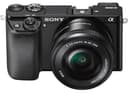
The Sony Alpha a6000 is a mirrorless digital camera featuring a 24.3MP APS-C CMOS sensor and the powerful BIONZ X processor, delivering sharp, vibrant images. With an ultra-fast 11 fps continuous shooting speed and 179 phase-detect autofocus points, it excels at capturing fleeting moments. Its compact design, OLED electronic viewfinder, tiltable 3-inch LCD, and built-in Wi-Fi/NFC connectivity make it an ideal choice for professionals and enthusiasts seeking high performance without the DSLR bulk.
| ASIN | B00KT69ZNI |
| Age Range Description | All Ages |
| Aperture modes | Aperture Priority, Manual |
| Are Batteries Included? | Yes |
| Aspect Ratio | 1.30:1 |
| Auto Focus Technology | Hybrid |
| Autofocus | Yes |
| Autofocus Points | 179 |
| Best Sellers Rank | 91,822 in Electronics & Photo ( See Top 100 in Electronics & Photo ) 163 in Mirrorless Cameras |
| Bit Depth | 14 Bit |
| Box Contents | Sony Zoom Lens 16-50 MM F / 3.5-5.6 OSS, 1 lithium-ion battery, 16 GB memory card |
| Brand Name | Sony |
| Camera Flash Type | Built-In |
| Camera Lens | 50 mm |
| Colour | Black |
| Compatible Devices | Sony E mount devices |
| Compatible Flash Memory Type | SDHC, SDXC |
| Compatible Mountings | Sony E |
| Continuous Shooting Speed | 11 |
| Crop Mode | APS-C |
| Customer Reviews | 4.4 4.4 out of 5 stars (358) |
| Digital Scene Transition | False |
| Digital Zoom | 4 x |
| Digital-Still | Yes |
| Display Fixture Type | Tilting |
| Display Maximum Resolution | 1920x1080 |
| Display Type | LCD |
| Dots Per Screen | 102,464 dots per square inch |
| Effective Still Resolution | 24 MP |
| Expanded ISO Minimum | 100 |
| Exposure Control | Automatic |
| External-Memory Size | 16 GB |
| File Format | MTS, M2TS |
| Flash Memory Bus Interface Type | SD |
| Flash Memory Speed Class | C10 |
| Flash Memory Type | SDHC |
| Flash Memory UHS Speed Class | 1 |
| Flash Modes Description | Automatic |
| Flash Sync Speed | 1/60 |
| Focus Features | Hybrid |
| Focus Mode | Automatic AF (AF-A) |
| Focus Type | Auto Focus |
| Form Factor | Mirrorless |
| Generation | 6000 |
| Has Color Screen | Yes |
| Image Capture Type | Stills & Video |
| Image Stabilization Type | Optical |
| Item Weight | 344 Grams |
| JPEG Quality Level | Normal |
| Lens Construction | Optical SteadyShot |
| Lens Type | 16, 50 millimeters |
| Manufacturer | Sony |
| Manufacturer Part Number | SNY_ILCE-6000L |
| Maximum Aperture | 3.5 Millimetres |
| Maximum Display Resolution | 24 MP |
| Maximum Focal Length | 50 Millimeters |
| Maximum Image Size | 24 MP |
| Maximum Shutter Speed | 1/160 Seconds |
| Metering Methods | Evaluative |
| Minimum Focal Length | 16 Millimeters |
| Minimum Shutter Speed | Bulb |
| Model Name | 6000 |
| Model Number | ILCE-6000L |
| Model Series | ILCE |
| Movie Mode | Yes |
| Network Connectivity Technology | NFC, Wi-Fi |
| Night vision | No |
| Number of Diaphragm Blades | 7 |
| Optical Zoom | 10 x |
| Photo Sensor Size | APS-C |
| Product Features | Video Recording |
| Rear Webcam Resolution | 24 MP |
| Recording Capacity | 48 Minutes |
| Remote Included | No |
| Screen Size | 3 Inches |
| Self Timer | 10 Seconds |
| Sensor Type | CMOS |
| Series Number | 6000 |
| Shooting Modes | Movie |
| Skill Level | Professional |
| Specific Uses For Product | Photography, Videography |
| Supported Image Format | JPEG, RAW |
| Total Still Resolution | 24 MP |
| Total Video Out Ports | 1 |
| Unit Count | 1.0 count |
| Video Capture Resolution | FHD 1080i |
| Viewfinder Magnification | 0.70x |
| Viewfinder Type | Electronic |
| White Balance Settings | Custom |
| Wireless Technology Type | NFC, Wi-Fi |
| Write Speed | 11 MB/s |
| Zoom | Digital Zoom |
S**I
Amazing camera! especially for beginners, great quality as expected. The sensor does require cleaning before EVERY use.
C**N
I’ve had the Sony A6000 since the end of August 2017, which amounts to five full months of shooting exclusively with it since jumping ship from Canon. My intention originally was to write a full review after a month or so but I wasn’t up to the task because I just wasn’t familiar enough with the camera after such a short period of time. So let’s jump right in. First, the negative points. The Badness Autofocus My first and foremost complaint about the Sony A6000 is the over all output of in-focus shots when in burst mode. I’ve heard only of a couple high-profile YouTube stars echo this sentiment in their reviews, including Jared Polin (who made a blanket comment about the Alpha line not always being the sharpest) and Tony and Chelsea Northrup (who mention it in their review of the camera). I’m going on the record now to state that in spite of Sony’s boast of having the world’s fastest autofocus system at the time of launch in 2014 (later iterations of the A6300 and A6500 boast more of more speed and focus points), the claim really doesn’t generate much applause for pixel-peepers like myself who like to have sharp images whenever possible. Granted, my chosen genre is street photography – which even the most well-known figures apparently have very little or no regard for sharpness or image quality in general – but with my own photography I seek to change this perception, at least through my contributions to the genre. Which is why I’m greatly perturbed with the percentage of in-focus image output for the Sony A6000 in burst mode. To be honest, I was very excited to get this camera in my hands because the spec sheet, in my opinion, was and still is the best mirrorless option based on price point. I’d even go out on a limb and say I wouldn’t even bother with any DSLR at the same price, even considering the additional negative things I’m about to tell you about. Based on price point alone, the Sony A6000 is the best stills camera option (I don’t care about video), at least on paper. It should be noted that there is no in-body stabilization in the A6000 and you have to pay almost three times as much for the A6500 before you get this feature. But I have to take into account that I was expecting a lot more from Sony and ultimately, was let down. I’m not sure if it’s realistic of me to have such high expectations for a $500 camera but there it is on the table. I just expected more. More in-focus shots, in burst mode. More sharpness when in burst mode when using primes – because no one really takes the 16-50mm kit lens seriously anyway. Or any kit lens for that matter. Lens Options The lens options for my street photography is terribly lacking at the time of this writing. Specifically, I’m really missing a 24mm pancake prime lens from Sony. They offer an inexpensive 16mm 2.8 version, which I’ll eventually purchase. But it’s really too wide for me for general street shooting. Sony does offer a Sonnar Zeiss 24mm 1.8 that costs more than twice as much as the Sony A6000 – but the lens for me is too big when compared with Canon’s APS-C 24mm pancake, which is great for keeping a low profile and picking up the action. Plus, my kit lens already covers the 16mm range and despite any misgivings I may have about it, I can still get the job done if I must cover more context. Also, after you shoot street photography for a few years you develop preferences for your prime lenses. And for me, anything at or above 30mm (45mm and above in full frame equivalent) just doesn’t cut it for me for over all general use in the streets. In fact, I’ve had to make do with a 30mm Sigma 2.8 lens for my go-to choice. I’ve recently acquired a strange manual focus 32mm Veledge 1.6 prime lens which is damned slow to operate thanks to a very stiff focus ring but which has produced some great quality images in the short time I’ve had to test it. But I’m still missing that wide angle sweet spot. What this means for me is that I’m truly forced to go back to my kit lens for the times when I really need a wide angle option for shooting street photography! This is a real pity. A simple offering of a pancake 24mm would solve the issue for me. Where is it, Sony? The bigger picture is this. Sony’s native glass options for their APS-C Alpha line isn’t very impressive either despite additional lenses being added to the line up recently. For example, if you set your filter on Sony.com for E-Mount and APS-C lenses, you only come up with 17 offerings. If you’re like me and reliant on Sony India, you’re stuck with only 14 options. This may not be a problem if you know what lenses you require and if Sony has them. You may also be able to find E Mount lenses from third parties, which is what I’ve done. I’ll also note here that not even third parties currently offer a 24mm prime pancake lens for the E Mount line. Maybe Canon can venture out and contribute to the E Mount cause? Hah! But that would make me a happy camper and Canon would become relevant to me once again. Battery Life Everybody and their mothers already know about this problem. There’s no way around it. The Sony A6000 batteries suck, like a vampire. On a full day of shooting street, I’ll easily burn through three batteries because when I’m walking around my camera is always on and ready. I used to joke that the best feature on my old Canon T3 was the battery life. But it’s no joke, even if it’s only a half-truth about being the best feature! Anyway, if you’re serious about street photography and shoot a lot you’ll need at least two extra batteries. I’m even considering adding two more because I’m hard on battery life due to my style of shooting. You can reduce the strain on your batteries by turning some of the A6000 features off, like the auto feature that flips between liveview and the EVF depending on how you’re shooting. There’s a motion sensor that detects whether or not you’re holding up the camera to your eye – a really cool feature that I always have on but really adds to battery drain. The Goodness After reading my three major problems with the Sony A6000 you may be wondering why I’m bothering with the camera at all for street photography. The truth is, it’s the good stuff that I’m going to cover now that make the A6000 my go-to camera of choice for street. It also makes the A6000 series my preferred form factor, even beating out the Sony A9 and A7R3, the best two cameras that I’ve ever had the pleasure to use! I’ll touch on this point later. It’s a grand statement to make, I know. So let’s dig in. Burst Mode 10 frames per second – in RAW. That’s all you really need to know. Despite my critique that many of the images shot in burst mode are not in focus, the flip side of this is that not all shots taken in burst mode need not always be sharp or in focus! I should probably explain. The turning point for me happened when I was trying to shoot kids jumping into a well in Mumbai. At the time, I had my trusty Canon T3 with me and I kept missing key shots. Forget about getting anything in focus – I couldn’t get the perfect jump because I could only muster three frames per second or so at best. I was consistently missing my NatGeo moments! Granted, there are a slew of Canon body options out there that can get the job done. But at the time, I was already considering a mirrorless system as an exciting possibility specifically for my street photography. And Canon didn’t have anything in its lineup to compete with the big boys. I have a new benchmark that I’ll use going forward if I must jump ship to other companies for my street photography. I must be able to capture the human form in free fall. I don’t need to capture the complexities of sports photography, wildlife, or any other subject that might have speedy parts in need of capturing with atom-freezing capabilities. But I must be able to capture free fall subjects and grab more than a paltry two or three shots. The A6000 fits the bill. I’m sure the A6500 (or if Sony puts out something else in this series later) would work even better for capturing more in focus shots and sharper ones, but for now the A6000 fulfills this need. Viewers don’t always expect (if ever) that a series of images showing a subject in fast motion be completely frozen in time with godlike clarity. In fact, some of the most dramatic types of shots shows motion. But you must be able to get a good selection of all the possibilities to start. And that happens when you have a burst rate of at least 10 frames per second. Size Matters – Especially In Street Photography I’ve shifted around my old Canon in the past few months and one thing now stands out like a sore thumb. DSLRs are just too big and increasingly more “stupid” when compared with the mirrorless systems by Sony. In short (pun intended), I’ll never go back to using DSLRs based on size and weight. Now, I’m perfectly aware of the fact that if you stick a 70-200mm zoom on any mirrorless body then a mirrorless body loses much of its small size appeal. But I’m working strictly in the genre of street photography. So I couldn’t care less less about any telephoto lens or even much of Sony’s lens lineup, for that matter. I’m only really concerned that Sony or a third party will put out my dream 24mm pancake sometime soon! But if you’re packing around mid-size lenses (most offerings between pancake and telephoto, let’s say) you’re still going to reap the benefits of using a smaller body size, no question about it. That’s even using lenses which are larger than the kit lens, which is most of them. The proof is in the size of the camera bag I now use, a Tamrac Explorer 42 Camera Bag. Compare this to a good-sized camera backpack that I had to lug around to accommodate my Canon gear. The difference between the two bags is drastic, not only in size but in weight. Now I’m able to access my shoulder bag a lot more easily and change lenses without having to take the backpack off, set it down, and change lenses, and put the backpack back on again. Now, I do this a lot more quickly and smoothly with fewer complications. Plus, wearing backpacks is a pain in the ass and a safety concern in at least two situations I’ve run across while shooting street photography in India. There’s a place called Sassoon Dock in south Mumbai where I begin my street photography workshops. To reach the end of the dock you must negotiate an unruly mob of fishermen, vendors, buyers, and maybe a few other tourists, to reach the end of the dock where it’s even more crowded because a lot of the auctioning for fish is happening there. Along the way, you’re forced to walk the ledge of the dock where there is no safety railing. I’ve walked this virtual plank a few times now with my backpack on and I’ve had great difficulty struggling through the bodies all the while fearing that I may receive an accidental or even an intention push and fall into the murky waters below. If I had to perform the same feat with my shoulder bag, I’d simply shift it around in front of my body. The other safety concern is with crowds in general and at train stations. If you’ve ever had to board a commuter train in India, you’ll know that often you’re one of the last aboard an already crowded compartment and you must push your way through to even board. A backpack is a huge detriment to you. Same goes for walking on crowded streets full of traffic. Receiving an accidental nudge could put you in harm’s way unexpectedly. Another way I look at it now, without unnecessary melodrama, is that a smaller form factor could save my life or prevent bodily harm in the future simply because my gear doesn’t interfere with my movements as much. I haven’t heard anyone else mention this yet but it’s worth thoughtfully contemplating, I think. Electronic Viewfinder This is a game-changer, and it’s not just about brand preference. This is strictly about EVF vs. OVF. Even though the Sony A6000 has the smallest and least good EVF in the 6000 series, I’d rather see my exposure in real time than have to go back to the monkey chimping inherent in DSLR use. Sorry, DSLR Guys, I’m through with you forever! It’s that much of a big deal. Seeing my exposure before taking the shot is vital – once you use the technology, that is. And in street photography, I’ll never go without it again. Two major reasons. First, conceptually it’s a better idea to see your exposure before you take your shot. Why would you want to wait and chimp to see if you got it by checking the back of your DSLR? Street photography is fast. Knowing you got the right exposure is vital because moments are largely unrepeated in the genre. Secondly, if you forget to adjust your camera settings in a new shooting environment (which changes moment by moment in street photography) then you’ll be able to see any monumental mistakes right away. You’ll be able to see whether you’re over or underexposed. No chimping needed. Make the adjustment and shoot. The very act of chimping will cost you valuable seconds. And this is simply not acceptable to me anymore. EVF and size factor in mirrorless systems alone will kill DSLRs in the long run. My opinion. Hopefully, companies like Canon will get back into the game and become industry leaders again instead of lagging embarrassingly behind. New Technology Without the need for a mirror and a prism, companies like Sony are able and willing to innovate and to include more technology in their mirrorless systems, keeping in line with advancements smartphones are boasting of – to the detriment of companies pushing their dinosaur DSLRs, like Canon and Nikon, whose DLSR sales took hard hits in 2016. Meanwhile, Sony took over the #2 spot in full frame interchangeable lens cameras in the US, largely thanks to their A7R2 line – just behind Canon and ahead of Nikon. What this reaffirms for me is that Sony’s mirrorless cameras may save the Sony camera business in the long haul. The rest of the industry needs to take note to survive the onslaught of the smartphone camera genocide. Even in my lowly A6000, I’ve got features on par with the latest smart phones and a couple features that stand out. The eye autofocus is worth noting here (more so in the A6300 and A6500). So too is face recognition and face registration. You can also download apps from the Sony PlayMemories store right into the A6000 to enable a host of special features. While having these features isn’t necessary for excellent photography, they are nice to have and will become useful for those who want to take more creative approaches to their work. Bottom line is we’ve come to expect a lot of neat tricks from our smartphone cameras. We shouldn’t expect anything less from the big camera companies either. And to date, Sony is leading the way with their mirrorless line. I Recommend The Sony A6000 For Street Photography While I have now at least tried the A6500, and would prefer it over the A6000, I’ll stand by my assertion that the A6000 is the best all-around camera for street photography. For me. Please note I’m not saying it’s the best all around camera or the best camera. It’s too much of a grand and subjective claim to make. But for me. For me. For me and for my street photography, the A6000 is the best value for the money. I highly recommend it over anything else out there. Yes. Either the A6500 or possibly a new A7000 will be in my future – even over the A9 or A7R3 – because of the even smaller form factor and price differences. Why? The A6000 series is even smaller than the A9 and A7R3. This is the uncomfortable truth I had to reconcile with because I really would love to own both these cameras too, although I have no business need for them at the moment. For now, the full frame upgrade is shelved. I’m completely happy with the APS-C mirrorless world. This is because for what I do, it is all I really need. I’ve had images published in a major magazine this year shot with my old Canon, my new Sony, and even my smartphone. And the images look great online and on the printed page. As a street photographer, this is all you really need to know, that you have the right equipment to get your work published.
T**K
Hızlı ve sağlam paketlenmişti. Bayram dönemi olmasına ve mevcut salgına rağmen zamanda teslim edildi. Satıcı oldukça ilgili ve sorularınıza en kısa sürede cevap vermeye çalışıyor. İlk aynasız fotoğraf makinam ve oldukça beğendim. Kit lens idare eder ama bir makina kadar daha iyi bir lense para harcamak şart gibi.Ürün çeşitliliği arttırılırsa tek adresim olur.Kargo şirketinden kaynaklı olsa gerek, Kargo Amazon üzerinden çok sağlıklı takip edilemiyor ne yazık ki. Şu an için tek eksisi bu bence.Teşekkürler Aras Foto
Z**D
got in time . and nice camera recommend for beginners
F**K
I would recommend this this camera to people who may want to do some casual photography, and may even plan to develop it further as a hobby later on. At its current price in 2019, it is in my opinion the best value you can get for your money. Skip the newer models like A6400 and A6100, and invest in this battle tested and better-valued camera. The biggest strength of the A6000 are the its price, compact size and XAVC video codec output. The biggest negatives will be its battery life, low-resolution electronic viewfinder, and lack of in-body image stabilization. Update #1 - Lens recommendations. After using the camera for a while, I got a Sigma 16 mm f/1.4 prime lens for it.The image quality is on a whole another plane of existence, and the large aperture makes it a great lens for low light situations. The 16mm focal length does seem a bit too wide at times though. If you want a good everyday lens to pair up with A6000, I would recommend a the SEL 35 mm f/1.8 lens as it has in-built stabilization which Sony calls SteadyShot, a large aperture for achieving the desirable background blur and better low light performance. Update #2 - Adapting vintage lenses to save a ton of money. Mirrorless cameras can be used with all kinds of legacy lenses due to the shorter flange distance. I have recently bought a Pentax Takumar 50mm f/1.4 and I am amazed at the image quality. All you need is an M42 screw mount to NEX mount adapter. For old Canon lenses you may use FD to NEX, and many others. Update #3 - Color profiles. Sony lags far behind Fujifilm and Canon when it comes to color science. For natural looking videos and JPEGs I would recommend you to use the following profile by going into the on-screen settings: Recommended custom profile for JPEGS is Neutral - 2 -1 -1 I will also recommend that you use Capture One or Lightroom to eke out the maximum information from your RAW files.