

Buy anything from 5,000+ international stores. One checkout price. No surprise fees. Join 2M+ shoppers on Desertcart.
Desertcart purchases this item on your behalf and handles shipping, customs, and support to Taiwan.
๐ Discover Your Path with Precision!
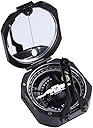
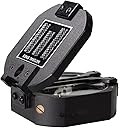
The XGeology Geological Compass DQL-8 is a portable, lightweight compass featuring an integrated clinometer, designed for professionals and enthusiasts in geology. With dimensions of 3.15" x 2.76" and a durable aluminum construction, this compass is built for accuracy and longevity, making it an essential tool for navigating the great outdoors.
| ASIN | B00I4W95CK |
| Additional Features | Portable |
| Best Sellers Rank | #180,627 in Sports & Outdoors ( See Top 100 in Sports & Outdoors ) #309 in Compasses (Sports & Outdoors) |
| Brand | Geological Compass |
| Brand Name | Geological Compass |
| Customer Reviews | 4.4 out of 5 stars 261 Reviews |
| Item Dimensions L x W | 3.15"L x 2.76"W |
| Item Weight | 0.65 Pounds |
| Manufacturer Part Number | LYSB00I4W95CK-SPRTSEQIP |
| Map Scale | 1ยฐ |
| Map scale | 1ยฐ |
| Material | Aluminum |
| Material Type | Aluminum |
| Model Number | SG_B00I4W95CK_US |
| Product Dimensions | 3.15"L x 2.76"W |
| Special Feature | Portable |
| UPC | 751738833353 701142333086 |
K**.
Impressed By The Quality At This Price! A Very Nice Pocket Transit!
I am impressed by the quality of this pocket transit compass. It has a nice weight and feel. Functions as it should, points to north. Other reviews have stated that this compass is a southern hemisphere compass because the red arrow points south, but obviously those reviews are wrong due to the fact that the white arrow (North) is illuminated for low light (see picture attached). I think this is just a misunderstood by those who do not understand this type of compass. The needle settles down quickly, not jittery. The dip lever on the bottom operates very smoothly and the level bubbles are nice and clear. The azimuth dial marks and numerals are very clear and easy to read. The sights are well aligned, as far as I can tell. All the hinges are easy to work, being a little stiff at first, but to be expected with a new unit. I think this would serve well in the field. It is durable and operates smoothly for reading all functions. The mirror is as clear as any glass mirror I have ever seen, however I can't tell what it is really made of, but it serves its purpose well. This is not a cheap flimsy knock-off compass, it is worth the price especially when compared to the Brunton at $400-$600.
B**S
Not quite a "new" Brunton, put great value for fifty bucks.
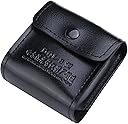
From the looks, heft and feel you'd not be able to tell this thing from a real Brunton. As others have noted, the needle takes a while to settle down sort of like an older Brunton. The magnet looks like a rare earth magnet, but it's apparently just a plain old magnet, otherwise it works like an old Brunton. I did not get to try adjusting declination because it uses a tiny screw to secure the adjustment screw and I could not find a tiny screwdriver to fit it. It does include a screwdriver for the adjustment screw. Also note that mine did not come with a halfway decent leather holster like some have posted. Mine has a crappy fake leather thing. And has METAL sights not plastic like the new Bruntons. Not at all bad. for $50. I have an embarrassing number of Bruntons - old ones, new ones, Japanese made ones, Real Bruntons including the Compro, standard one (in lovely blue), the Geo and the Axis. Certainly not quite as good as a new Brunton, but it works and does have metal sights (my beef with Brunton). The manual (if you can call it that) is pretty much useless, but you can download a Brunton manual online and it's gonna work the exact same way. If you don't already know how to use a Brunton, there are many YouTube videos and as I indicated you can download the manual. It is a well made and accurate knock off of the Brunton (copyright expired years ago). Perfect for a poor geology student.
B**G
Great compass
Great compass, lots of functions but a little bulky.
R**S
Amazing for 56 bucks!
I own a Brunton, but I am teaching Field Geology this fall and discovered that our collection of real Bruntons is in a sad state of repair. A web search turned up the Harbin compass, and I bought one on a whim to see if it would work at all for our class needs. I admit my expectations were not high. Sure enough the case is nothing to speak about. But, surprise, surprise, the instrument itself is really a solid, nice build. It has a metal case (painted black), a free spinning, weighted needle, azimuth dial with clinometer, ability to sight (and the sighting arms are stiff enough that they do not flop), a better damper than my real Brunton, and a little catch pin that keeps the top aligned with the rest of the compass when the top is closed. The various parts are held together with actual screws (so you can adjust the stiffness of the hinges) and the internal components are held in with metal keepers just like a real Brunton. The end result is vastly better than the hard plastic -bodied Bruntons that my Department bought some years ago. My only quibble (aside from the black body which will be easy to lose in the field) is that the needle is white with a red end on the SOUTH end, not the north end...I will be popping the glass off my new compass (there is a keeper and everything!) to rectify this issue with a daub of paint. I will also paint the body some day glow colors so I can find it in the field. The other need is to buy a better case. As some other reviewers note, a good leather case (~$38) costs almost as much as the compass itself! I am frankly flabbergasted that Harbin has made such a nice instrument for such a low price....
A**R
Cool looking and accurate
In all honesty, I got this because it looked cool. I'm not a geologist and won't be using this to measure strike and dip. I don't map out caves. I was looking to replace my sylva compass that developed a huge bubble that made it worthless. I saw this, thought about it for a couple days, and ordered it after watching videos about how they worked and what it was used for. After a few days of use, I love it! It takes some skill to get the pointer to hold still, but with the mirror and pointer, my accuracy is spot on. I don't really use the compass for determining elevation. Some years ago I did a lot of land nav in the military, and taught a few folks how to use a lensatic compass over a measured course. Initially most would be at least 5 or more degrees off and hundreds of feet off target after a km. I'd be surprised if, using this compass, they were off by more than a few feet. Today I use this as a contractor to determine communications bearings at radio sites and map out locations between mountains and hills. For me it is so much better than a 'normal' compass. The durability is very good if the lid is closed and not bounced around while being carried. I've used this almost daily for about a month and it's still as good as new. But I take care of my things - your milage may vary. Would I get this again? You betcha. Cheaper and easily as durable an any other compass, a lot more accurate, and the cool factor is off the charts.
S**H
Excellent low-cost Brunton substitute
First thing you have to understand is that this is a compass for geologists and others who make measurements in the field. The people who have given it low marks don't understand this. They are trying to use it as an orienteering compass. There are many simpler, less expensive alternatives, including ones from Brunton, that are better for that. But if you want to measure such things as geological strike and dip or accurate azimuths to a degree or so, this does the job well at a fraction of the cost of a Brunton Pocket Transit. It is surprisingly well made for a Chinese import. As others have said, it takes a few seconds for the needle to stablize, but when it does, it is accurate. Others have complained about the mirror alignment but mine is spot on. I was surprised to see that the clinometer scales for degree and percent slope are switched from the positions they are with a true Brunton, but then I realized why. With the true Brunton, the vernier adjustment lever on the back is in the exact center of the compass. On this one, it is offset (probably to make it cheaper to manufacture). Because of this, the scales must be moved up from where they are on the Brunton. If the degree scale was above the percent slope scale as in the Brunton, the numbers near 90 degrees would be partially hidden by the frame. Switching the positions of the scales avoids this problem. It still measures inclination accurately. I can't say yet how durable it will be, but it seems well made (even Brunton tells you not to walk around extensively with the compass open). I wish the outside was painted a lighter color than black so it would be easier to spot if you set it down in the field, but that is a minor concern that is easily fixed with some yellow tape.
R**V
Best value for money
I have mixed feelings about this unit. On one hand, itโs aluminum chasis feels sturdy and it is definitely the best you can get for the money, but, on the other hand, if you really want to use it in the field, you fist need replace the bad quality mirror with a new one which is what I did ($1 USD), then itโs vital to tweak the needle for put it in perfect balance. I like it, but there still 2 annoying facts about this compass: 4 points for night navigation that obscure the graduations and the lock mechanism, which moves the needle when you try to lock it for readings. Keep in mind that red end of the needle actually points to the south. Not a big deal when you get used of.
A**N
Not a Brunton, but still a good pocket transit.
As my review title would suggest, this is obviously not a Brunton. I have had this pocket transit/geological compass for almost four years now. In that time it has never failed me. For a fraction of the cost of a Brunton, you get, what is to me, a very quality piece of equipment. As other have stated, the fact it "doesn't point north" is partly true. It does point north, but for those who know the purpose and use of a pocket transit understand that the directional markings are not like a normal compass because it serves a specific purpose. In four years I have used this compass to shoot azimuthes, determine angle and grade of a slope, determine the height of objects, as a level/clinometer, and a plumb bob. Things to note, on mine, the large and small peep sites were very stiff when I recieved it. I used a tooth pick to put a drop of olive oil in each joint and worked them back and fourth and the loosened up. The channels in the side are not long enough to use effectively with a Brunton tripod. You can, if careful, but it will be wobbly. I'm not sure how dampened the needle is, as it seems to take a little longer than a Brunton to settle at north. One thing I do kind of like about it over the Brontun, other than the price, is that the needle arrow of north, a band at the south arrow, and all four cardinal directions do glow in the dark. Overall, if you are looking for a geological compass but don't want to pay the price point of a Brunton, this is your product. Know that it is not a compass meant to be used for land navigation, and won't "point north". Pocket transits are truly the original multi-tool for caving, construction, geology, engineering, and mining. It takes the place of many different tools and fits conveniently on your belt.
Trustpilot
1 month ago
1 month ago