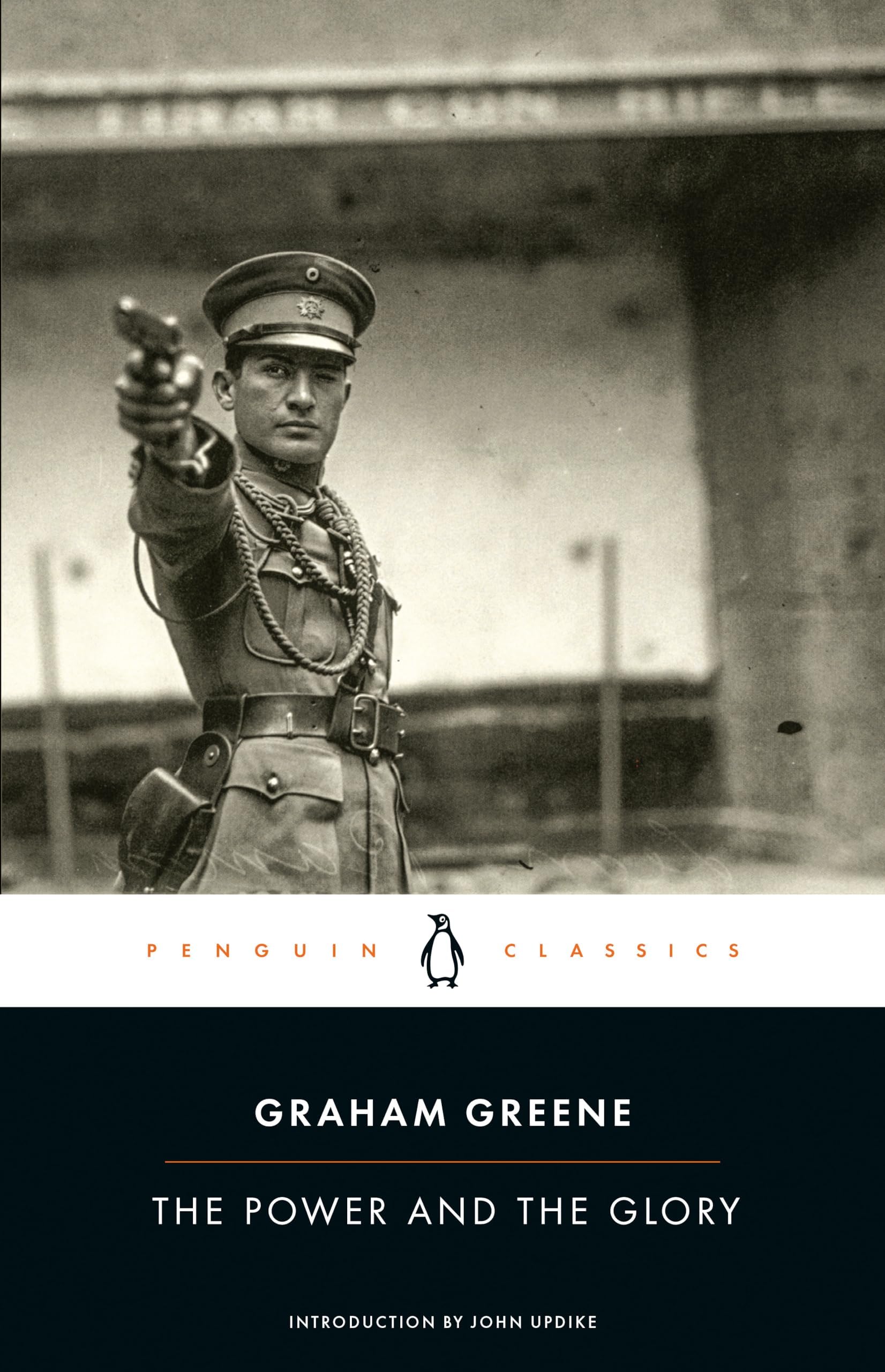
The Power and the Glory (Penguin Classics)
Product ID: 162291136
Desertcart purchases this item on your behalf and handles shipping, customs, and support to Taiwan.
One of the greatest novels of the twentieth century, in a new edition commemorating its 75th anniversary Seventy-five years ago, Graham Greene published The Power and the Glory, a moralist thriller that traces a line of influence back to Dostoyevsky and forward to Cormac McCarthy. Named one of the 100 best novels of the twentieth century by Time magazine, it stands today as his masterpiece. Mexico, the late 1930s: A paramilitary group has outlawed the Catholic Church and is executing its clergy. Now the last priest is on the run, fleeing not just an unshakable police lieutenant but also his own wavering morals. As he scraps his way toward salvation, haunted by an affair from his past, the nameless “whiskey priest” is pulled between the bottle and the Bible, tempted to renounce his religion yet unable to ignore the higher calling he’s chosen. Timeless and unforgettable, The Power and the Glory is a stunning portrait of both physical and spiritual survival by a master dramatist of the human soul. Penguin Classics is the leading publisher of classic literature in the English-speaking world, representing a global bookshelf of the best works throughout history and across genres and disciplines. Readers trust the series to provide authoritative texts enhanced by introductions and notes by distinguished scholars and contemporary authors, as well as up-to-date translations by award-winning translators. Review: The elegant writing alone makes it a five-star winner. - The Power and the Glory, set in 1930s Mexico during a period of state persecution against the Catholic Church, follows a whisky priest on the run and a police lieutenant who vows to rid his small corner of the world of the clergy. Their paths, fraught with danger and moral dilemmas, intersect with a group of unfortunate characters, each of whom profoundly impacts the fate of both men. Mr. Tench was the whisky priest’s first encounter at a port where they both searched for their own version of freedom. “A few vultures looked down from the roof with shabby indifference: he wasn’t carrion yet.” A dentist by trade, Mr. Tench, had come to Mexico from England nearly twenty years earlier and found the country to be a bit like the Hotel California — he’d checked out long ago but could never leave. As the doleful dentist and the camouflaged cleric share a glass of bootlegged brandy while waiting for a boat, fate intervenes and pulls the padre back into the bowels of a country from which he was not likely to escape. “There is always one moment in childhood when the door opens and lets the future in. We should be thankful we cannot see the horrors and degradations lying around our childhood, in cupboards and bookshelves, everywhere.” This was not a story to be rushed. I found myself reflecting on how prejudice can cloud our vision. Life is vast, and we limit ourselves when we close our hearts to other perspectives. Some passages halted my reading, leaving me to gaze into the distance as I basked in their brilliance. The narrative was a potent exploration of darkness, with occasional rays of hope to light the way. The praise I’ve seen for this book is well deserved. The elegant writing alone makes it a five-star winner. Review: A Book to Ponder - (Spoiler) I initially had a tough time getting into this book--couldn't find anything to enjoy about it. I came to the conclusion about midway through The Power and the Glory that this wasn't a book to be enjoyed. It was a book to ponder deeper meanings of faith, politics, humility, commitment, sin, and consequences. The protagonist, the priest, who is never named, is the only priest left in a certain state of Mexico where priests have been outlawed. He has spent the last eight years running from the police to evade capture. He is an imperfect archetype of a savior/martyr, haunted by his past failures and yet still struggling to remain committed to the priesthood. The priest is a conflicted individual, but his character grows; in the beginning of the story he tries to escape on a boat, but at the conclusion, he goes back to the state where priests have all been shot. Knowing he will be caught and killed, he returns to hear the confessions of a dying murderer. There were many characters in this book representing "types," such as the antagonist, the lieutenant who hated the clergy; and the mestizo, a type of Judas. The many children represented hope, as poignantly shown in the final few pages when the young boy lets the priest into the house to hide him from the police. I most identified with the priest and his internal struggles. Greene did an excellent job of showing the priest's outward struggle to avoid capture as well as his inner turmoil of sin and unrepentant spirit with reference to his illegitimate daughter. All the characters were real, deep, and memorable. The takeaway from this book to help me be a better writer includes: 1. Make every character in the book count for a purpose and a deeper meaning than just "another person" to fill up the pages. 2. Include qualities even in the antagonist that make him a sympathetic character--the story will be more believable. No one is all good or all bad. 3. Be willing to tackle a controversial position--a protagonist that is severely flawed and that falls short of the standard can still be redeemed, changed, and become a hero. 4. Think of ways to use people or animals or locations to enhance symbolic meanings that grow the story. For instance, the priest's fight with the dog over the bone; the references to the dentist's equipment and working on teeth; the numerous beetles bashing themselves against walls--symbolizing pain, the fight for survival, the baseness of human depravity, and loss of dignity. 5. What you write will linger later in the mind of the reader--shine a light of hope; i.e., the priest who knocked on the door and was met by the young boy. 6. Not all books are to be necessarily enjoyed, but perhaps serve a greater purpose. Do you want to only entertain, or are you willing to probe the deeper meaning of life and leave the reader with significant ideas to grapple and ponder?










| Best Sellers Rank | #3,250 in Books ( See Top 100 in Books ) #47 in Teen & Young Adult Classic Literature #59 in War Fiction (Books) #167 in Classic Literature & Fiction |
| Customer Reviews | 4.2 out of 5 stars 3,961 Reviews |
K**R
The elegant writing alone makes it a five-star winner.
The Power and the Glory, set in 1930s Mexico during a period of state persecution against the Catholic Church, follows a whisky priest on the run and a police lieutenant who vows to rid his small corner of the world of the clergy. Their paths, fraught with danger and moral dilemmas, intersect with a group of unfortunate characters, each of whom profoundly impacts the fate of both men. Mr. Tench was the whisky priest’s first encounter at a port where they both searched for their own version of freedom. “A few vultures looked down from the roof with shabby indifference: he wasn’t carrion yet.” A dentist by trade, Mr. Tench, had come to Mexico from England nearly twenty years earlier and found the country to be a bit like the Hotel California — he’d checked out long ago but could never leave. As the doleful dentist and the camouflaged cleric share a glass of bootlegged brandy while waiting for a boat, fate intervenes and pulls the padre back into the bowels of a country from which he was not likely to escape. “There is always one moment in childhood when the door opens and lets the future in. We should be thankful we cannot see the horrors and degradations lying around our childhood, in cupboards and bookshelves, everywhere.” This was not a story to be rushed. I found myself reflecting on how prejudice can cloud our vision. Life is vast, and we limit ourselves when we close our hearts to other perspectives. Some passages halted my reading, leaving me to gaze into the distance as I basked in their brilliance. The narrative was a potent exploration of darkness, with occasional rays of hope to light the way. The praise I’ve seen for this book is well deserved. The elegant writing alone makes it a five-star winner.
L**S
A Book to Ponder
(Spoiler) I initially had a tough time getting into this book--couldn't find anything to enjoy about it. I came to the conclusion about midway through The Power and the Glory that this wasn't a book to be enjoyed. It was a book to ponder deeper meanings of faith, politics, humility, commitment, sin, and consequences. The protagonist, the priest, who is never named, is the only priest left in a certain state of Mexico where priests have been outlawed. He has spent the last eight years running from the police to evade capture. He is an imperfect archetype of a savior/martyr, haunted by his past failures and yet still struggling to remain committed to the priesthood. The priest is a conflicted individual, but his character grows; in the beginning of the story he tries to escape on a boat, but at the conclusion, he goes back to the state where priests have all been shot. Knowing he will be caught and killed, he returns to hear the confessions of a dying murderer. There were many characters in this book representing "types," such as the antagonist, the lieutenant who hated the clergy; and the mestizo, a type of Judas. The many children represented hope, as poignantly shown in the final few pages when the young boy lets the priest into the house to hide him from the police. I most identified with the priest and his internal struggles. Greene did an excellent job of showing the priest's outward struggle to avoid capture as well as his inner turmoil of sin and unrepentant spirit with reference to his illegitimate daughter. All the characters were real, deep, and memorable. The takeaway from this book to help me be a better writer includes: 1. Make every character in the book count for a purpose and a deeper meaning than just "another person" to fill up the pages. 2. Include qualities even in the antagonist that make him a sympathetic character--the story will be more believable. No one is all good or all bad. 3. Be willing to tackle a controversial position--a protagonist that is severely flawed and that falls short of the standard can still be redeemed, changed, and become a hero. 4. Think of ways to use people or animals or locations to enhance symbolic meanings that grow the story. For instance, the priest's fight with the dog over the bone; the references to the dentist's equipment and working on teeth; the numerous beetles bashing themselves against walls--symbolizing pain, the fight for survival, the baseness of human depravity, and loss of dignity. 5. What you write will linger later in the mind of the reader--shine a light of hope; i.e., the priest who knocked on the door and was met by the young boy. 6. Not all books are to be necessarily enjoyed, but perhaps serve a greater purpose. Do you want to only entertain, or are you willing to probe the deeper meaning of life and leave the reader with significant ideas to grapple and ponder?
G**O
The Hardest Sort of Novel to Review ...
... is a novel that's obviously a work of exceptional literary craft but that you don't like. I don't like this novel, though I read it avidly. I'm far more comfortable with Graham Greene's "entertainments" -- the satirical novels that Greene himself considered lesser works -- than with his fictional expressions of his "Catholic Communist" conscience. That's what my aversion amounts to -- a distaste for Greene's philosophical message. I have the same problem with the novels of Vargas Llosa; the comic works like "Aunt Julia and the Scriptwriter" please me immensely, but the political/ideological works like "Death in the Andes" repel me intellectually. "The Power and the Glory" is set in Latin America, as is "Our Man in Havana". Both novels portray societies burdened by corruption and violence under elitist tyrannies, the former a tyranny of ideology and the latter a tyranny of wealth. A huge gap separated the writing of the two books, that is, Green's experience of World War 2 and his partial disillusionment with 'quietist' Catholicism. The protagonist of "The Power and the Glory" is a fugitive priest, a 'wanted man' under the regime of would-be purifiers and saviors of the peasantry. These ideologues could just as easily be fascist as communist; the closest reality to their extremism might be the Khmer Rouge of Pol Pot. The Priest -- a drinker, a "whiskey priest -- evades capture for years, until he is possibly the last priest still at large in a particularly vindictive anti-clerical state of southern Mexico. His only hope is to slip across the mountains into another state where anti-clericism isn't as extreme. He isn't entirely clear, however, whether his 'vocation' isn't martyrdom -- though he considers himself unworthy of such a beatification -- or else survival to be of service to parishioners. For a small, weak, drunkard of a man, the Priest shows incredible endurance and tenacity; in the end, he accepts betrayal as his fulfillment of his sacerdotal role. The obvious association of his inevitable sacrifice with that of Jesus Christ is the core message of the book. Unless the reader is willing to 'privilege' the Priest's commitment to Christian sanctity over the commitment to a religion of social engineering -- the ideology of the Lieutenant who pursues the Priest inexorably -- one wrong-headedness seems more or less as bad as another. There's a comparison to be made -- one that seems almost inevitable -- between "The Power and the Glory" and Malcolm Lowry's novel "Under the Volcano". Both novels are set in Mexico in the 1930s, under one of the most brutal 'caudillo' regimes. The central characters are both novels are drunkards and self-haters. Both 'heroes' are like moths attracted to their own obliteration, and both novels depict the core corruption of Power that ineluctably results in 'fascism' broadly understood. But Lowry's novel is 'orders of magnitude' superior to Greene's -- more vivid, more viscerally disturbing, more honest. In Lowry's book, every character, however briefly present, is intensely encountered psychologically. Next to Lowry, Greene seems conventional and verbose. But "Under the Volcano" is one of the "ten best" novels of the 20th C, in another league from anything Greene wrote or could have written.
N**S
The Power and the Glory.
Read raved reviews about this writer. But i found this book tedious to read. Writer uses long descriptive prose that goes on and on when a few short lines would do. Some of the characters were interesting, but at times I was confused which character writer was referring to. Very disappointing read. Cannot recommend.
H**R
Saint and Sinner
A small spot of brandy in his glass - as if it was an animal to which he gave shelter. I must have read all of Graham Greene in the 1970s and then I forget most about him. I remember him as a follower of Conrad and an ancestor of John Le Carré. Many good films were made from Greene novels and `entertainments'. Most recent one that I remember was a good version of the Quiet American with Michael Caine. I chose The Power and the Glory for my first revisit after over 30 years. I was half prepared not to like it, but I failed with that. This was one of Greene's early great successes. It has been filmed by John Ford with Henry Fonda. Greene wrote it in the late 1930s after a short visit to Mexico. It is about a `whisky priest' who is on the run from a fascist anti-clerical death sentence. (Greene himself had converted to Catholicism in the 1920s, but was not overly going on about it. He claims that the piety of simple people in Mexico did much to make him a better Catholic.) The priest never acquires a name in the novel, differently from his compadre José, who gives in to the new law that priests must marry. Our priest drinks and he has a daughter, but he remains loyal to his oath in other respects. His main hunter is a young police lieutenant, a prototype of the `idealistic' fascist. He leads the Red Shirts. The priest has the courage to be a coward. He puts others at risk by not giving himself up. After a series of narrow escapes his mental power is drained. He longs to be caught. After rejecting the martyr role for years he begins to embrace the idea out of sheer mental and physical exhaustion. His flight is like the bad dream when you want to run and cant. Greene was a skilled story teller and he was good at leaving the discovery of meaning to us. That's how it should be. The story is timeless and placeless in its basic substance. Mexico is an accident. Therefore Greene's superficial knowledge about the place doesn't disturb. This is just a miserable tropical place with jungles and swamps, like any other. The novel has been included in several `best 100' lists and I wouldn't deny that it has a claim to such a position. I think that it should have a good chance to survive for some more time as one of the great novels of the 20th century. Greene was also quite a master of style. I can enjoy him sentence by sentence. The more surprising is his blackout on page 19 of this edition, when `great grey cylindrical waves' lift the ship's bows (and the hobbled turkeys shift on deck). Come again? Cylindrical waves?
D**V
It is a terribly sad, but good book
It is a terribly sad, but good book. I had never read Graham Greene, although I had certainly heard of him. I had earlier dismissed him as a sort of John Le Carre, writing about the complexities of international espionage. However, then Peruvian novelist Mario Vargas Llosa praised The Power and the Glory in Vargas Llosa's series of essays on various writers entitled The Truth of Lies, and so I thought that I would give the book a shot. It is not an easy read nor, at first glance, an uplifting one, although one can seem moments of redemption and revelation laid out in the book. Everything is set in a Mexican state that I believe is meant to represent Tabasco during the 1920's, shortly after the Institutional Revolutionary Party's ascension to power. At that time, and in that state, it seems that the Mexican government was carrying out a pitiless purge of Roman Catholic priests, and although there were a number of believers, they observed the Catholic rites underground. It appears that the government effected the purge using philosophical observations akin to Lenin's observation that religion is the opiate of the masses. Greene had spent time in Mexico prior to writing the novel, and wrote a memoir that expressed his loathing for the country and all that he saw. And certainly, both the foreigners and the natives living in the novel's setting are deeply unhappy. The former suffer from a profound sense of dislocation, and often dream of going home. The latter are oppressed by unbelievably cruel hardships, including political repression and hunger. Vargas Llosa explained that the novel presented a conflict between the upright Lieutenant, who is totally committed to his secular beliefs and hopes to extirpate the church in order to do away with obscurantism in the hopes of bringing paradise to this world. His bite noire is a priest, who is sinful, guilty of fornicating and drinking and yet, much more human than the rigid Lieutenant. However, I did not see it that way. The Lieutenant is admirable in his own way, particularly when compared to his corrupt and complacent superiors. However, Greene paints the Lieutenant in broad brush strokes and spends relatively little time with him. Greene spends far more time with the corrupted "whiskey-priest," and the real conflict is between the whisky-priest's attempts to discern the nature of his own calling, which he pursues with increasing diligence, which is remarkable considering horrific suffering that he passes through, including near starvation. Still, the whiskey priest cannot decide if he was closer to God when he was a younger priest, relatively well to do and with a parish, or if he is closer now, even if he spends the night in jail and even if he robs rotten meat from a dog because he is hungry. For me, Greene uses the whiskey-priest to explore various theological conundrums. As the novel progresses, we see that the whiskey-priest is becoming weary of life, which is understandable because he has been on the run for eight years. And yet, when he returns to the very state where the police are chasing him, ostensibly to hear the last confession of a murderer, Greene makes clear that in part, the whiskey priest has begun to despair of this life. Thus, Greene asks us to ask if the priest's decision to return is a Christ-like gesture, in which he willingly sacrifices his own life for the betterment of another? Or it is a selfish gesture - in which his desire to die is in a way reflective of a selfish desire to cease living and thus cease suffering? On that note, a remarkable aspect of the novel is the tremendous hatred that nearly every character feels towards this world. And yet, that contributes to the novel's power, because Christianity indeed deals and indeed to a degree condones a contempt for this life. Regardless of the feelings that he may have harbored about Mexico, Greene sets out the priest's struggles with great subtlety and precision, showing him advancing towards a nearly beatific state at times while alternatively feeling repulsed and disgusted by the people around him. At each point, we are encouraged to ask if the priest is moving closer to God, or indeed farther away.
M**L
A thriller novel about a priest’s moral struggles in a time of persecution
This book was fascinating and mysterious, and it kept me wondering what would happen next. It is a fictional novel about a priest in Mexico during a time of anti-Catholicism when Catholicism was outlawed. This priest had been on the run for years, and the police had been unable to catch him. We start in the story by being introduced to different people, and it is unclear what is happening. However, as we progress through the pages, the story starts to focus on the priest, known as the whisky priest. We learn he has many moral struggles and is pulled between certain vices or sins and his higher calling. It is indeed a thriller novel. Throughout the book, I wondered where the story was going, what was his reasoning for staying in Mexico, and whether he would give up the drink and would be able to confess and get himself back on the right path. Despite his struggles, he still pursued his priestly duties, his higher calling. We see this moral contention, and it allows us to ask these moral questions to discuss. Every time the priest did something good, I was cheering him on. I would vouch to say a few things about the whisky priest. He kept his vocation, even if he admitted to being a bad priest. He was self-aware of himself and his sins and faults. In the ways that he kept his vocation, he preserved his dignity. He rejected the evils of the state. He fulfilled his priestly duties, particularly in celebrating mass and giving confessions. He struggled with his sins. I am glad to have read this book and enjoyed it. It was very engaging and thought-provoking. I would recommend it to those who enjoy reflecting on moral dilemmas and fans of thrillers who appreciate a suspenseful narrative set against the backdrop of religious persecution.
A**R
Great read
Great book, good conditions
A**R
Superb
Best book. Best copy. Enjoy reading.
.**.
A subtle, intelligent story about a man on the run
This is a story about a priest on the run from the authorities in 1930s Mexico, during a time of state persecution of the church. It's a "wild west"-type state where getting the wrong side of the local police chief can easily end in torture and summary death. Despite this premise however, this novel is not one of Greene's thrillers, and whilst absorbing reading, it's also the kind of book which requires some effort at times, though the clear prose and vivid, cinematic descriptions of Mexico add colour and make it enjoyable to get through. Despite the priest-on-the-run theme, the dominant feeling is one of residual tension, and perhaps foreboding and general menace, rather than gripping excitement, and those looking for light entertainment would do better to pick up another of Greene's novels. In taking us on this warts-and-all journey into the world of the "whisky priest", Greene is exposing the complexities of human character, gently showing us the contradictions inherent in peoples' lives and views of ourselves and others. Yes, we can be drunkards, arrogant and weak-minded, but also full of compassion, humanity and responsibility. We can be vengeful and murderous, but also coherent and pure. Who is the better person - the honest, incorruptible lieutenant who won't flinch at taking hostages and killing innocent people in order to create a better world for their children, or the corrupt, affable police chief who causes less damage through his laziness and incompetence? The priest who gives up his honour and everything he believes in for a cushy life, or the one who refuses to hand himself in, thereby causing huge pain and suffering to those whose help he is dependent on? Greene has beautifully crafted a book looking at human frailties and strengths with great subtlety and tact. The protagonist of this novel - the sinner priest - is so real and multifaceted that I ended up recognising parts of him in countless people, not to mention in myself. This is a book I enjoyed reading and which I am sure will stay with me for a long time yet.
V**O
Ottimo acquisto
Ho trovato il libro che avevo letto in italiano per regalarlo a chi legge in inglese
M**A
Five Stars
Makes one appreciate religious freedom.
A**A
Obra maestra. Edición correcta y "original Penguin".
Ni qué decir de la obra más allá de que es una obra maestra. El libro en sí es de la calidad "acostumbrada" de Penguin... lo pongo entrecomillado porque en estos tiempos aciagos ya nada garantiza que no te llegue una edición horrible, con el sello Penguin, pero que es realmente "made to print", o sea, impreso por un tercero con la anuencia de Penguin, normalmente a cargo de un cuarto, contratado por Amazon mismo. Ya se subcontrata todo y, para no variar, la calidad parece ser la primera cláusula anulada de ese sub-contrato. En fin, yo tuve suerte, pero tengan cuidado.
Trustpilot
2 weeks ago
2 months ago