Desertcart purchases this item on your behalf and handles shipping, customs, and support to Taiwan.
๐ Remove the old, reveal the newโclean smarter, not harder!
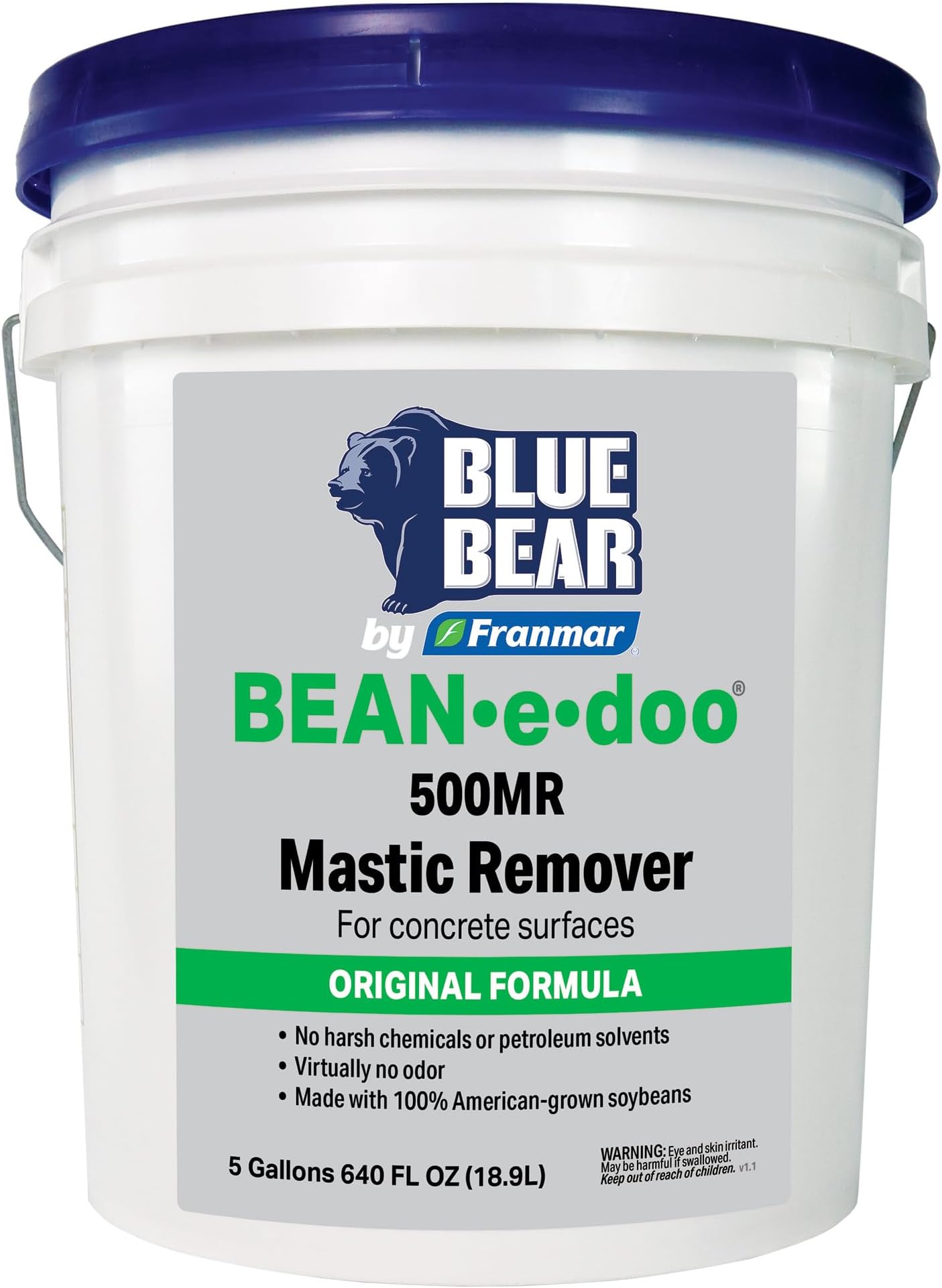
Blue Bearยฎ 500MR Beanโขeโขdoo Mastic Remover is a professional-grade, soy-based adhesive remover designed to tackle even the toughest mastics, including black and asbestos types. With fast softening times of 1-2 hours, low odor, and a biodegradable formula free from petroleum solvents, itโs safe for use in sensitive indoor environments like schools and hospitals. Covering up to 125 sq ft per gallon, it offers efficient, eco-conscious mastic removal with easy cleanup, making it the go-to choice for modern flooring projects.


| Asin | B00U2RHY00 |
| Best Sellers Rank | #220,971 in Tools & Home Improvement (See Top 100 in Tools & Home Improvement) #29 in Flooring Adhesive Remover |
| Brand Name | Blue Bear |
| Customer Reviews | 4.4 4.4 out of 5 stars (246) 4.4 out of 5 stars |
| Item Form | Liquid |
| Item Volume | 5 gallons |
| Manufacturer | Franmar |
| Material Features | Biodegradable |
| Model Number | 1 |
| Number Of Items | 1 |
| Part Number | 1 |
| Scent | Unscented |
| Size | 640 Fl Oz (Pack of 1) |
| Special Features | No Petroleum Solvents, Almost No Odor, Safe to Use |
| Special Ingredients | Soy Ester |
| Specific Uses For Product | Sealant Remover |
| Surface Recommendation | Stone |
| Unit Count | 640 Fluid Ounces |
| Upc | 040926766406 |
User
Works on the oldest mastics
This product worked great on complete removal of 80 year old mastic. Now, it doesn't just eat mastic instantly, it takes a bit of working. You need a floor scrubber with hard bristles. It takes about a half hour for the compound to start affecting the mastic. Should be scrubbable at that point. After a good scrub you should get a clean squeegee wipe and the compound will be dark like used motor oil. The compound will keep the mastic from sticking to the bristles as well. Squeegee into some absorbent so you can sweep it into a bag. Don't just dump a bunch on and let it sit. It will evaporate and the mastic will become gummy. Just hit a corner, scrub, squeegee, and then reapply if you need more. You can make the product stretch more that way.The odor is no big deal. Citrusy, but definitely has an underlying "Cooking oil" smell. It actually works better than paint thinner and yes, I tried that on a small spot. Value? Well, the stuff isn't cheap, but I have tried the cheap stuff and it doesn't work. This stuff will work no matter how old the mastic is so you can't get much better value than that. It is oil so you will need a good supply of Dawn soap or a suitable degreaser to mop the floor clean with. You can probably push some absorbent around to wick up what you can as well. You have to get all that oil out if you plan on redoing the surface.
User
Works great! Buy enough to liquify the mastic!
I have a 1000 square foot basement that had old vinyl tile on it. After the tile was removed, I had of course discovered the black mastic that will lead most people to this product. I watched several videos, read the reviews, and did my research on different methods of application and removal.Ultimately, I ended up needing two five gallon pails to fully liquify the mastic. The first pail liquified certain spots where I had put it on thick, but others were just tacky. With ten gallons of Bean-e-doo I was able to successfully liquify the mastic. The mastic turns into a black oil substance and was wasy to soak up and remove.My procedure for application and use was as follows. Using a small broom, I applied a liberal coat of bean-e-doo across the floor. I let the bean-e-doo sit for three hours and then went down stairs with a steel bristle deck brush on a handle. I squeeged the liquid around the floor until I located a spot that was still hard. I would then squeegee the liquid oil like substance into this spot and scrub it with my metal brush until it was bare concrete. After I had scrubbed all of the hard spots and successfully removed most of the mastic, I squeeged the mastic oil into a centralized location and covered it with four bags of kitty litter. I shoveled the saturated kitty litter into the empty beanie-e-doo pails and an additional bucket I had laying around. I sealed all three of these and took them to a disposal center.I used a mixture of one gallon dish soap and two gallons of simple green to degrease the floor temporarily while I prep part of the floor for demo and a bathroom installation. I again used the steel brush and scrubbed the floor as I went. This was followed by pressure washing the floor and then I squeeged it dry.Upon completion I intend to use the emerge degreaser that I purchased to remove any residual product left behind.On a side note, it did leave the basement smelling pretty bad, but with the new egress window I am cutting out it should ventilate well.
User
Easy with a rented floor buffer machine
I needed to remove about 700 square feet of black mastic from 1967. First, tried two other products that weren't able to soften my mastic. I switched to the Blue Bear and it did the trick.I did my job by applying the wettest coat of Blue Bear that I could. I used 10 gallons for my 700 square feet of floor. I allowed it to sit overnight. In the morning, the floor was still wet in areas, but in other areas the mastic had absorbed the Blue Bear liquid.Next, I went over the whole floor with a rubber squeegee and collected all of the now liquified mastic in a bucket. After the squeegee work, a lot of thick mastic still remained, but it had been softened.I then rented a 17 inch floor buffer and bought 20 of the 3M black floor stripper pads. I also bought 7 gallons of Zep citrus degreaser concentrate to wet the floor and help with the cleanup. From there it was almost easy! I poured the degreaser concentrate right on the floor and used the machine to wet scrub the mastic. This method would remove about 4 square feet of mastic every 15 seconds. All of the liquid and mastic wound up soaked into the stripper pads. Once a pad filled up with sludge it would need to be changed. I easily used all 20 of my pads and wished that I had bought 5 more. I finished the main job in about an hour and then cleaned up the corners by hand with a steel wire brush.Finally, after two rounds of mopping with detergent, my floor was clean and ready to tile.
User
Cutback? Sure. Carpet Adhesive? No.
Iโm iffy on my overall rating. To be clear, this worked wonderfully on cutback adhesive. I removed the VAT with a wallpaper steamer and a 6โ drywall knife. In some areas, the tiles came off with essentially no effort. This was a mixed blessing: the more steam needed to remove the tiles, the less effort involved in removing the cutback (because most comes off with the tile). Alas, the converse is true: if the tile is easy to remove, the cutback is attached to the concrete, not the tile. (Also, a recommendation: put the tiles in very small cardboard boxes and then wrap the boxes in plasticโ that will keep them from poking through the asbestos bags. When I say very small, I do mean very small, because those things are heavy in any quantity.).I used a 3/4โ nap roller on a long handle to apply the mastic remover. The first application, I let it sit while I did something else. The second application, I walked around with a deck scrubber and scrubbed at every area where Iโd applied the remover. The first time, I tried using a squeegee, but the concrete was uneven enough that the wide squeegee didnโt work well. (Also, one of the areas was a small bathroom in which maneuvering the squeegee was impossibleโ something I hadnโt considered.) The second time, I used a 7โ floor scraper to move the liquid instead. That was more effective. In both cases, I ended up liberally covering everything with oildri quicksorb and then sweeping/vacuuming it up. The oildri worked wonderfully. I went after the floor afterward with the matching degreaserโ which Iโd give a low score. After two applications, there was still noticeable oily residue and smell. My third try was with Dawn dish soap, which seems to have been more successful. (Maybe the Blue Bear degreaser works better with a commercial floor scrubber?)The remover says it also works on carpet adhesive: let it sit 4 hours and use a scraper. My experience is that it doesnโt work on the carpet adhesive at all. Followed directions exactly; 0 carpet adhesive removed. (I can probably get it off with a steamer and scraper, but I was hoping for a miraculous success like the cutback.)I guess ultimately it depends on what youโre buying it for, and how much work youโre willing to put in. But! Learn from my experience: use a deck scrubber to agitate and a smallish floor scraper (instead of a large squeegee) unless your concrete is like glass.
User
Worked on the black tar like mastic from decades ago.
I used this on the dreaded black mastic that is sticky and tar like and most likely has asbestos in it. It softened it up within a few hours and a second coat took off the last residue where it may have been thicker. This mastic had been down since the 50's I believe and now the floor is clean and ready for tile. I did use a degreaser after finished so the new tile would adhere well. I like the fact that it is hard to have airborne asbestos when it is all in a gooey liquid form so it seems quite safe. It smells a bit like citrus, pleasant and mild.
User
works!
This stuff works! I removed old carpet from my basement and found the mess in the picture above. After 2 applications you can see the after results were successful (aside from the edges that was not the products fault, but the result of a sloping foundation. So 5gal covered ~500sq ft but since I had to do it twice I used 10gal.Some tips:1. put a nice even coat, doesn't have to be super thick, but don't spread too thin or it won't be as effective2. let it set at least 4 hours. I only let the first coat set 2 hours and was left with a lot of leftover mastic, hence the second application. If done correctly, this might have only taken one coat.3. Use gloves, respirator (good one not cheap elastic one), and spikes for your shoes, they'll get messy4. I used a scrub brush as I was distributing the product to help get the thick spots up and around the baseboards5. Use a squeegee (like one in the pic) to gather and soak up with cat litter (haven't tried diatomaceous earth as others suggested, but cat litter works fine)6. Degrease and rinse thoroughly, this product is oily (took me two rounds of degreasing/rinsing, I used beanedoo's degreaser as well.7. Set aside a full day to complete everything, as the product has a strong smell (though 'safe' since soy based apparently) and you want to apply it, leave it for at least 4 hours (leave the house), come back and squeegee, degrease and rinse it so the smell is gone within the day.Good luck!
User
D-limonene outperforms in shorter period of time
Save your money, this product will take several coats to remove glue and leave residue behind.I switched to generic D-limonene to remove my carpet glue from concrete, the D-limonene acted within 15minutes and pulled far more glue. Additionally since it is non-toxic you can mix it with soap and water to do final scrub without worrying about traditional adhesive chemicals.
User
This stuff is awesome!
This stuff is awesome. Our house was built in 1970; the floor was an asphalt tile probably with asbestos. During the time the most popular mastic was black asphalt, which in some cases also included asbestos. After we decided to upgrade to tile and wood floors I found the Black Mastic under the entire floor tile. I did some research and found out the following. This product is used in hospital floors because it has little or no odor. Additionally, Asbestos cannot harm you unless it is airborne. Thus if you try to remove this mastic with a grinder you could get asbestos in your lungs.This product removes the black mastic by liquefying it thus no airborne problem. I bought it and used it and I was amazed because it loosened and liquefied the black mastic after letting it sit on the mastic about one or two hours. I noticed that someone complained about removing the liquidified black mastic and to overcome this problem on my floors by getting a lot of paper towel rolls and used them by spreading out the paper towels to soak up the old black mastic.Additionally, I used a pump sprayer with paint thinner to keep the old black mastic in solution. Once it appeared to be clean I washed the floor with liquid soap and water. When I was done the floor dried clean and we sealed the floor, where the wood floor was installed and we had the tile put in right on top of the floor I had just cleaned. I would recommend this product, it worked well, it is the only mastic remover I found that works well yet doesnโt smell up the house.
Trustpilot
1 week ago
1 month ago