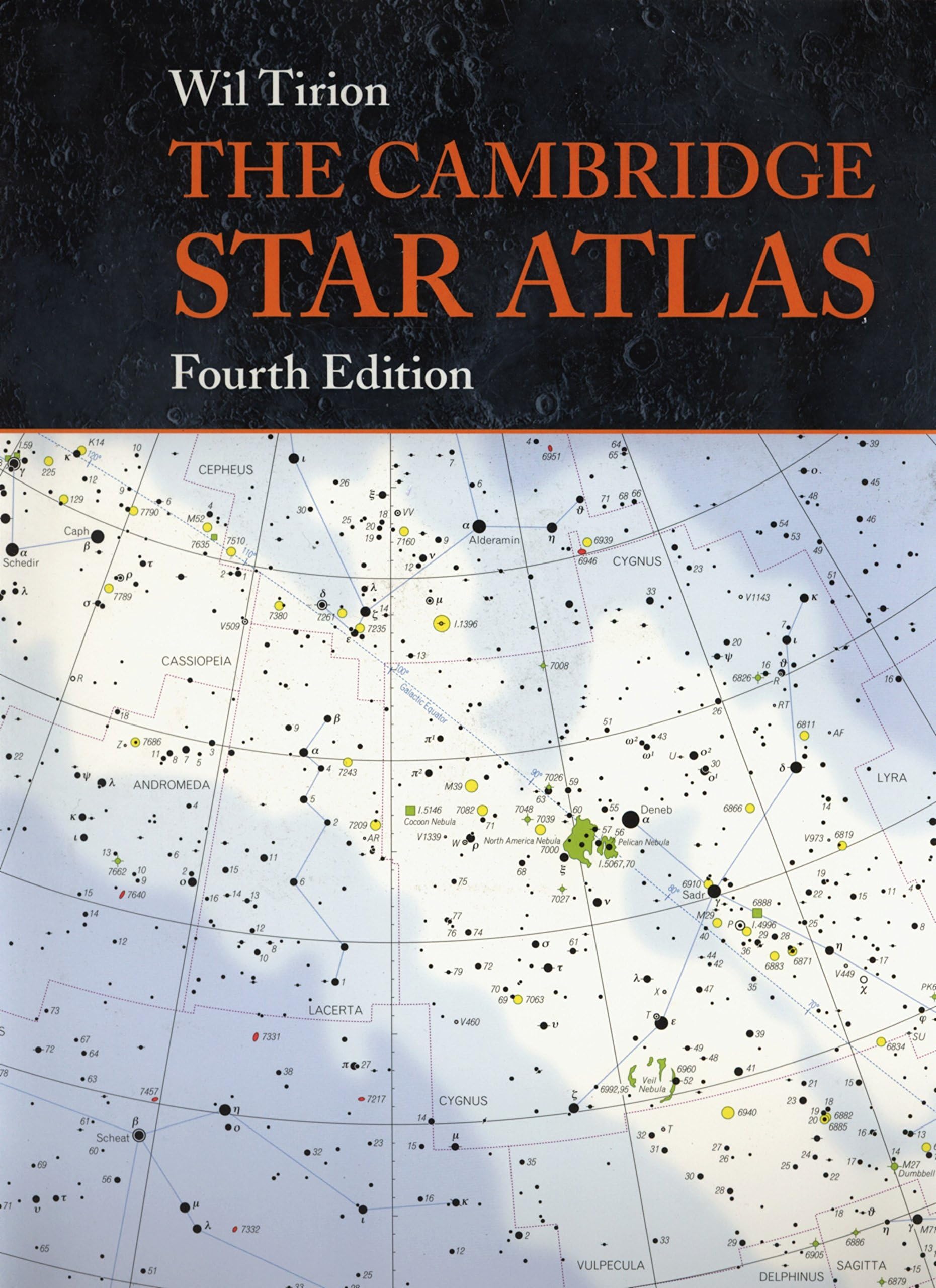
The Cambridge Star Atlas
Product ID: 3304299
🌌Detailed star maps
📏Precise scale
🔭Compatible with telescopes
Desertcart purchases this item on your behalf and handles shipping, customs, and support to Taiwan.
🌠 Discover the Universe, One Star at a Time!
The Cambridge Star Atlas is a meticulously crafted guide designed for both amateur and professional astronomers, featuring detailed star maps, precise scaling, and compatibility with telescopes, making it an essential tool for anyone looking to explore the night sky.
| Best Sellers Rank | #280,294 in Books ( See Top 100 in Books ) #22 in Astronomy & Astrophysics #61 in Star-Gazing (Books) #330 in Astronomy (Books) |
| Customer Reviews | 4.6 out of 5 stars 458 Reviews |
D**Y
Wich Star is that
Really nice star atlas definitely a great tool if you’re a backyard astronomer or just a star gazer. This is one of the most complete atlas’s you can buy for the money.
W**R
Plenty of Detail
Lots of detail on the maps. Once I got used to the layout and the tables I found it very useful.
A**N
Cambridge Star atlas
This product is concise and easy to use and is laid out logically. Of particular benefit, it's easy to estimate the relative brightness of stars by the size of the dots. You need a little background to make the atlas more useful-- particularally, a basic understanding of right ascension. The maps of the moon surface are good and there are both the correct pictures and inverted ones with labels, as seen in a reflecting scope. Physically, the spiral ring binding lays the pages flat and the paper is relatively thick and rigid. On the charts that are to be held below the horizon when being used(where East is to the right when looking north,) there is a terrestial slyline clearly visible. Also for beginners, there are didactics on the phases of the moon and instructions on how to find the correct sky chart for your particular area with the above exceptions noted. I have not used the atlas in the field yet, but since there is good contrast between the background of the page and the black star dots, it should be easy to view with a red light. Azimuthman
M**R
Great atlas for stars down to magnitude 6.5
Overall great quality and a good primer to localize many globular clusters, galaxies, nebulas, some variable stars and double stars. Some text in concept figures is rather small.
L**.
A great gift for fathers
Beautiful and accurate star atlas. A great gift for fathers day. I used to go camping with my dad when I was younger and we would look up at the stars. I got him this gift along with a telescope to view the night sky with further detail and accurate understanding/images. He is also a sailor, so using the stars to wayfind is nostalgic.
J**1
Excellent star atlas continuing observers
This atlas has a large volume of observation basics and knowledge. And then some star charts too. As can be expected the author has done an excellent job on the charts. They look beautiful. I have not had them out yet. It’s now raining in Ohio. This is not as the his star atlas 2000 was. It is limited to magnitude and therefore details. It is close to what the atlas 2000 needed. A complete reference guide to focus the intermediate observer on a trail of discovery. It’s too bad that there is almost 40 years between this and the star atlas 2000. (However my career path has taken me far from the observation path for 30 years too.)
A**R
Good first sky atlas
I purchased this as a companion for the Sky & Telescope Pocket Sky Atlas I have been using for the past 8 or so years. I find myself preferring the S&T at the telescope but for planning, the wider field of view and chart layout of the Cambridge has an advantage. Other value adds of the Cambridge are a set of moon maps for nights when the moon is up as well as a listing of prominent stars which you will use as anchor points during star hopping. One thing I was disappointed to see omitted from the Cambridge was the Caldwell catalog, not even just a listing mapping the C-numbers to NGC/IC-numbers. While technically not-a-catalog, the Caldwell catalog is specifically designed for amateur observers starting out with smaller scopes. Not a deal breaker as if you already are aware of the Caldwell catalog you can easily look it up on-line and do the mapping yourself then look up the object by its NGC/IC identifier in the Cambridge charts. From a pure "star chart" perspective I still think the S&T is superior but the additional information in the Cambridge I think makes it a good first sky atlas choice, especially over other beginner resources that are effectively reference books with a few whimpy charts. If you can afford both the Cambridge and S&T, you can't go wrong getting both to keep you busy for a while.
G**.
Excellent Reference Book
Excellent layout. Easy to navigate through the charts. Easy to assimilate. Great reference book.
J**I
The Cambridge Star Atlas
Excelente manual para pesquisas e orientação nas observações astronômicas.
M**E
Excellent chart! I am new at astronomy
Excellent chart! I am new at astronomy, i bought my first telescope last February, and i was printing constellation charts from Wikipédia before ordering this wonderful book. It is really easy to read, even for a beginner like myself, the distances from one star to the other are easy to visualize, some people might prefer a Pocket size chart, but this one fits in my optical bag and i'll never regret buying it! A must have for anyone interested in astronomy
H**O
Bellissimo
Se cercate un bell'atlante stellare questo fa al caso vostro. Giunto alla quarta edizione, è ormai un classico. L'atlante è composto da una mappa su di una pagina e gli oggetti principali sull'altra di fronte. Gli oggetti stellari sono evidenziati con colori adeguati, come pure gradevole è il colore di fondo delle cartine. La rilegatura a spirale con cui viene proposto è comoda e funzionale. Varie altre carte completano il volume, fra queste anche ammassi stellari, nebulose e altro. Insomma è fatto come si deve, proprio bello!
P**L
Excellent indispensable
Cet atlas est très clair, complet et facile d’utilisation. La nouvelle édition est encore plus aisée à utiliser. On commence avec les constellations visibles à l’œil nu et l’on continue avec les objets de Messier pour en arriver aux astres et galaxies plus difficiles à observer et à localiser class
お**ち
良い星図です。
星図もですが、月や天体に関する解説もなかなか充実しています。英語が読める人ならとても楽しめるんじゃないかと思います。自分は英語が読めないので惜しい思いをしました。。。 - 月に関する解説 - 月の詳細な地図、細かい地名 - 季節の天体について、また天体の動きについての解説 - 季節の星座マップ - メシエ天体目録(どの星図にあるか)ngc、icナンバーも併記、その他情報 - メシエ アンド インデックスチャート - スターチャート。各天体(星団、銀河等)の説明 - 星図1〜20 - 全天マップ。星座、散開星団、球状星団、散光星雲、惑星状星雲、銀河 - その他の恒星目録 …だいたい以上のような構成です。 欠点といえるかどうかは個人の主観なのでなんとも言えませんが、以下の点が気になりました。 - 天の川表示の色合いが薄く、分かりづらい。まあそもそも天の川は肉眼で見ればほとんどの地域ではうすぼんやりとした感じなので、リアルといえばリアルです。 - リング製本なのでページの引っかかりがある。 これはリング製本の書籍全般に言えることです。 - 恒星が6.5等級まで。一般的な星図とほぼ同じなので欠点とは言えませんが、目の良い人が肉眼で見える恒星だけの表示になります。双眼鏡の低倍率でも見える淡い恒星は載っていませんので、それを確認したい人はより細かい表示の星図の方が良いです。 …総じて素晴らしいと思います。白黒反転のバージョンの星図も出して欲しいですね。
Trustpilot
3 weeks ago
1 month ago