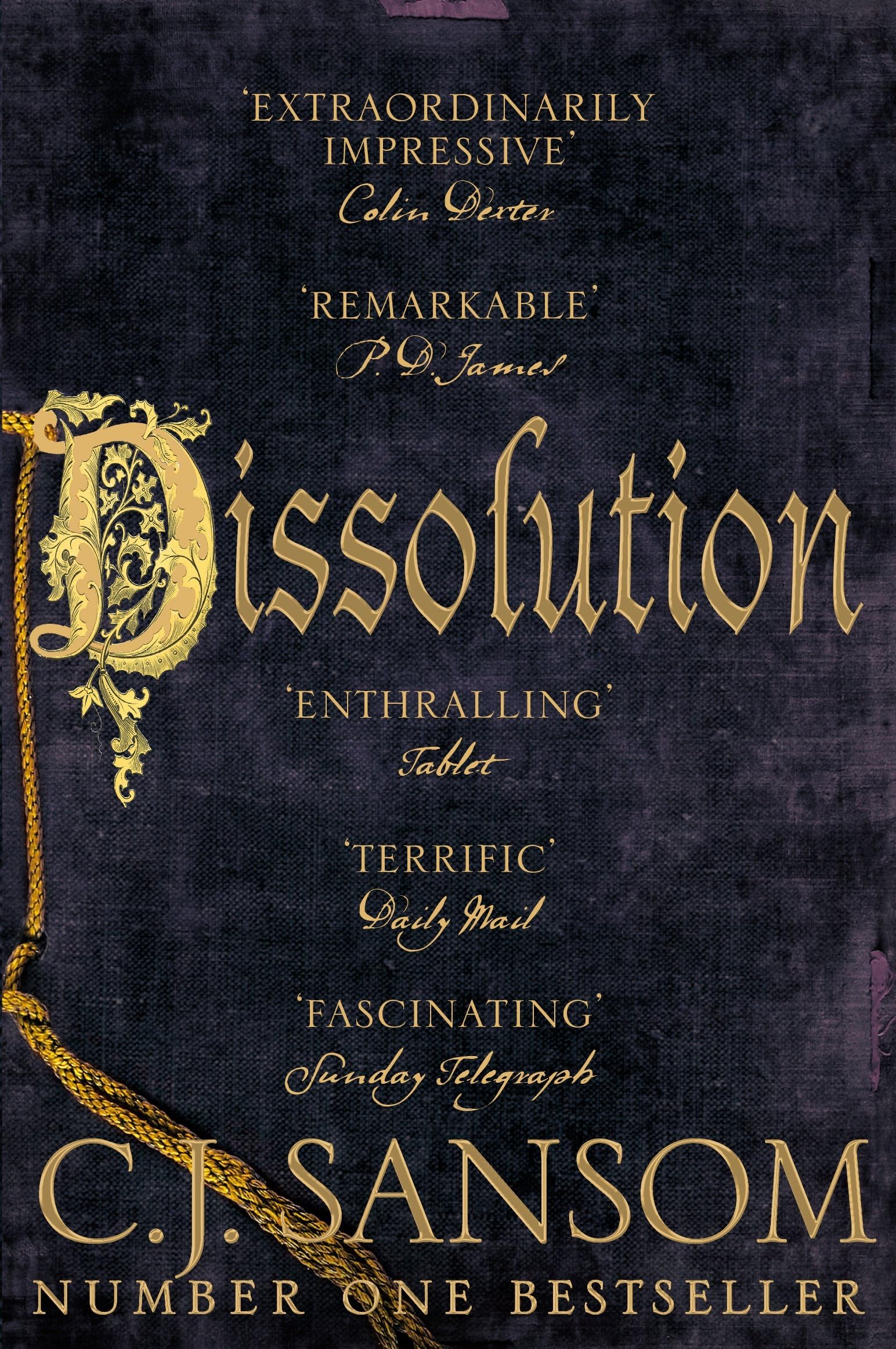
Dissolution: 1 (The Shardlake series, 1)
Product ID: 49691936
Now a major Disney+ original series 'C. J. Sansom’s books are arguably the best Tudor novels going' – The Sunday Times Dissolution is the first novel in C. J. Sansom’s phenomenal bestselling Shardlake series, perfect for fans of Hilary Mantel and Phillipa Gregory. After one of Cromwell's commissioners is brutally murdered, Matthew Shardlake is drawn into an investigation that becomes darker than he could have ever imagined . . . England, 1537. It is a time of revolution that sees the greatest changes in England since 1066. Henry VIII has proclaimed himself Supreme Head of the Church. The country is waking up to savage new laws, rigged trials and the greatest network of informers it has ever seen. And under the orders of Thomas Cromwell, a team of commissioners is sent throughout the country to investigate the monasteries. There can only be one outcome: dissolution. But on the Sussex coast, at the monastery of Scarnsea, events have spiralled out of control. Cromwell's commissioner, Robin Singleton, has been found dead, his head severed from his body. His horrific murder accompanied by equally sinister acts of sacrilege. Matthew Shardlake, lawyer and long-time supporter of Reform, has been sent by Cromwell to uncover the truth behind the dark happenings at Scarnsea. But Shardlake's investigation soon forces him to question everything that he hears, and everything that he intrinsically believes . . . Follow Shardlake into the dark heart of Tudor England with the next book in the series, Dark Fire . Review: These novels are so addictive. But do read them in the right order. - It started with this one. I'd never read anything by this author before. It took me a while to get into his style and the deceptively ambling pace, made me wonder if I'd made the right choice. But Sansome cleverly weaves his plots and the characters gradually fill out. His historical knowledge and descriptions are great and perfectly complement the places, people and plots of the story. Now I'm addicted and up to novel number six. Matthew Shardlake, physically impaired but highly intelligent and knows about the law. He's the most understated hero ever. Think Columbo in a Tudor role. Review: A fine Tudor mystery - I hadn’t heard of C J Sansom before, somehow he had passed me by but, as an author, he was recommended to me by a golfing buddie, so I thought I’d give him a go and I’m glad I did. The copy of Dissolution that I read was subtitled ‘10th Anniversary Edition’ and was published in 2008, so this author has been writing for some time and this book is the first in a series featuring the same protagonist, a lawyer by the name of Matthew Shardlake. It is England in the winter of 1537. Ann Boleyn has been executed and Queen Jane Seymour has recently died shortly after giving birth to Henry VIII’s much desired male heir. The dissolution of a number of small monasteries, abbeys and priories has led to rebellion in the North of England, causing the dissolution process to be paused. Instead, the larger, richer monasteries will be ‘persuaded’ to ‘surrender’ themselves to the King, handing over their land and treasuries to enrich Henry and provide lands for his favourites. A Royal Commissioner sent to Scarnsea Abbey, in Sussex, to persuade it to surrender, has been murdered and Matthew Shardlake is sent by the Vicar General (also Lord Privy Seal), Thomas Cromwell, to find out who committed the murder and, also, to complete the mission of the previous commissioner and obtain the surrender of the monastery. Shardlake is presented with a range of suspects, all of whom have motives for committing the crime. There is the Abbott, the Bursar, the Prior, the Infirmerer, the Sacristan and several others. While there is plenty of evidence as to previous bad behaviour, the problem is finding any evidence to convict any of them for murder. To add to Shardlake’s problems, snow arrives, virtually cutting the Abbey off from the outside world. Then there is a second murder, or is it the third? On the whole the reader is presented with a satisfying detective story which would baffle Scotland Yard’s finest if it were set in a later period. Hampered by the lack of any modern assistance, Shardlake must solve the crimes using only his own wits and the assistance of Mark Poer his young, if rather rebellious, protégé. The characters are well drawn and suitably reticent about what they know or are willing to say. There is a strong feeling of period, especially when the author describes cities and towns such as London. The plot is believable and told in a suitable style for the period in which the story is set. Fans of detective fiction will be just as satisfied as fans of historical fiction. So, why only four stars? Firstly, there is quite a lot of theological debate between Shardlake and the monks and with his assistant Mark. While the monks have sought to protect themselves by swearing an oath to obey Henry’s new laws on Christian worship, it is clear they were reluctant to do so. Given the period this sort of debate probably actually took place, but here there is a little too much of it and it slows the pace of the story. On the other hand, I did learn a lot about what had gone on. Bigod’s rebellion, for example, was real but I had never heard of it. Secondly, the way the author drip feeds the ‘evidence’ into the story doesn’t allow the armchair detective to solve the crime before Shardlake. We have to wait until the author provides the last vital bit of the jigsaw puzzle before the murderer can be revealed; there is no way of deducing it beforehand, which rather spoiled the fun for me. The author does provide some pointers to what may have happened, but the revelation of the murderer does feel a bit like a conjurer saying ‘hey presto’. I like to be able to feel cleverer than the protagonist and the author doesn’t provide me with that opportunity. But, that aside, this is a very entertaining historical detective novel and I will be reading more in the series.


| Best Sellers Rank | 413,339 in Books ( See Top 100 in Books ) 3 in Spiritual & Historical Fiction 10,386 in Science Fiction Crime & Mystery |
| Customer Reviews | 4.4 out of 5 stars 18,053 Reviews |
Y**N
These novels are so addictive. But do read them in the right order.
It started with this one. I'd never read anything by this author before. It took me a while to get into his style and the deceptively ambling pace, made me wonder if I'd made the right choice. But Sansome cleverly weaves his plots and the characters gradually fill out. His historical knowledge and descriptions are great and perfectly complement the places, people and plots of the story. Now I'm addicted and up to novel number six. Matthew Shardlake, physically impaired but highly intelligent and knows about the law. He's the most understated hero ever. Think Columbo in a Tudor role.
C**T
A fine Tudor mystery
I hadn’t heard of C J Sansom before, somehow he had passed me by but, as an author, he was recommended to me by a golfing buddie, so I thought I’d give him a go and I’m glad I did. The copy of Dissolution that I read was subtitled ‘10th Anniversary Edition’ and was published in 2008, so this author has been writing for some time and this book is the first in a series featuring the same protagonist, a lawyer by the name of Matthew Shardlake. It is England in the winter of 1537. Ann Boleyn has been executed and Queen Jane Seymour has recently died shortly after giving birth to Henry VIII’s much desired male heir. The dissolution of a number of small monasteries, abbeys and priories has led to rebellion in the North of England, causing the dissolution process to be paused. Instead, the larger, richer monasteries will be ‘persuaded’ to ‘surrender’ themselves to the King, handing over their land and treasuries to enrich Henry and provide lands for his favourites. A Royal Commissioner sent to Scarnsea Abbey, in Sussex, to persuade it to surrender, has been murdered and Matthew Shardlake is sent by the Vicar General (also Lord Privy Seal), Thomas Cromwell, to find out who committed the murder and, also, to complete the mission of the previous commissioner and obtain the surrender of the monastery. Shardlake is presented with a range of suspects, all of whom have motives for committing the crime. There is the Abbott, the Bursar, the Prior, the Infirmerer, the Sacristan and several others. While there is plenty of evidence as to previous bad behaviour, the problem is finding any evidence to convict any of them for murder. To add to Shardlake’s problems, snow arrives, virtually cutting the Abbey off from the outside world. Then there is a second murder, or is it the third? On the whole the reader is presented with a satisfying detective story which would baffle Scotland Yard’s finest if it were set in a later period. Hampered by the lack of any modern assistance, Shardlake must solve the crimes using only his own wits and the assistance of Mark Poer his young, if rather rebellious, protégé. The characters are well drawn and suitably reticent about what they know or are willing to say. There is a strong feeling of period, especially when the author describes cities and towns such as London. The plot is believable and told in a suitable style for the period in which the story is set. Fans of detective fiction will be just as satisfied as fans of historical fiction. So, why only four stars? Firstly, there is quite a lot of theological debate between Shardlake and the monks and with his assistant Mark. While the monks have sought to protect themselves by swearing an oath to obey Henry’s new laws on Christian worship, it is clear they were reluctant to do so. Given the period this sort of debate probably actually took place, but here there is a little too much of it and it slows the pace of the story. On the other hand, I did learn a lot about what had gone on. Bigod’s rebellion, for example, was real but I had never heard of it. Secondly, the way the author drip feeds the ‘evidence’ into the story doesn’t allow the armchair detective to solve the crime before Shardlake. We have to wait until the author provides the last vital bit of the jigsaw puzzle before the murderer can be revealed; there is no way of deducing it beforehand, which rather spoiled the fun for me. The author does provide some pointers to what may have happened, but the revelation of the murderer does feel a bit like a conjurer saying ‘hey presto’. I like to be able to feel cleverer than the protagonist and the author doesn’t provide me with that opportunity. But, that aside, this is a very entertaining historical detective novel and I will be reading more in the series.
F**T
Murder in a Monastery - Faster, easier read than Name of the Rose
If you’re a fan of medieval monastery murder mysteries, and either loved The Name of the Rose, or just couldn’t plough through it, this is the book for you. The Name of the Rose, I am embarrassed to say, was a DNF for me (the only book I started but didn’t finish in the last five years or so). I would love to go back to it someday, as the setting in particular fascinated me, but I couldn’t connect with the writing style. Dissolution, the first book in the Matthew Shardlake series, was a fast and cosy whodunit which helped to scratch that itch in the meantime. I say cosy, though at times it was anything but. It is set in the time of Henry VIII, after the execution of his first wife, and Thomas Cromwell’s assault on the Catholic Church. One of his agents has been murdered at a monastery. Enter Matthew Shardlake, lawyer / investigator with a hunch. On his back. There’s mention of dungeons and racks and torture, but nothing too graphic. Religious discussions that never got overwhelming. Overall, an engaging plot, interestingly written characters, and as I mentioned, an intriguing setting. If you loved The Name of the Rose, give this a try. If you hated it, give this a try. I know I’m looking forward to continuing with the series. Apparently there’s a TV series coming up soon.
S**S
ABSOLUTELY SPLENDID...................................
As one who normally only reads in bed, I could not lay this book down, and got stuck into it every chance I could. There is a certain magic about it, not that the plot is fantastic, but it is compulsive reading, I loved the main character, the hunchback Master Shardlake, and the physicician Brother Guy, a black face in Tudor England - a rare man indeed. There are four murders and a lengthy list of suspects in an Abbey destined for closure by the Crown. King Henry VIII has distanced himself from the Pope in his need to divorce Catherine of Aaragon and marry Anne Boleyn......and on the story goes............... Commissioner Shardlake is sent to Scarnsea Abbey by Lord Thomas Cromwell to investigate the murder of the previous Commissioner, Singleton. Then they start dropping like flies. Can one of the monks be a murderer? Where is Cadfael when you need him? The author has done some considerable research into this period and has given us an absolute cracker of a good old-fashioned whodunnit. The characters are colourful, diverse and interesting and the dialogue spontaneous - when it could have seemed olde worlde. The landscape and surroundings well described without becoming boring and you can picture yourself there.There is no shortage of excitement and at times I was reading faster and faster and turning the pages like the clappers. Let us hope it the start of a long series. I could take a lot more of this. A fabulous read, not to be missed!!!
J**K
Agatha Christie Medieval Style
Normally I wouldn't give crime thrillers set in monasteries in the Middle Ages a second glance, having been bored stiff by The Name of the Rose (film and book) years ago which set off an industry of historical crime novels. However, I bought this book after being impressed by Sansom's novel Winter in Madrid. At first I thought I had made the right decision and the book gets off to a good start with the hero, a hunchbacked lawyer-turned-detective called Shardlake, being given a secret assignment by the Machiavellian Thomas Cromwell who is plotting to seize all the monasteries in England on behalf of Henry VIII. It is almost like a James Bond novel (without the gadgets) and the investigator heads off to a monastery in the Sussex marshlands to find a killer who has decapitated his predecessor. From then on the body count mounts and our hero finds himself trying to track down a mass murderer, with the evil Cromwell breathing down his back and demanding results. The writing is good and some of the characterization strong but once we get to the monastery, where we are conveniently trapped for a week by heavy snowfall, the pace begins to slow and the plot begins to creak. James Bond disappears and we end up in classic Agatha Christie murder-in-the-library territory and wait to find out who among the five possible murderers will be exposed. Overall, a reasonable read.
L**N
History brought to life by a master writer
Excellent reading a genuine gripping series, all a master class in historical storytelling.
A**R
Delivery on time
Very good product
K**R
History brought to life - the second time around!
I first read this story some years ago, well before I bought my kindle, and thoroughly enjoyed it. Eventually I donated my paperback copy to a charity to make space for more books. Then, one day, I bought my kindle and began collecting the rest of the Shardlake series and enjoyed these also. Of course there is no need to worry about space saving now, I can collect as many books as I like. So, I saw Dissolution for sale at a good price (the kindle version) and decided on a whim to get it and re-read it. I am glad I did. Sansom has a way of taking the reader right into the story. It is a dark and dangerous period of history. There is a mixture of ingredients: murder, mystery, intrigue all to be resolved by the anti-hero, a man who is often shunned by the rest of the world because of his disability in a time when prejudice, ignorance and superstition were rife. This story takes place in the depths of a bitter winter which is so well described by the author that I sometimes shivered when I was reading! Sansom is very knowledgeable on history and weaves that knowledge in this spellbinding story. Even though I had already read this book I was held as captivated as I had been the first time around. I am now planning to re-read the rest of the series in order.
M**R
The Protestant Reformation brought to Life
The Protestant Reformation was a complex transition in the U.K. This book shines a light on all the major societal changes that it involved. It makes it much easier to understand, and it clarifies how different people felt about it. The author is highly knowledgeable about the reformation. And, importantly, he is an outstanding writer. It’s a gripping story that is hard to put down. It is highly entertaining and enjoyable, a real page turner. When I finished the book, I found myself with a much more nuanced understanding of the complexity of the highly controversial Protestant Reformation.
L**A
Leggete i primi sei libri prima
Tutto mi è piaciuto. Ho letto tutti e 7 questa serie di libri - ti riportano nei regni di Enrico VIII e poi suo figlio Eduardo VI con la crudeltà, squallore e fatti storici di quel periodo. L'avvocato Matthew Shardlake diventerà un amico, lo conosci, soffri con lui, senti le sue paure in un periodo storico dove la giustizia non regna supremo, la medicina come la conosciamo noi non esiste … consiglio la lettura partendo dal primo libro - L'Enigma del Gallo Nero poi La scomparsa del Fuoco Greco e poi gli altri 5. Provare per credere ma preparati a sentire la mancanza di Matthew Shardlake quando arrivi alla fine della serie. Speriamo che C J Sanson scriva ancora qualche libro seguendo il suo eroe nel regno di Elizabetta I.
W**G
Excelente
Very good by any measure. I really look forward to the next ones... a lot if fun in a fast paced reading
R**I
A thrilling history crime fiction by the renowned C.J. Sansom
A thrilling history crime fiction by the renowned C.J. Sansom.
K**R
Devolution
Good well written and enjoyable
Trustpilot
1 month ago
2 weeks ago