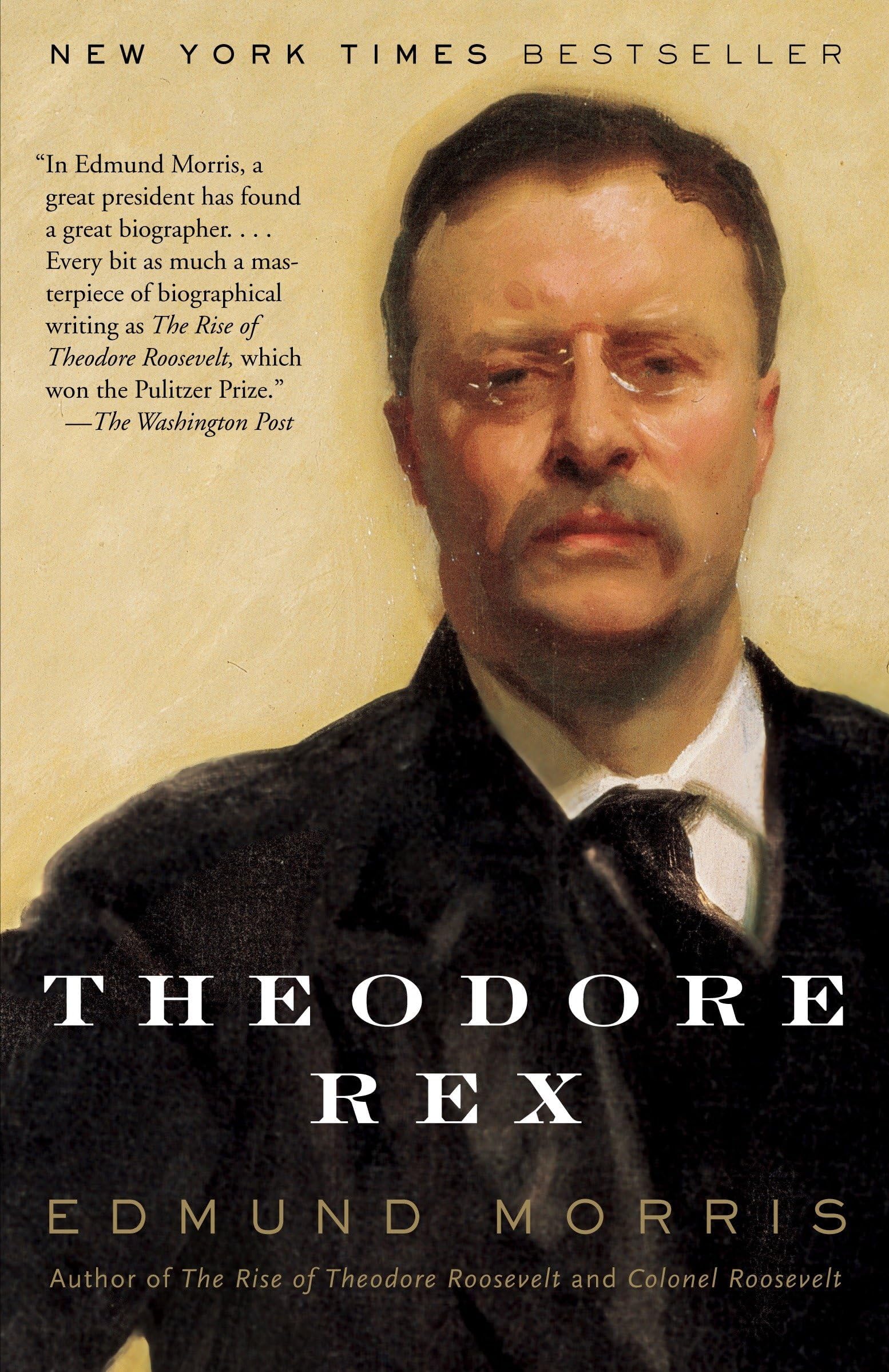
Theodore Rex: Edmund Morris (Modern Library Paperbacks)
Product ID: 61631855
🏆Award-winning biography
📚Top-ranked historical bestseller
📦Next-day UK dispatch
Desertcart purchases this item on your behalf and handles shipping, customs, and support to Taiwan.
📖 Own the story behind America’s first modern presidency—don’t just read history, live it!
Theodore Rex by Edmund Morris is a critically acclaimed, bestselling biography detailing Theodore Roosevelt’s transformative presidency. Celebrated for its rich narrative and historical depth, it covers TR’s political genius, conservation efforts, and global impact. Dispatched next working day from the UK, this award-winning book is a definitive read for anyone passionate about American history and leadership.


| Best Sellers Rank | 180,129 in Books ( See Top 100 in Books ) 16 in United States Historical Biographies 109 in Political Leader Biographies 1,031 in Historical Biographies starting 1901 |
| Customer Reviews | 4.6 out of 5 stars 1,570 Reviews |
H**H
An Excellent Chronicle of the First Modern Presidency
Theodore Rex by Edmund Morris is a very good book detailing the presidency of Theodore Roosevelt. It is a well-written, informative and detailed work outlining the effect that Roosevelt had upon both the office of the President and the United States. Theodore Roosevelt was a politican of firm views. A supporter of the market system, who nevertheless saw its flaws and inequities, he worked to reform a system which seemed stacked in the favour of cartels and monopolies. A Republican who was not afraid to challenge his own party on a variety of issues - although this ultimately caused problems and storred up resentments for the future - and was willing to use his undoubted popularity to appeal to the wider electorate in order to bring about change. A conservationist and a global statesman whose actions and measures preserved millions of acres of wilderness, but who was also one of the driving forces behind that great monument to industrial progress, the Panama Canal. Overall, an excellent book examining the extraordinary presidency of a remarkable man.
J**N
First Steps to Becoming a World Power
Edmund Morris writes an excellent book on Theodore Roosevelt's presidency. He comes across as probably the best U.S. President.being probably more Democrat than Republican in his ideas and used Congress to get those ideas passed as well as using executive powers to by-pass Congress when necessary. He was not anti-business, just against businesses using their power unfairly, and he was not pro-labour per se, just wanted labour to be treated fairly. He set the U.S.A. on course to become the world power that it now is. A book is well worth reading, giving and insight to Roosevelt's opinion of Germany and Japan that were becoming aggressive and an interesting episode is the tactics used to put a stop to illegal Japanese immigration.
M**K
Kindle in UK?
Book 1 is available on kindle in the UK. As is book 3. This one, book 2, is only available on kindle in the USA, not the UK. This should be fixed.
D**N
Compelling
Charts TDR's presidential years. Detailed, yet compelling read, look at President Roosevelt, the highs and the lows. Yet I doubt we will see the like of him again. Excellent history and essential reading.
T**R
Rex Rave Reviews
The definitive biography of Theodore Roosevelt. Lyrical, detailed, engaging. But also insightful and accurate. Well written.
C**L
If only we had politicians like TR today...
It says something about Theodore Roosevelt that this second volume, covering his White House years, is possibly the least interesting of the three. That a life could be more exciting and interesting in his years before and after the Presidency is something that could probably only be said about one President, and that's Theodore Roosevelt. That said, this volume really serves to highlight what a remarkable politician TR was. It's almost a shame that he was President in perhaps the one decade where little of world import happened. Although perhaps he was the reason so little happened! One can only wonder 'what if' someone like TR has been in the White House during WW1. Would America have taken so long to enter? Would he have stood Congress' refusal to ratify the League of Nations? Would it even have got to that point? For a man so famously aggressive and bellicose, it is telling that his most famous phrase is 'speak softly and carry a big stick'. TR understood perhaps better than anyone that an aggressive attitude and a powerful army often serves to remove the need to use them. His Presidency was often marked with battles with Congress, but it's interesting just how often TR came out on top. He was a master at manipulating the press, at twisting issues to serve his needs, at balancing one side against the other. He was also one of the few politicians, perhaps of any era, who really seemed to listen to the public mood. He began his Presidency promising to continue the conservative policies of McKinley and ended up very nearly a Progressive. For those of us who see what the Republican Party has become, it's fascinating to see TR backing so many things we almost think of as anathema to modern Republicans - the importance of the environment and conservation, the danger of massive corporations, the need for income and death taxes, the support of labour over corporate interests. Again, this is a masterful book. There are few public figures of whom I would be prepared to read such a massive three-volume biography, and I can think of few other biographers who could make such a read not just interesting, but entertaining and thoroughly enjoyable. Roll on, volume three!
C**Z
The best book of the trilogy
The best book of the trilogy
D**S
A unique biography of a most unique man
Edmund Morris' book stands out from conventional biographies. It is written sometimes from a POV style, which is more common in a fiction novel than a history. But the book is enriched by it. The POV captures Teddy Roosevelt's personality perfectly, as he confidently tackles one issue after another. The book kicks off with Roosevelt taking the presidential oath after the murder of William McKinley, and concludes upon his exit from office in 1909. As President, Roosevelt consistently exhibited the same energy and hard work he was renowned for in his personal life. These character traits and his general instincts defined his presidency more than any obvious ideological bent. He was not a socialist who sought to end class inequality, nor a total nativist, nor a Hamiltonian tariff protectionist. He was not a race egalitarian, nor a committed bigot like Woodrow Wilson. But Roosevelt followed through on his personal instincts and implemented policies with perfect execution. His period in office was marked by several lasting achievements. His sympathetic view of the American working man led him to oversee an expansion of labour rights and workplace regulations. His distrust of unfairly concentrated economic power led him to rein in the rail monopolies, despite opposition from conservative Republicans in his own party. His positive view of executive power and American imperialism led him to pursue aggressive foreign policies abroad. His interest in global affairs led him to successfully navigate international crises, such as the treaty negotiation that ended the Russo-Japanese War. He was incredibly foresighted about the possibility of a Pacific war with Japan, and massively built up America's navy. And of course, there was Roosevelt's pet project of building the Panama Canal, which began during his presidency (although to accomplish this he helped orchestrate Panama's illegal secession from Colombia). By the time Roosevelt left office, America had a stronger Presidency, geopolitical position, and economy from when he took over. It had also seen a reduction in class conflict, much to Roosevelt's satisfaction. One reason Roosevelt was motivated to adopt progressive policies and mediate worker-employer disputes (as he masterfully did with the Pennsylvania miners' strike) was to reduce the odds of social instability and anarchist chaos. Few other men could've simultaneously won the respect of Slavic miners and titans like JP Morgan. Roosevelt never seems to have rested for long, and the book shows how intensely he worked throughout his presidency. Even his holidays often involved things like hunting or exploring nature. His love of strenuous exercise, which stemmed from his time as a common rancher in the Dakotas, was also displayed in DC itself. He would commonly play tennis with politicians or foreign ambassadors, or take them hiking and swimming. This masculinity defined Roosevelt more than any other characteristic. He prioritised strength in every field of life. This manifested in dark ways too. Roosevelt was a firm believer in Social Darwinism, imperialism, and racial hierarchy. The most shameful episode of his presidency was linked to the American occupation of the Philippines. Early in Roosevelt's presidency, he discovered that US General Jacob Smith had ordered massacres of Filipino males above the age of 10. Roosevelt was content to ignore this evil until it ignited outcry among American journalists and both major parties. Only then did Roosevelt decide to spring into action and expel Smith from the army. Morris documents this and other flaws honestly, which ensures that Roosevelt's biography is not a hagiography. Another example was Roosevelt's inability to fully condemn the white supremacy of the American South. He criticised lynchings as barbaric and promoted some black civil servants, but did not believe in full civic equality. He stayed silent when whites in Atlanta conducted an anti-black pogrom in 1906. His invitation of Booker T Washington early in the White House ignited outrage in the white South, and he never took such a bold step again. Roosevelt was incredibly popular among Americans throughout his presidency. At the time he was universally acknowledged by his compatriots and foreign visitors as the most popular American alive. His enemies tended to be conservative Republicans and Democrats sitting in Capitol Hill, along with their elite backers in business. But even those politicians and plutocrats often gave way to his legislative dealmaking and personal charm. The Republican Party was unanimous in giving Roosevelt the 1904 nomination, despite some speculations of a conservative revolt. Roosevelt's heterodox policies, bombastic and energetic personality, and civic nationalism helped him win the 1904 election in one of the biggest landslides in US history. Immigrant groups, native-born northerners, blacks, and even the Solid South state of Missouri voted for Roosevelt in droves. In fact, the love for him was so strong that the 1908 RNC Convention would've certainly endorsed him for another term if he'd asked for it. When he left office, it was consensus that Roosevelt was one of the best presidents America has ever seen. That is thankfully still the case today. He gives every political wing something to admire. For the Left: his environmental conservationism, his creation of America's national parks system, and his willingness to stand up to the biggest corporate monopolies of the era. For the Right: his promotion of the nuclear family headed by a working man, his embodiment of masculine virtues, his strong national security policy, and his WASP sense of noblesse obligeé. Roosevelt also possessed qualities that should be valued by everyone. He had a thirst for knowledge that made him read and review dozens/hundreds of books in various languages every year. He was akin to a human encyclopedia. Yet he also had a frontiersman's preference for taking action over sitting things out. He was a devoted family man, too, and his children went on to accomplish their own feats. Who can forget Teddy Roosevelt Junior storming the beaches of Normandy at the age of 56? All in all, this is a great portrait of perhaps the most quintessentially American man in that nation's history.
通**い
伝記
ルーズベルトの名は知っていても、軍人出身の大統領で、先の世界大戦のときの人という程度の豆知識しかなかったのですが、ボブ・ウッドワードのプラン・オブ・アタックの中でジョージ・W・ブッシュがイラク戦の前のテキサスの自宅牧場で読んでいたという記述に出会い、興味をもって購入しました。強烈なキャラクターの主人公であるだけでなく、伝記中の伝記とアメリカで言われているだけあって、物語の展開などは巧みで、ルーズベルトの詳細はどうでもよい私のような読者も退屈することなく読めました。また、文章がいいので、抄本版のCDも買い、英語の勉強のために聞いています。たまたま読んだ本に引用されていて、厚い本なのに安いから買った程度の動機でも十分に満足できるものでした。
M**H
Soddisfatto
quello che cercavo
L**4
Very detailed biography
This is a terrific and very detailed biography of Theodore Roosevelt's presidential years. I highly recommend it for anyone who wants to learn more about this great American president.
B**U
I L L U M I N A T I N G .
An entertaining eloquent portrayal of Theodore Roosevelt as the President of the United States. From the unexpected assassination of President William McKinley, assuming the Presidency, then winning the Presidential election after 3-1/2 years in office, and subsequently, his continued impact upon America and the world, including, the Panama Canal, the successful mediation between Japan and Russia, the establishment of national parks, and, reconfirming the Monroe Doctrine in South America. The Author skillfully resurrects Roosevelt to life. One can almost hear Teddy enthusiastically proclaim "DELIGHTED" or "BULLY" -- his favorite expressions. In 1908, Roosevelt was eerily prophetic in asserting that war with Japan would ultimately happen. He declared "... war with Japan ... would [occur] one day.... The surerst way to postpone it ... was to prepare for it as much as possible, and show evidence of a steely willingness to fight" (Page 534). He was proven correct as Pearl Harbor was devastated 33 years later in 1941, which led to the U.S. participating in WWII, and commanded by his nephew, President Franklin Roosevelt. Theodore's active naval enlargement defined his foreign policy of dealing from strength: "We infinitely desire peace, and the surerst way of obtaining it is to show we are not afraid of war" (Page 229). Although lacking the elusive charismatic flair of the Author's first volume, overall, this book was engaging, detailed, informative. And, at times, subtlety humorous. For instance, in peacefully concluding the possible precipitous conflict with the Columbians at Panama, "... [Columbian] Colonel Torres ... [finally] agreed to accept an 'indemnity' of eight thousand dollars ... [and was] sent a farewell gift of two cases of champagne" (Page 293). Thus, violence was averted. If all hostilities could be so easily solved with money and alcohol.
M**S
Bom livro
Detalhada biografia de um grande presidente.
Trustpilot
2 months ago
3 weeks ago