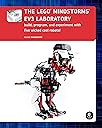
The LEGO MINDSTORMS EV3 Laboratory: Build, Program, and Experiment with Five Wicked Cool Robots
Product ID: 77853758
📊Hands-on STEM learning
🤖Advanced EV3 robotics
⚙️5 programmable robots
Desertcart purchases this item on your behalf and handles shipping, customs, and support to Taiwan.
🤖 Unlock your inner robotics genius with LEGO EV3 mastery!
The LEGO MINDSTORMS EV3 Laboratory is a comprehensive guide to building and programming five sophisticated robots using the LEGO EV3 set. Authored by a robotics expert, it combines hands-on projects with STEM education, covering mechanics, programming, and engineering principles. Perfect for young adults and professionals eager to deepen their robotics skills beyond basic builds.
| Dimensions | 20.7 x 2.8 x 25.4 cm |
| Edition | 1st |
| Generic Name | Related Text |
| Isbn 10 | 1593275331 |
| Isbn 13 | 978-1593275334 |
| Item Weight | 1 kg 60 g |
| Language | English |
| Print Length | 432 pages |
| Publication Date | 13 October 2013 |
| Publisher | No Starch Press |
| Reading Age | 12 years and up |
User
Nice. Like it
This book in the programming side is a little complicated,but once you understand it its very easy. The models are also very nice. Five stars
User
A must buy.
There are a lot of Lego NXT books out there, and I own a few of them. This book is by far the best I have purchased (I read it cover to cover in a single sitting the day I received it), but it will not please everyone. Why? Let me explain.I am not an automatic fan of everything Lego. I don't collect sets, and I don't furiously build everything I stumble upon. I bought the NXT 2.0 kit with the sole purpose of educating my kids, just as I bought real fossil sets, kumon math books, small and not so small microscopes, etc... Call me a sucker for anything that claims, with a reasonable grounding in reality, to be technically and scientifically educational. Sadly, I was probably a bit over-optimistic: a 6 years old boy and a 3 years old girl are not a good audience for a robotic kit. Now that they are a few years older, I decided to try again, with the same goal - entertaining education - and an EV3 kit. It is from that perspective that I will judge this book.The book begins with a good and brief introduction to the EV3 kit pieces and their names. Unlike some of the other NXT 2.0 books I own, this part is not an overly verbose page filler. Mentions of structures and frictions are a hint of things to come.Chapter 2 and 3 introduce the mandatory base platform and the visual block programming. This is probably the weakest part of the book: while they are excellent and have to be there if only for the users who will only buy one book, I can't help thinking it deprives us from a bit more of what follows, which is even better.Chapter 4, 5 and 6 dive deeper into programming and the first application. Interesting experiments are suggested, not randomly but in the framework of a logical pedagogical approach.Chapter 7, "The math behind the magic" floored me, because I didn't expect it. It could have said something like "the robot doesn't perform greatly, but hey, its only Lego and real robots performed better" No, like an invisible hand guiding us through experiments, it quietly introduces the notion of measurement noise. A fundamental notion that touches so many things in our modern science and technology, that our kids could eventually encounter during their secondary studies if they have a good math or science teacher, is presented in a way that a 12 years old boy can understand! And followed up by experiments that lead to immediate practical improvements in the robot's behavior.Chapter 8 is a cookbook of Lego recipes that addresses structural integrity, friction, typical machine parts. It is goal oriented: do you want strength? A lot of friction or none? This is again a place where I have seen other books (and Lego's own instructions) fail: they give you building instructions but don't tell you why the model is being build that way. Here, your get a good primer on common mechanisms and structural issues. After reading it, you won't think in terms of "I put a beam here because the instructions say so" but you'll know the reason why you are doing it "I put a beam here because I want to improve the rigidity of that important piece". Again, fundamental issues of mechanical engineering insidiously pushed into the brains of our kids (and I like that!)The rest of the book follows a regular pattern. Build a robot, experiment a bit, improve, experiment more, think. It touches essential programming concepts (the notion of variable, arrays, logic etc....), fundamental software architecture patterns (state machines!) in a style that is never boring or paternalistic. A bit of math is used here and there but nothing (except maybe the basic use of trigonometry) that a 12 years old couldn't understand. The added bonus, of course, is that kids realize that the math they learn at school is useful in the real world.To summarize: this book marvelously introduces kids to fundamental scientific, engineering and software programming concepts. Its flow and pedagogical approach is so smooth that kids aren't bored and don't even realize they are taught those things (which is a very, very good thing with kids - try to force them study polygons properties by rote because polygons are important).Now, for the caveat: The only audience that could be a bit disappointed is the type of audience that wants to build spectacular robots for the fun of it, or because they find the Lego build process mindlessly relaxing. The robots in the book aren't fancy or truly spectacular.For the adult who wants to build solid robots and learn sound building and design techniques: an excellent book.For my purpose: the almost perfect book. (I find something like Bricx to be ultimately better than the standard visual development environment and its quirks)
User
Für Jeden Lego Planer ein tolles Handbuch
Meine aktive Lego-Zeit ist nun schon 40 Jahre vorbei und für mich als Informatiker suchte ich einen Einstieg in das EV3 System mit dem Ziel jungen Menschen die Robotik nahe zu bringen. Das Buch ist dafür ein optimaler Leitfaden: Erst werden die einfachen Schritte des Systems mit einem modularen Rad-Roboter vermittelt und dann die Brücke zu Mathematik und Physik geschlagen, ohne auf die Motivation junger Menschen zu verzichten. Mein Favorit der sehr schön konzipierten Roboter ist die Gans. Die muss man als Lego Fan gebaut und beobachtet haben.Ich kann das Buch für jeden (Wieder-) Einsteiger empfehlen! Das Englisch ist gut verständlich und stellt keine Hürde dar!
User
Supporto didattico eccezionale
Amo molto i libri ben fatti, soprattutto se l'obiettivo principale è quello di formare menti fresche ad un mondo così dinamico.Libro ben strutturato che invoglia la lettura già dalle prime pagine e il desiderio di vedere realizzate le creazioni qui proposte.Solo chi ama il proprio lavoro è in grado di trasferire altrettanta passione agli altri.Inoltre il libro è in inglese: mi sono reso conto tardi di quanto sia importante conoscere bene una lingua.Ora anche mio figlio di 9 anni si sta avvicinando a questo libro e pian piano sta imparando la terminologia con me al suo fianco. Un'ottima occasione per stare insieme e condividere passioni. Molto soddisfattoDario
User
Escrito por un genio
El autor de este libro es un genio. Um libro muy completo y bien explicado. Incluye temas que son imprescindibles y básicos para empezar, y que además no deben estudiarse por separado: Técnicas básicas de construcción, teoría y práctica con trenes de engranajes y programación. Y por supuesto todo ello puesto en práctica con sus alucinantes propuestas de robots.
User
Très bon livre sur l'EV3.
Très bon livre, bien écrit, clair. Une boîte EV3 suffit pour construire les différents modèles proposés (un modèle à la fois évidemment). Donne aussi des idées pour aller plus loin. A noter qu'Eyrolles édite aussi un très bon livre en français proposant également des montages avec l'EV3. Ces deux livres se complètent tout à fait.
Trustpilot
3 days ago
5 days ago