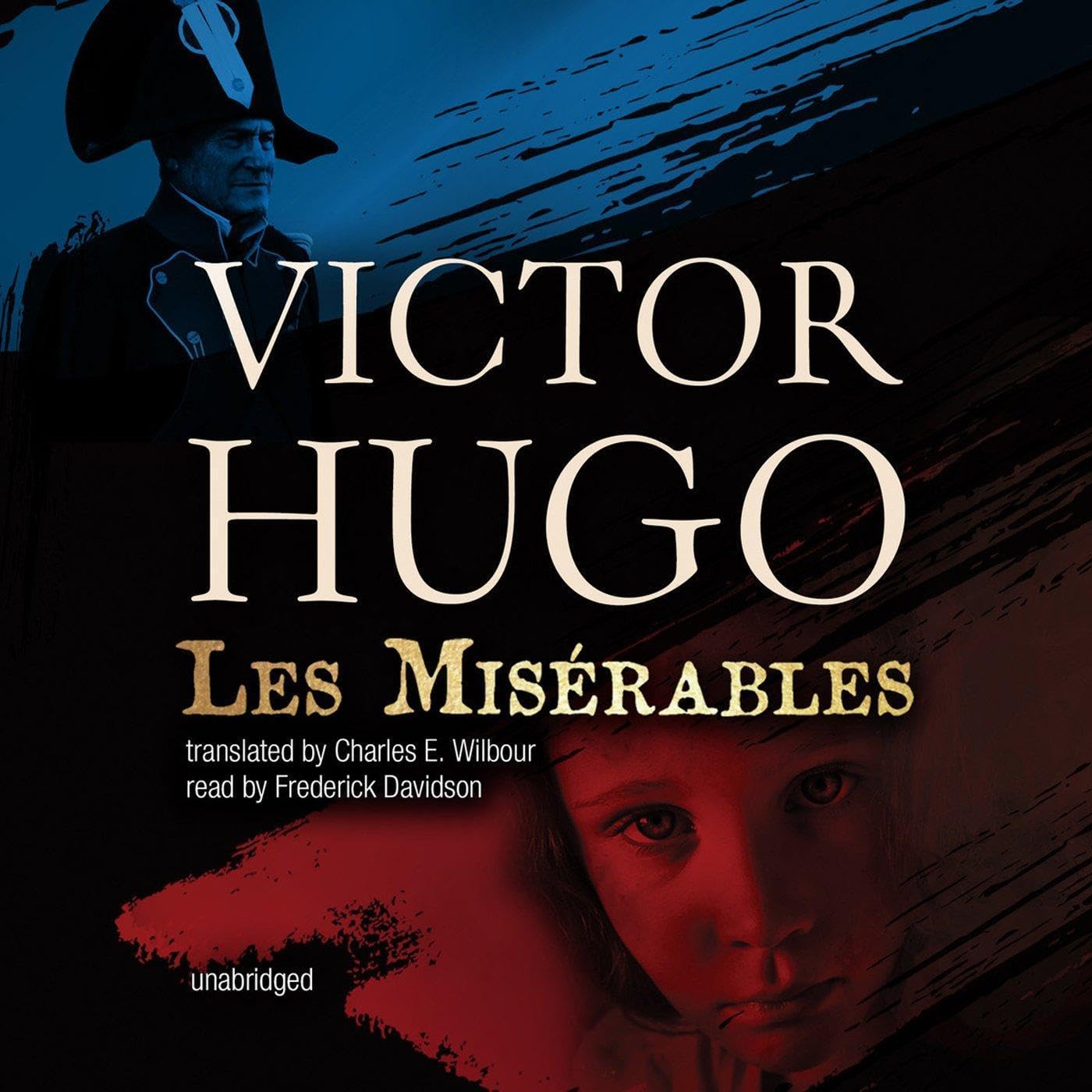
desertcart.com: Les Miserables (Audible Audio Edition): Victor Hugo, Frederick Davidson, Blackstone Audio, Inc.: Audible Books & Originals Review: Exceptional - This is an exceptional book! A book of deep emotion and ineffable tenderness. I once took a music appreciation class. We discussed using minor chords, dissonance, sub themes, and lulls in the flow of a composition to make the beautiful parts more beautiful; the one enhances the other. A piece of music I have become attached to over the past year is Claude Debussy's Prelude to the Afternoon of a Faun. The music kind of drifts through various melodies and has a certain amount of dissonance, but there is no overriding theme. Two short segments near the end are so touching and beautiful to me. They are not tied to any of the earlier melodies and, in that sense, could stand on their own, but if they were not part of this music the impact would be significantly less. It's as if Debussy is saying: I had to put all of that other stuff in so that when I presented this you would understand how truly beautiful it is. I feel the same way about Les Miserables. There are times when Hugo spends chapters--page after page after page--describing, defining, and providing back story--some of which has its own interesting anecdotes, metaphors, or simile, but that doesn't seem germane to anything that came before. I found myself slogging through these sections wondering how they relate to the story, what impact they could possibly have. Then, finally, he ends up back at the story and some small thread of the tapestry he has been weaving comes to light; his comments are deep and profound. I underline them. I marvel at them. I make comments in my book about them. But when I go back later I realize his points are truly beautiful and meaningful only when I understand everything that came before. It is hard to talk about this book with someone who isn't familiar with it because I realize they don't have the understanding needed to appreciate the profound and beautiful, and that it is utterly impossible in a few short sentences to bring them up to speed. I'm reading the unabridged version and would have it no other way. Sometimes reading it is hard and dismal; sometimes the vocabulary and foreign words are exasperating--thank goodness for a couple of good electronic dictionaries and Google translate; sometimes the history alluded to is unfamiliar--thank goodness for Wikipedia. But sometimes...sometimes the ideas expressed, the principles put forth, the calls to action, the feelings that come to me are absolutely sublime. Review: A Few Personal Observations - Victor Hugo will simply not shut up. Or, not until he tells you everything he knows about his topic at hand. His chapter- and book-long digressions on the streets of Paris, their denizens (and particularly the street urchins of the city, the gamin), or the sewers of Paris, their construction, expansion, and functioning, or the differences between insurrections and riots, or the long, shambling, somewhat accurate account of Waterloo, or so much else have exasperated readers for nearly two centuries now, even when they grant him a foreshadowing - deep, deep foreshadowing - method to his particular mad narrative style. But he is a thrilling writer of timeless stories and memorable characters - even though, for all those words, descriptions, interior monologues, most of these strike me (with the exception of Frollo in Notre-Dame de Paris) as only a centimeter deep - and recalls for me two favorite 19th century writers, Dickens and Tolstoy, in his ability to elevate soap opera into art that stirs the heart. There's not much I can add to the many fine notices of Les Misérables here from desertcart reviewers. It has been on my bucket list for decades, and I'm happy to have finally got to it, in the Wilbour translation, which I specifically chose from the many options. I've come, grudgingly, to the view that 19th century novels not written in English are best read in 19th century translations. These are often criticized for their stuffiness and 19th century idioms. I'm going to surmise that, in the original languages, these novels seem stuffy and old-fashioned to contemporary readers of those languages. But I like Wilbour (and, for the great Russians, Constance Garnett). What I wish for the Wilbour translation, though, is that the Everyman and Modern Library editions would annotate the the long passages of untranslated French verse, inscriptions, songs, and scholarly rederences with footnoted translations and explain some of the more obscure references that only specialists will understand. Hugo loves to put his erudition on display and is a relentless name dropper, and his mid-19th century French readership probably caught most of his references. For 21sr century English-speaking readers, not so much. The meticulously annotated Modern Library Classic edition of Notre-Dame de Paris is exceptional for resolving in an endnote every question raised in Hugo's text. I find it interesting that Wilbour left in the text so much of the original French. At the same time I recognize that educated English speakers of the 1860s will almost certainly have had some French. But I'd love a fully annotated Wilbour. If anyone who reads these words might direct me to such an edition, I'd be gratefully delighted. And I'd also like to applaud Frederick Davidson, known also as David Case (which is, I believe, his true name) and a few other pseudonyms, for his brilliant narration of Hugo. I walk for an hour or so a day, listening to a book. When I'm at home, I sit down with the book itself and pick up at the point I left off in the audiobook. Case is so compelling an interpreter that he makes you want to listen non-stop to the radio play that is a well-narrated novel. Very often, I did, speeding up the audio to reading speed while following along in the text. To audiobookophiles, Case is a well-known, beloved voice (his narration of War and Peace is dazzling) of more than 700 titles, great and obscure. If you've found Les Miz (or War and Peace, for that matter) forbidding for its length, download the audio from your local library and try it as an audiobook. (I'd add, check the book out from the library as well.) Yes, it's a very different experience than simply reading the text silently, but it's similarly wonderful in its ability to expose layers of a book or highlight nuances of meaning that fast readers might miss. This is a justifiably great novel, another one that has become a thing more talked about than read. Lovers of classic literature owe it to themselves to scale its dizzying heights.
S**N
Exceptional
This is an exceptional book! A book of deep emotion and ineffable tenderness. I once took a music appreciation class. We discussed using minor chords, dissonance, sub themes, and lulls in the flow of a composition to make the beautiful parts more beautiful; the one enhances the other. A piece of music I have become attached to over the past year is Claude Debussy's Prelude to the Afternoon of a Faun. The music kind of drifts through various melodies and has a certain amount of dissonance, but there is no overriding theme. Two short segments near the end are so touching and beautiful to me. They are not tied to any of the earlier melodies and, in that sense, could stand on their own, but if they were not part of this music the impact would be significantly less. It's as if Debussy is saying: I had to put all of that other stuff in so that when I presented this you would understand how truly beautiful it is. I feel the same way about Les Miserables. There are times when Hugo spends chapters--page after page after page--describing, defining, and providing back story--some of which has its own interesting anecdotes, metaphors, or simile, but that doesn't seem germane to anything that came before. I found myself slogging through these sections wondering how they relate to the story, what impact they could possibly have. Then, finally, he ends up back at the story and some small thread of the tapestry he has been weaving comes to light; his comments are deep and profound. I underline them. I marvel at them. I make comments in my book about them. But when I go back later I realize his points are truly beautiful and meaningful only when I understand everything that came before. It is hard to talk about this book with someone who isn't familiar with it because I realize they don't have the understanding needed to appreciate the profound and beautiful, and that it is utterly impossible in a few short sentences to bring them up to speed. I'm reading the unabridged version and would have it no other way. Sometimes reading it is hard and dismal; sometimes the vocabulary and foreign words are exasperating--thank goodness for a couple of good electronic dictionaries and Google translate; sometimes the history alluded to is unfamiliar--thank goodness for Wikipedia. But sometimes...sometimes the ideas expressed, the principles put forth, the calls to action, the feelings that come to me are absolutely sublime.
P**O
A Few Personal Observations
Victor Hugo will simply not shut up. Or, not until he tells you everything he knows about his topic at hand. His chapter- and book-long digressions on the streets of Paris, their denizens (and particularly the street urchins of the city, the gamin), or the sewers of Paris, their construction, expansion, and functioning, or the differences between insurrections and riots, or the long, shambling, somewhat accurate account of Waterloo, or so much else have exasperated readers for nearly two centuries now, even when they grant him a foreshadowing - deep, deep foreshadowing - method to his particular mad narrative style. But he is a thrilling writer of timeless stories and memorable characters - even though, for all those words, descriptions, interior monologues, most of these strike me (with the exception of Frollo in Notre-Dame de Paris) as only a centimeter deep - and recalls for me two favorite 19th century writers, Dickens and Tolstoy, in his ability to elevate soap opera into art that stirs the heart. There's not much I can add to the many fine notices of Les Misérables here from Amazon reviewers. It has been on my bucket list for decades, and I'm happy to have finally got to it, in the Wilbour translation, which I specifically chose from the many options. I've come, grudgingly, to the view that 19th century novels not written in English are best read in 19th century translations. These are often criticized for their stuffiness and 19th century idioms. I'm going to surmise that, in the original languages, these novels seem stuffy and old-fashioned to contemporary readers of those languages. But I like Wilbour (and, for the great Russians, Constance Garnett). What I wish for the Wilbour translation, though, is that the Everyman and Modern Library editions would annotate the the long passages of untranslated French verse, inscriptions, songs, and scholarly rederences with footnoted translations and explain some of the more obscure references that only specialists will understand. Hugo loves to put his erudition on display and is a relentless name dropper, and his mid-19th century French readership probably caught most of his references. For 21sr century English-speaking readers, not so much. The meticulously annotated Modern Library Classic edition of Notre-Dame de Paris is exceptional for resolving in an endnote every question raised in Hugo's text. I find it interesting that Wilbour left in the text so much of the original French. At the same time I recognize that educated English speakers of the 1860s will almost certainly have had some French. But I'd love a fully annotated Wilbour. If anyone who reads these words might direct me to such an edition, I'd be gratefully delighted. And I'd also like to applaud Frederick Davidson, known also as David Case (which is, I believe, his true name) and a few other pseudonyms, for his brilliant narration of Hugo. I walk for an hour or so a day, listening to a book. When I'm at home, I sit down with the book itself and pick up at the point I left off in the audiobook. Case is so compelling an interpreter that he makes you want to listen non-stop to the radio play that is a well-narrated novel. Very often, I did, speeding up the audio to reading speed while following along in the text. To audiobookophiles, Case is a well-known, beloved voice (his narration of War and Peace is dazzling) of more than 700 titles, great and obscure. If you've found Les Miz (or War and Peace, for that matter) forbidding for its length, download the audio from your local library and try it as an audiobook. (I'd add, check the book out from the library as well.) Yes, it's a very different experience than simply reading the text silently, but it's similarly wonderful in its ability to expose layers of a book or highlight nuances of meaning that fast readers might miss. This is a justifiably great novel, another one that has become a thing more talked about than read. Lovers of classic literature owe it to themselves to scale its dizzying heights.
V**A
A masterpiece in a high quality + low price edition
As the title says, I love this novel by Victor Hugo, and Everyman’s Library has done an excellent job (as usual) with this high-quality edition. The book is made with premium materials and offers the full unabridged version at an affordable price.
B**M
Hauntingly good – a must read
I am by no means a scholar . I cannot compare translations as this is the first book by Victor Hugo that I've read. After seeing the musical I decided to read the book. I'm glad that I did it in this order. Having seen the musical I did not get lost in the book's twists and turns and I had patience when the story went off into different avenues. Likewise I could selectively read the sections on history. I have always been moved by the story's theme of morality based on law versus morality rooted in love. This book is unquestionably worth reading!! The development of the characters and their struggles are so rich that I found myself crying during parts of the book. While the musical is a moving and touching story , it is nothing compared to the book itself. The best compliment I can give to a book is that touched my life and that its main characters shall live on within my heart. My life is richer for having read this book. The many sections that I have highlighted I shall revisit over and over for years to come.
C**G
Magnificent
Hugo’s masterpiece doesn’t need my accolade. It’s a sprawling work, a masterful view of mid 19th century Paris not to be missed. Prepare for a long haul but you’ll love it.
L**G
Great edition of Les Miserables.
H**N
Love this story
S**N
Fully satisfied
N**N
I absolutely loved it. All the actors are so good and convincing in the part they play. I especially enjoyed seeing some of the actors who played on the stage version both the original 1985 cast and in the 25th anniversary.
A**R
It is nice not having to carry this big book home from the shop.
Trustpilot
2 months ago
3 weeks ago