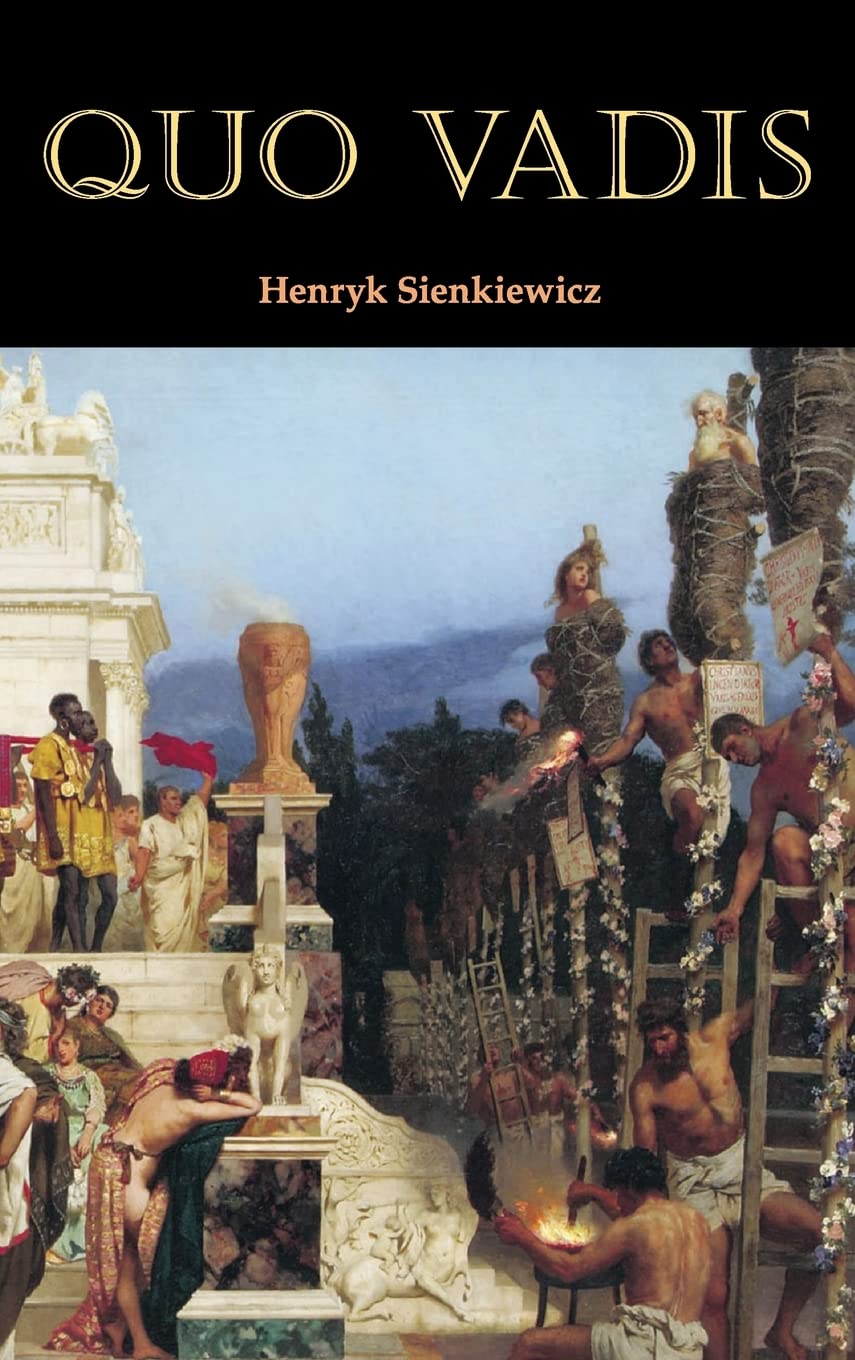
Quo Vadis
A**W
What a Novel
The first time I read this book was when I was a senior in high school in fall of 2004.I never regretted picking up this book that late afternoon and making the effort to flip to the first chapter out of curiosity and read the first few lines. It's one of the few books that has an irresistible beginning that grabs you by the horns and doest let go until you finish. I was so hooked that I had finished it before mid-night of the next day. And this is a kid that loathed, and I mean LOATHED to read.I've always had a fascination with ancient civilizations and history, especially the glory and power of the Roman Empire. I've never read a book which so well described the Roman culture, the people, the politics, the cuisine...to the point that I could taste their food, smell the incenses, hear the sounds of market forums, see the towering buildings of ancient Rome and witness the extravagant parties an Emperor like Nero would host on a regular basis. The plot is just incredible, considering that most of the characters are real and their decisions all based on historical accounts. Sienkiewicz's ability to so closely interweave history with the heart wrenching plot is what transcends this book from a great novel to a masterpiece.The most important impact it had on me was on a spiritual level as a Roman Catholic. Even though I was going through Confirmation at that time, the classes were lead by volunteer parents who had a very shady understanding of their own faith and the experience was so unbearably boring and corny that I was really repelled from my faith.Reading this book helped me realized the profound message of Christ and the cost at which it was passed down to me.It opened my eyes to begin understanding where to look for true beauty in a women, where to look to find true strength in a man, and how fame, power, riches and physical beauty are all nothing compared to the faithful and loving heart of a humble Christian.
W**H
Five Stars
Love, Christian Religion and old Rome.Important book in our live.
E**I
Better Than Expected
I ordered this book because I thought of it as a book I should have read many years ago. When I began reading I was a little put off by the archaic translation and thought of putting it down. After giving it some time, however, I was attracted by the story and found I could put up with the language. I was gripped by the story and found some of the discussions between Paul and Petronius to be good debates between an Epicurean and a Christian. The history in the book is very uneven. For example, the account of the death of Petronius hews pretty close to the description given in Tacitus (or was it Suetonius?), but no one believes that Nero was responsible for burning Rome, and the description of the Jews role in the whole affair has no basis in fact whatsoever. Keeping these caveats in mind, it is still a good read.
Z**K
Five Stars
Great read
N**E
Incredible
Favorite. Book. Ever.
S**E
Bad Translation
This is a horrible translation. Gender is off so it's he instead of she, son instead of daughter, her instead of him. Lots of floating commas. One simple proofreading would have helped.
H**T
Excellent Novel. Very Rich In Detail. Style Is Perfect.
Published in 1895 and made twice as silent films, Quo Vadis: A Narrative Of The Time Of Nero was a popular novel in its time, and received new life in 1912 and 1924 as two silent films, and once again in 1951 as a major motion picture starring Robert Taylor, Deborah Kerr, Leo Genn and Peter Ustinov. Like Ben-Hur: A Tale Of The Christ and The Last Days Of Pompeii, the source material is richer in detail than the motion pictures, giving the reader a wider view of the world as it was. Obviously, not everything from the novels could be included in the motion pictures, as the films had to be suitable for children, and they were very well done. Graphic violence, strong language, and sexual content were absolutely proscribed in motion pictures per the Hays Production Code, enacted in 1933, and no one complained, as the films were tastefully done, depicting the depravity of Rome without actually showing anything.There are some people who complain about the writing being 'archaic,' and 'old-fashioned.' That was the way books were written in the nineteenth century, and the writing was excellent. The authors did meticulous research to get every detail of ancient Judaea and Rome correct. If you are unwilling to read a great novel like this because you don't want to be 'bored,' then you are too bullheaded and blockish; go read Fifty Shades Of Grey, since that is the level of your understanding, then.This edition includes beautiful illustrations by Salvatore Fiume, and a detailed booklet, giving information about the novel, the author and the translator.I highly recommend reading the novel first, and then see the 1951 film.
N**Z
It's a summary
I liked it but this is a summary and basically a booklet; it is good for young people or someone who just want a quick view of the theme.
Trustpilot
2 days ago
5 days ago