

🎧 Elevate your sound game with cables that actually perform.
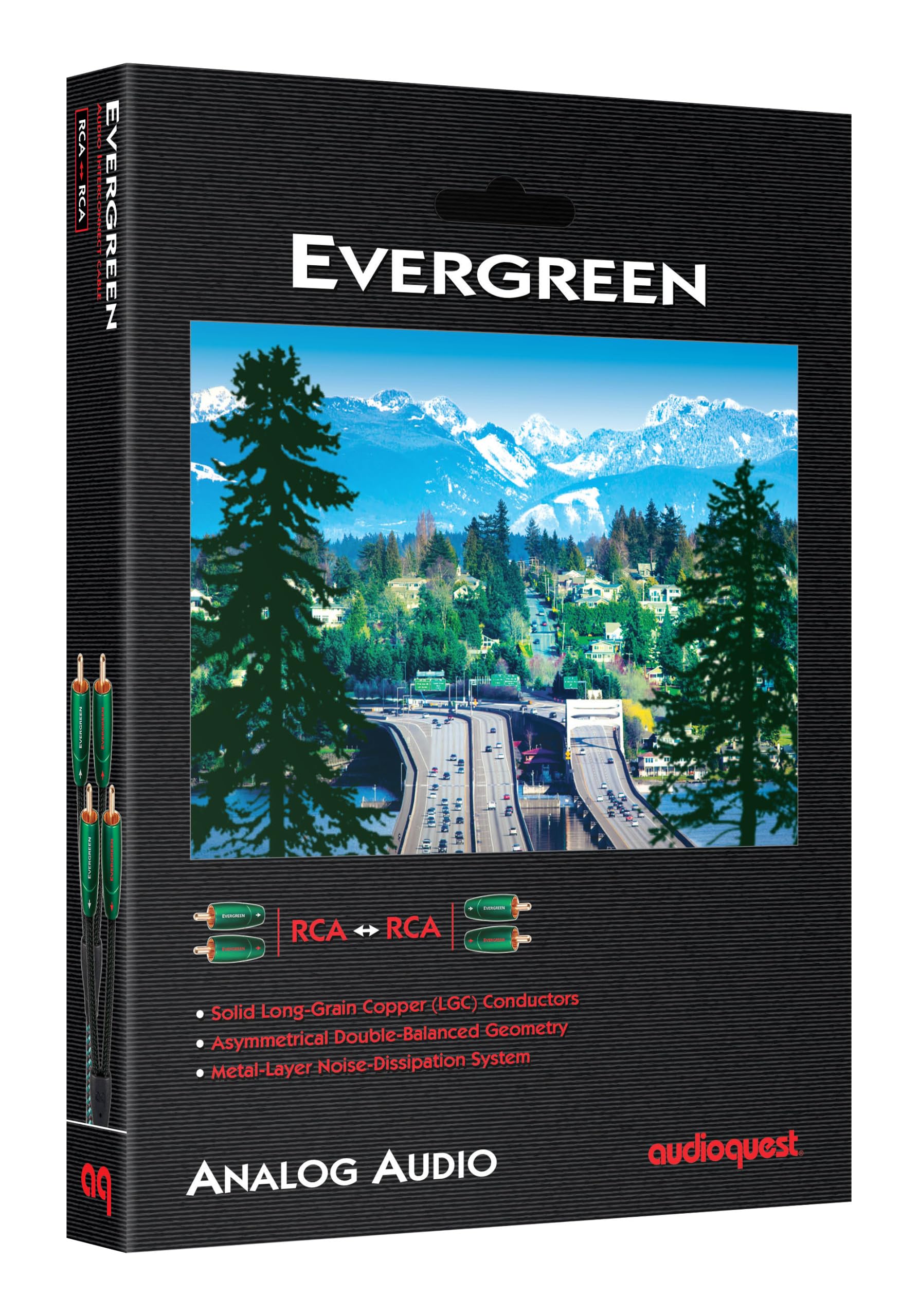
The Audioquest Evergreen Stereo Cable (0.6 m) features solid long grain copper conductors, gold-plated RCA connectors, and a metal-layer noise dissipation system. Designed for audiophiles seeking clean, interference-free audio, its flexible foamed polyethylene insulation and compact length make it ideal for professional and home setups alike.


| ASIN | B005T421IG |
| Best Sellers Rank | #31,002 in Electronics ( See Top 100 in Electronics ) #418 in RCA Cables |
| Brand | AudioQuest |
| Cable Type | Composite |
| Color | Black |
| Compatible Devices | Blu-Ray & CD Players, Integrated Amplifiers & AV Receivers, Line-Level & Phono Preamplifiers, Monoblocks & Stereo Amplifiers, Music Streamers & Servers |
| Compatible Phone Models | Potentially compatible with older or specific smartphone models with RCA inputs, please verify with manufacturer |
| Connector Gender | Male-to-Male |
| Connector Type | RCA |
| Customer Package Type | Standard Packaging |
| Date First Available | October 6, 2011 |
| Global Trade Identification Number | 00092592060456 |
| Indoor/Outdoor Usage | Indoor |
| Is Discontinued By Manufacturer | No |
| Item Weight | 3.53 ounces |
| Item model number | EVERG0.6R |
| Manufacturer | AudioQuest |
| Model Name | Evergreen |
| Number of Items | 1 |
| Number of Pins | 2 |
| Outer Material | polyethylene foam |
| Shape | Round |
| Special Feature | Magnetic |
| UPC | 092592060456 |
| Unit Count | 1.0 Count |
N**K
Flexible and Great Sound
These cables are awesome. Definitely well made and they are very flexible (especially compared to my previous Monoprice ones I had prior to these). I bought two of these cables, each being two feet long, as I had a friend who gave me this same model Evergreen cable for free (and the blue one pictured) but it was way too long for my use. I’m gonna give that one away to a friend so he can use it for his setup in the future. The connection is super snug and they look great, I really like having these colors in my setup rather than just all black ones. These cables made my setup sound noticeably better. And before you say anything, yes, the amplifier has enough ventilation.
B**H
Double-Balanced Asymmetrical Geometry, whatever that means!
Oh, audiophile cables, how I love you so. A source of endless entertainment, both from the wattses and voltageres that you carry from my DAC to my amp, and from the mind-numbing copy that graces your packaging. The box for the Evergreen starts out with a lovely story about where the cable gets its name. Apparently this cable is named after a bridge in Washington that, I kid you not, "because of structural issues, a replacement is inevitable." So, before we get to all the buzzfeatures, our cable is compared to a rickety old bridge -- failed marketing maneuver, or planned obsolescence? So on to the features. First up is that the cable is made of 'long grain copper,' which is a positive. My last cable was made of long grain rice, and that was not ideal. The sound was kind of wet, a bit sticky. I much prefer the long grain copper that the Evergreens are made of. The second selling point is 'solid conductors,' which again is the mark of a quality product. Back in the late nineties I tried a fancy new audiophile cable that used highly salinated water, touting their second point as using 'liquid conductors,' but as anyone with a cat and a waterbed knows, some things are really best left solid. Point three is the 'Double-balanced asymmetrical geometry,' and while I don't know what that means, I have always found symmetry a bit boring (but balance crucial!). Point four is 'asymmetrical conductor sizes,' which reminds me of my train ride into DC with my short, sassy conductor and my tall no-nonsense conductor. Good guys to have around when you're in a jam, so I'm going to give the Evergreen some credit here for their conductor dream team. Point five is the 'Metal-Layer Noise Dissipation System,' which, I'm not even going to make a joke here, I think is just a really silly word for 'shielding.' The last feature is 'Foamed Polyethylene Insulation,' which sounds like the itchy stuff in my walls, and I will say that my music has a nice itch-that-needs-to-be-scratched quality about it. The final word on the box is the instruction to make sure that the arrows point from your source to your destination. I botched this one rule up and everything sounded like a 128kbps MP3. Then I realized I was actually listening to a bunch of 128kbps MP3s, and that was easily rectified without disconnecting my fancy green cables. I'm not a believer in audiophile cables, and at ~25 dollars, this can hardly call itself an audiophile cable. It's not made of 101% oxygen-free silver copper Dalmatian. The insulation hasn't been injected with nitrogen or helium or radon. Heck, it hasn't even been doused in holy water! And to boot, it's named after a failing bridge. But there are a few things that make this cable worth the 25 bucks. First, the construction is solid. The connectors feel great. Tough, solid, yet not so massive that you can't get two paired up in a tight set of jacks. The cables themselves, the combination of conductor material and insulation also feel sturdy. Sturdy, yet flexible enough to maneuver without issue. That sounds silly, but it really can alleviate quite a bit of frustration when you're snaking cable around. The connectors are gold plated, and while I don't have much faith in that improving my tight, tight bass response, I have had trouble over the years with lesser connectors oxidizing, and that never ends well for anyone. Gold should hold up better in this regard. The cables also seem well shielded, something that actually has a great deal of impact, and that lesser cables often fail at. The path my interconnect between DAC and amp takes is not too pleasant, and the cheap interconnect I grabbed from an old parts bin was picking up all sorts of line noise, hard drives spinning up, CB radio, EVP, you name it. These cables really are well insulated from all the nonsense interference that tries to infiltrate our earwaves. So, while I'm terribly leery in products that contain more laughable market-speak than relatable features, I can't help but recommend these. For a fairly low price, you get great construction, shielding that actually helps keep your signal clean, and gold plated connectors that will help prevent an oxidized mess from binding them to your components. And unlike its eponym, I think this cable is going to last me quite a while.
Z**C
Listening stimulus? Check.
I’ll confess: I’ve been fantasizing ... about blowing whatever stimulus check i might get on audio gear. Can’t decide between amp or DAC with my current “A” system. I even thought about going on some audio forum and asking other audiofools their opinions, but i’ll start here. My wife can decide right away though. Saving it (responsible) or traveling. What’s mine is hers after all, though she does leave me to my music. Hence my dilemma ... and this cable. So in the meantime i clicked on this and patched it in a couple days later. (Nearly) instant gratification! I love what i have, but if you’ve read this far you know how audio folks go. Here’s the BOTTOM LINE: BUY IT, TRY IT if you can spend the money. If you listen to music in a decent system you’ll get your money’s worth. Unless you prefer a “wall of sound.” It does seem to isolate the vocals in the center, and more forward. I know there’s a lot involved in this pastime, and the subjective/objective debate also inevitably leads to the subjective cost-to-benefit ratio. Subjectively there’s placebo effect. Expectation bias. You know you spent the money, you’re hoping to hear positive differences. So i’m guessing you’re simulated to listen more attentively. “Seek and you will find.” And i found the usual audio-speak stuff. An increase in space around the individual sounds in a recording. An increased ability to place instruments in the soundstage. An increase in perceived naturalness of tone (listening to acoustic instruments now. In fact it’s almost hard to type as my attention is pulled back to the music). Hearing details not heard before. How the sounds in the studio moved in the air. Really. From a cable. Tweak accomplished. I have one other experience with recent Audioquest products, a 3.5mm to RCA stereo cable, and since i have that as a choice to use, it’s definitely preferred to any other. “Sounds better.” That’s enough. I get good use out of them. Rated this as four star in value, as i’d really get more of them if they were say, $10 cheaper, and would love to get foot-longs, if they existed, as interconnects (and relatively inexpensive, like the “World’s Best”) The cable ‘reviewed’ feeds my amp, so it’s the last connection in the chain, except for speaker cable. It’s from a Chi-Fi preamp/tube buffer with GE tubes. That’s another cheap tweak, relatively speaking, i like them and have them where i can. I tried to remove it from my chain, since it sits on top a new Schiit Saga +, which i hoped would do the same things, but have more inputs and remote volume control. But when streaming i can’t push the volume to my upper limits; the streamer doesn’t output as much as say, a Chromecast audio or a Dayton Audio WBA31, but it upsamples to 192 kHz so (placebo effect?) i leave it in. The Saga, in either tube or bypass mode has little to no gain, and i can max my current (and recent) amp’s output. Plenty loud without it via CD player, but i leave it in since i mostly stream for new music. For the curious, and upgrade opinions welcome, here’s the chain, moving backwards: Q-Acoustics 3050i speakers QED XT25 speaker cables Chi-Fi ICEPower 125ASX2SE amplifier This Audioquest cable. FX-Audio preamp w/ GE tubes, set at 11 o’clock A “World’s Best Cable” interconnect Schiit saga + preamp, stock tube Ghent Audio interconnect FX-Audio SQ-5 DAC (PCM 1794 my favorite of several that i have in this price range for naturalness of tone) — for CDs: Velocity digital coaxial cable, $13 for the 1.5 ft length free Magnavox DVD player as transport (has remote) Or - early 90’s Denon DCD-660 analog out only to the Schiit — for streaming: QED Reference optical cable w/cheap 3.5 adapter, from a NEXUM TuneBox TB20 to the SQ-5 Or- Audioquest Evergreen mini-jack to RCA stereo cable from a Dayton Audio WBA31 directly into the Schiit, since i have the spare inputs, but it’s not used as much. Mostly to compare the sounds, but A-Bs are a bit much to fuss with. Upgrade-wise, thinking more powerful Hypex NCore amp, Schiit Bifrost 2? what order? Etc...
W**S
Al mijn apparaten zijn met AUDIOQUEST kabels verbonden! Goede kwaliteit voor een redelijke prijs, niet voor niets.
I**N
Bin sehr zufrieden
S**G
Good product, but costly.
Z**C
J'étais un peu sceptique mais en effet, ce câble RCA apporte une amélioration audible par rapport à un câble basique. Meilleur définition, meilleur soundstage, notamment en hauteur. Meilleure présence des voix. Certes, le câble n'est pas donné mais la différence de rendu sonore est bien là. Cette différence est comparable à la différence entre deux sources CD. L'une de moins bonne qualité sonore que l'autre. Tests réalisés avec ampli Cambridge et lecteur CD/DVD Sony ainsi que lecteur CD JVC sur des enceintes Dali Oberon 7. Câble un peu rigide et connecteurs un peu difficiles à pluger car un tout petit peu petit. Mais la qualité sonore fait oublier le reste.
W**E
Worth the money
Trustpilot
2 months ago
1 month ago