
Buy The Demon-haunted World: Science As a Candle in the Dark by Carl Sagan (ISBN: 9781439505281) from desertcart's Book Store. Everyday low prices and free delivery on eligible orders. Review: A superb book for the questioning mind - Do you like to question things? Well you should like this book. There are two keys aspects to this book: 1. A detailed analysis of unsubstantiated beliefs 2. An exploration of critical thinking 1. Sagan describes all sorts of unusual beliefs such as demons and witches which were once held with absolute certitude by the masses. He details outrageous claims of alien abductions and all sorts of unusual apparitions. This is all sprinkled with all sorts of interesting facts and anecdotes. Whether it's the story of innocent people being found guilty for child abuse by using confession under hypnosis as evidence or the fact that there have been over a million UFO sightings since 1947, the reader is kept in engaged along the way. Inevitably Religion gets a mention. Sagan points out how scripture was used to justify some inhuman activities such slavery and racism However Sagan is fair here. He points out that mainstream Religions accepts mainstream Science, such as Darwinian evolution and it is really only the fundamentalists who cannot deal with Scientific findings. He also describes the story of the Jesuit priest, Friedrich von Spee, who turned whistle blower, detailing the abject fallacy and idiocy of witchcraft trials. 2. Of course no book on critical thinking would be complete without a discussion on what constitutes critical thinking. Sagan is is succinct in his explanations. He details scientific and evidence based methodologies. He explains various logical fallacies which consistently make humans think something is true when it is actually not. Sagan is not also to afraid to point out the imperfections of Science. He discusses the tentative nature of Science and he questions of some of bad aspects that have manifested from a usage of it. Atomic and Hydrogen bombs, two obvious examples. Sagan explores the inescapable reality that Science has failed to capture the masses. Why is it only 75% of American don't know antibiotics kill bacteria not viruses? He explores some of the reasons for this as well as different ways of teaching Science and critical thinking. He is only too gracious and bashful to recommend everyone should read this book, but I would have no problem doing that! Review: Fabulous book - Carl Sagan - genius
| Best Sellers Rank | 1,677,523 in Books ( See Top 100 in Books ) |
| Customer reviews | 4.7 4.7 out of 5 stars (6,941) |
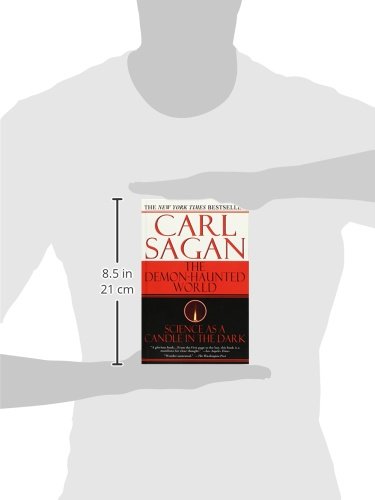
| Dimensions | 2.54 x 13.97 x 21.59 cm |
| ISBN-10 | 1439505284 |
| ISBN-13 | 978-1439505281 |
| Item weight | 449 g |
| Language | English |
| Publication date | 1 Jan. 1789 |
| Publisher | Paw Prints 2008-06-26 |
A**D
A superb book for the questioning mind
Do you like to question things? Well you should like this book. There are two keys aspects to this book: 1. A detailed analysis of unsubstantiated beliefs 2. An exploration of critical thinking 1. Sagan describes all sorts of unusual beliefs such as demons and witches which were once held with absolute certitude by the masses. He details outrageous claims of alien abductions and all sorts of unusual apparitions. This is all sprinkled with all sorts of interesting facts and anecdotes. Whether it's the story of innocent people being found guilty for child abuse by using confession under hypnosis as evidence or the fact that there have been over a million UFO sightings since 1947, the reader is kept in engaged along the way. Inevitably Religion gets a mention. Sagan points out how scripture was used to justify some inhuman activities such slavery and racism However Sagan is fair here. He points out that mainstream Religions accepts mainstream Science, such as Darwinian evolution and it is really only the fundamentalists who cannot deal with Scientific findings. He also describes the story of the Jesuit priest, Friedrich von Spee, who turned whistle blower, detailing the abject fallacy and idiocy of witchcraft trials. 2. Of course no book on critical thinking would be complete without a discussion on what constitutes critical thinking. Sagan is is succinct in his explanations. He details scientific and evidence based methodologies. He explains various logical fallacies which consistently make humans think something is true when it is actually not. Sagan is not also to afraid to point out the imperfections of Science. He discusses the tentative nature of Science and he questions of some of bad aspects that have manifested from a usage of it. Atomic and Hydrogen bombs, two obvious examples. Sagan explores the inescapable reality that Science has failed to capture the masses. Why is it only 75% of American don't know antibiotics kill bacteria not viruses? He explores some of the reasons for this as well as different ways of teaching Science and critical thinking. He is only too gracious and bashful to recommend everyone should read this book, but I would have no problem doing that!
M**Y
Fabulous book
Carl Sagan - genius
M**Y
Well written
It took me a while to finish this but I'm glad I did. The author writes in an engaging style. It could be a fairly dry subject but he tries to keep it entertaining. He starts off by talking about alien abduction stories - whether we should take them seriously, why people believe them, how we could get to the bottom of what's actually going on. He then moves on gradually to scientific illiteracy in the USA (scary) and briefly discusses the bad uses science has been put to, such as the atom bomb. However the main theme of the book is scepticism and how it is a useful tool to combat deluded beliefs.
A**R
Good for Sagan fans
I love Carl Sagan and everything about him. I have watched Cosmos multiple times over and find it so stirring I am almost moved to tears at points. So I am writing this as a Sagan fan. This book contains lots of great Sagan stuff: an evenhanded look at the issues, nice literary quotes, optimism, sceptism, imagination, a defence of science, a love of humanity, humility, well-referenced, and respectful treatment of those who (earnestly) buy into, pursue or promote things we know are false. (Not so, for those who know they are false but use their credulity of earnest believers to line their own pockets or increase their power.) However, I quickly realised that a lot of Sagan's appeal is his personality and voice. Reading this was almost a let down after watching dozens of his videos on Youtube. Not because the book is bad -- it isn't -- but because his in-person delivery is so good. I found the same thing after watching a ton of Richard Feynman videos and then switching to his books: when you subtract the voice, the smile, the laughter, the comedic timing, the dramatic pauses etc. then, I found, a great deal of the enjoyment was lost. All to say: manage your expectations and you'll be fine, or read this before watching Cosmos! The aim, content and execution of the book is good: almost all human beings are trying to figure out meaning in their lives, connect with nature, and be captains of their own destiny -- it is simply that not all ways of doing this are equally true or successful. The book looks at why, and at why false or ineffective ways of doing this are so persistent, from a sympathetic point of view that we all deserve to have both the emotional consolations and everyday relevance of things like religion and astrology, but without turning away from the fascinating and effective truths of science and technology.
M**S
The late, great Sagan's best book.
Great man. Great book. Let's get the minor criticisms out of the way first. Carl can ramble slightly at times. His points are valid and thought provoking. However, I felt that a little editing was required. That aside...wonderful. Clear, balanced, unbiased and honest. He takes a look at all the key areas of science - from his own interest as a child to a closing chapter on how the essential promotion of the critical thinking protects us from fundementalists, crackpots, psuedoscience, political manipulators and those who profit from obscuring the truth. His tone isn't hectoring and less likely to discourage some. My favourite moment (and one I've re-read) is the chapter 'Obsessed with Reality' in which he takes a look how media can be fooled - and therefore fool us - with unsubstantiated claims. He tells the story of how the great Randi fools the Australian press with 'Carlos' - a kind of channeling version of Chopra/Tolle - which should act as a warning to all and is also (I found at least!) quite funny. Worth publishing in every school is his 'baloney detection kit'. It might help us spot some of our errors and not be taken in by some of the less honest, sincere or otherwise, in our society. Thank-you Carl. You're sorely missed.
C**N
Excelente o livro. Entrega feita no prazo e em perfeitas condições.
S**H
I sit before my computer, typing out a review of what is my favorite book. I’m daunted by the magnitude of this task, having just finished the book for the fourth or maybe fifth time. I wish I could remember when I bought this book, likely close to a decade ago, but I’m sure that I must have been awestruck to discover a book written by a man who has influenced my life and my interests to such a great extent. One of the great memories of my early life was that of waiting to plop down in front of the TV set for a few Sunday nights in 1980, as our PBS station aired a thirteen part series called Cosmos. Accompanied at the TV by my mom and grandmother, Cosmos captured my imagination in ways that will last my whole life. It was a series not merely discussing outer space, but in fact, it addressed the history of humanity’s understanding of our place in the world, the universe, and in life. Why is the memory of a TV show so incredibly dear to me? I could say that the show opened my mind to concepts and philosophies and possibilities that I never imagined, and that’d be a fair and true statement. What really makes the series so pivotal in my life, though, is that I shared such a formative experience with my mom and my grandmother; two people to whom I owe my life, my intelligence, and, hopefully without too much hyperbole, my essential spirit. At the age of nine, it’s not very likely to imagine that I would have planted myself in front of a television tuned to PBS on a Sunday evening, but the patient guidance and love of my mom and grandmother gave me the gift of knowledge and wonder. Needless to say, I’ve always been partial to the works of Dr. Carl Sagan. Demon Haunted World: Science as a Candle in the Dark is the first work of Dr. Sagan’s that I’ve read as an adult and in the many years I’ve owned this book, I’ve read it at least four times. Why re-read a book so often? The answer is found in my reverence of the book’s message, its point, and its passion. Not only have I read it often, but I have made an irregularly observed tradition to start each new year with a fresh reading. At least three times, I’ve picked the book up within hours of watching the ball drop in Times Square, heralding in the new year. Many who know me, already know this is my favorite book, but I’m deeply challenged when I’m asked what the book is about, and several paragraphs into my review, I’m probably overdue in attempting to answer this exact question. In this book, Dr. Carl Sagan tackles one of the key problems facing our time, as well as repeated throughout the history of our civilization, and that is the propensity for humanity to delve into our darkest superstitions and most bleak behaviors when our knowledge or ego is challenged. It seems that throughout the history of our species, we’ve turned our backs on critical thought and skepticism at times when those with claims to power and zealotry and wealth have found it advantageous and profitable to subvert the masses. Why discuss witch burnings and crop circles and claims of government coverups of alien abductions from 50 years ago? The answer lies in the here and now. At a time when every facet of our daily lives revolves around technology; when each and every human being lives under the threat of annihilation by nuclear weapons; when communications are global but subject to being monitored in violation of the founding documents of our nation (granted this is a problem that would occur years after Sagan’s death, yet it’s exactly the type of behavior Sagan speaks of), we find that critical thought wanes in the population of our own nation, not to mention that of the entire world. Credulity and old habits creep into our consciousness. Our world, our freedoms, and our lives come under attack. Go to the movies and watch ghosts haunt a house or watch the undead torment campers in the woods. Turn on the TV, and you’re likely to find tales of alien spacecraft being hidden by the government. You’re equally likely to channel surf past a shopping network selling new age crystals. But where on broadcast television are you likely to find a substantive debate on issues of education or technology? Where do you see educational programming talking about the technology that engulfs our very lives? As Sagan points out, imagine the irony that kids can watch a cartoon about a prehistoric family with a dinosaur for a pet (I actually protest... I enjoyed the Flintstones!), but may never have the opportunity to watch a show about the invention or technology of television, itself! At what cost to our freedoms, will we accept great claims without great proof? What decisions do we as a world culture need to make to grow and prosper and what can we learn from our history, replete with credulity and domination and fear mongering? Should we shrink from the challenges of education and critical thinking, what price will we pay? Will it be our personal or national economic stability? Will we see our freedoms curtailed (as if we haven’t witnessed that already)? Or will we pay with the extinction of our species? The thesis as I understand it, of this book is that we, as a culture and society, may be repeating a common mistake of our history: accepting a diminution of our critical thinking skills at our own distinct peril. Because of the threats we face though, this time we stand at these crossroads at possibly the least opportune of times. Throughout history, those in power or those who seek it, have abused our fears and used them to control the masses to their own advantage or profit. This book begs to serve as a wake up call to anyone willing to accept the challenge not only to read it, but to deeply ponder each of its points and positions. It offers the methods of critical thought as the grand lighthouse by which we can safely steer our course through the treacherous times and malevolent forces we face. Dr. Sagan, true to the book’s title, offers the methods of science as a candle in the darkness in men’s souls. This book occupies a special place in my life, as I’ve stated. I believe that this is a book of such enormous importance, that it should be required reading in every senior level high school class in the country. It may not be comfortable reading, and Dr. Sagan wrote on an astronomically high reading level (forgive the pun, as Dr. Sagan was of course a world renown astronomer) that it may take weeks or months to fully drink in the material, but the discussion that Dr. Sagan presented are vital. The arguments he presents are vital to our intellect, our freedom, and to our humanity. For making me think and contemplate, reading after reading, this book scores five stars.
F**S
Muy buen producto
S**S
Excellent. Dommage que ce livre n'ait pas été traduit en français.
N**O
Da leggere assolutamente
Trustpilot
5 days ago
1 day ago