

Desert Online General Trading LLC
Dubai, United Arab Emirates
Desert Online General Trading LLC
Dubai, United Arab Emirates


Full description not available
H**A
Ideal text for undergraduate courses on gender studies, anthropology and sociology
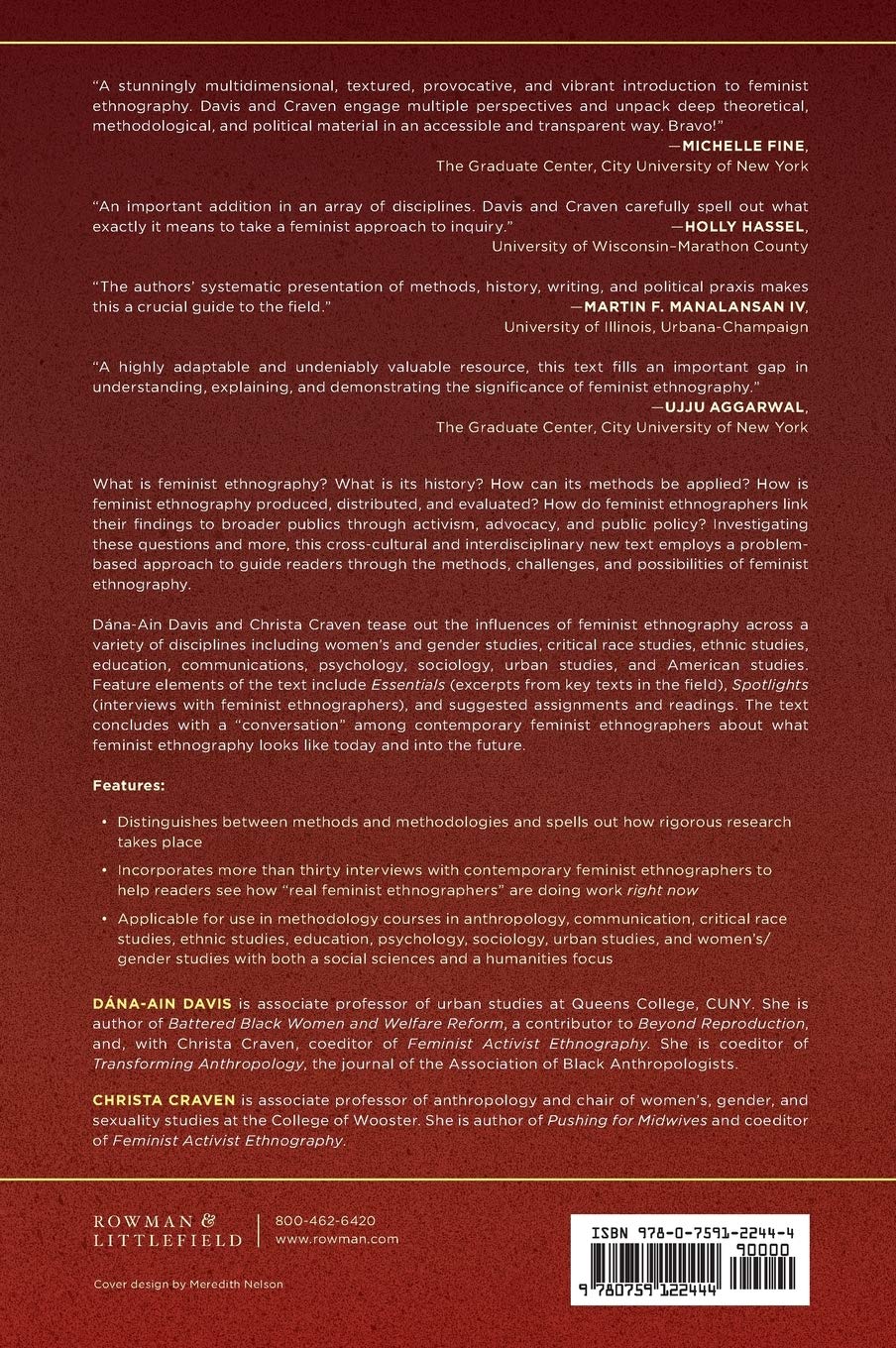
Ideal textbook for undergraduate courses on gender studies, anthropology and sociology. The book offers a comprehensive overview of feminist research and interventions within anthropology and related disciplines. It also features a very helpful timeline (starting in 1800s to 2016) of how feminist thought has evolved, and various waves of feminist thinking, and the corresponding events that occurred during those periods the influenced conversations on feminism. Following each section, the book also features highlights from interview with feminist researcher - which the students find very useful. I am happy to add this book to my course syllabi and I'm looking forward to teaching in this semester.
A**T
Five Stars
Excellent text book for those who are starting their research journey.
M**Y
This textbook is about feminist praxis, while being model of feminist praxis itself. Brava!
Q: Where else can you find both Louis Lamphere and Janelle Monae cited in the same book for their contribution to feminist methods and inquiry?A: Feminist Ethnography: Thinking Through Methodologies, Challenges, and Possibilities by Dana-Ain Davis and Christa Craven.It comprehensively yet succinctly covers history, theory, debates, methods, methodology, and advice for production and distribution, all in one place… and in under 200 pages! This is required reading for undergraduates, graduate students, professors, and anyone who considers themselves a feminist researcher already or aspires to be.One of this textbook’s many strengths is that it highlights feminist ethnographic work through vivid and concrete examples within and beyond anthropology, both covering and extending beyond the written monograph. This is to say, the range of examples makes it is equally suitable and useful for students in both the social sciences and the arts, and for feminist activists situated in academia or elsewhere.The text is brimming with pictures of feminist ethnographers alongside their words from interviews or their research. This gives the book a vibrant polyvocality that reflects the commitment to feminist praxis on the part of the authors. In the process we learn about feminist figures, across the gender spectrum, whose research has contributed to local and global political struggles.The carefully designed “Thinking Through” exercises foster active learning and community building. These assignments can be directly applied to furthering one’s own research goals — at the point of conception through production— while effectively strengthening an international network of feminist ethnographers. For instance, in one exercise the reader is asked to identify a feminist ethnographer at their school or another institution and interview them (p.72). The results of this same exercise, executed by Davis’ own students, are exhibited in several of the “Spotlights” throughout the book.The intergenerational nature of the textbook, featuring the reflections of PhD students as well as professor emerita, enriches the perspectives on the many topics covered. Moreover, it shows a refreshing feminist intervention to the hierarchical academic practices that designate the wisdom of some as more valid than others.One of my favorite chapters is the one dedicated to producing feminist ethnography (Chapter 6), for the way it encourages creative approaches that go “off the page”. Signaling this diverse array of ethnographic products— from interactive websites to documentary films to dance performances— will no doubt inspire the next generation to think more broadly and boldly with regards to how to strategically make their research accessible to different audiences. The chapter’s groundedness in real life examples rather than abstract theoretical provocations makes the exciting future of feminist ethnography seem tangible. We are called to answer the charge and given the tools to do so.Davis and Craven don’t just talk the talk; they walk the walk.
M**S
Excellent! Davis and Craven go well beyond the traditional ...
Excellent! Davis and Craven go well beyond the traditional textbook, including interviews they conducted with over 30 feminist ethnographers (Gayle Rubin, Scott Morgensen, Esther Newton, Whitney Battle-Baptiste, Elizabeth Chin, Aimee Meredith Cox) and excerpts from key texts and authors (The Combahee River Collective, Chandra Mohanty, Zora Neale Hurston, Judith Stacey, Sara Ahmed, Lila Abu-Lughod, Faye Harrison). This creates a dynamic text that includes scholars, viewpoints, and approaches often left out of overviews of feminist ethnography--especially the essential contributions of women of color and queer/LGBT scholars.At the same time, Davis and Craven do not give short shrift to the essentials. Supplementary materials (a chronology of “key events in feminist ethnography,” a glossary) help contextualize and clarify, while chapters on the history of feminist ethnography, its methods, debates, ethics, forms, and myriad audiences provide a comprehensive and thoughtful introduction to the field. Throughout, Davis and Craven lay out core issues and problematics (including what counts as “feminist”) without insisting on singularity or false agreement; the ease with which they cover such wide-ranging ground makes the book a pleasure to read. Short yet cogent summaries of debates ground concerns in real-world material, while their choice to frame chapter sections with questions—“How engaged or involved should a feminist ethnographer be?” or “(How) Should you give back to research participants?” or “Is feminist ethnography inherently activist?”—and to feature pictures and brief backgrounds of diverse scholars working in the field (and in its margins) enable students to see feminist ethnography as a living, breathing field. At a time when so many dismiss feminism as irrelevant, Feminist Ethnography serves as an welcoming and vibrant invitation, without simplifying or dumbing down the central issues that make feminist ethnography so important.
L**J
Textook
This was my textbook for a class. It had good information.
A**N
This book is for you
Multiple thumbs up for this informative and highly engaging book on feminist ethnography. Written with an undergraduate audience as its primary focus this book has a much wider reach. In this book Davis and Craven unabashedly posit feminist ethnography as a practice situated within a canon that is an essential part of how we should think through issues, ask questions, and address some of our most pressing concerns today. This is a how to book that will keep instructors and students talking, debating, and learning in constructive and inclusive ways.
M**N
DOING Feminist Anthropology
Clear, provocative, and expansive. Davis and Craven brings together materials, methods, and ideas that make up the heart of what is now known as feminist ethnography. Rather than being a text that merely explains what feminist ethnography IS, this valuable resource offers the possibilities and promise of feminist ethnography in terms of what it DOES and what it can DO. A problem and practice centered approach provides a vitality to this book that cannot be found with its predecessors.
Trustpilot
4 days ago
1 week ago