
DOWNLOAD THE APP


Customer Services
Copyright © 2025 Desertcart Holdings Limited
DOWNLOAD THE APP
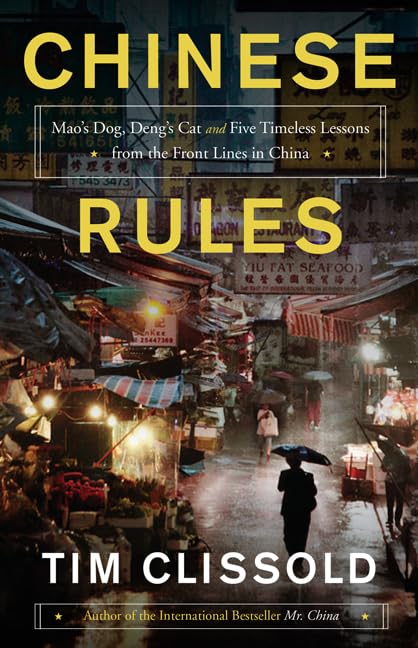
Chinese Rules: Mao's Dog, Deng's Cat, and Five Timeless Lessons from the Front Lines in China – A Business Memoir and Practical Guide to Winning in the Modern East [Clissold, Tim] on desertcart.com. *FREE* shipping on qualifying offers. Chinese Rules: Mao's Dog, Deng's Cat, and Five Timeless Lessons from the Front Lines in China – A Business Memoir and Practical Guide to Winning in the Modern East Review: Excellent introduction to Chinese business culture. - Excellent introduction to Chinese culture and business conduct. The author is an experienced China hand with a deep understanding of the history, language and culture of the country learned from years of doing business on the ground. A highly practical, readable and entertaining book. Heartily recommended. Review: History story-telling at its best - Tim's second book about China a bit abruptly switches back and forth between fascinating insight on Chinese history, and the PRC "projects" of a fictional London based investment fund. Fiction aside, with history story telling at its best and cool details, all the way from George Macartney's frustrating-in-the-extreme trade delegation to the Qing court, to Deng's reforms, the author neatly laid out the five pivotal "China Rules": 1. China doesn't play by anyone else's rules. 2. Stability (through intimidation and bribes) has always been the key for government officials. 3. Never attack directly. 4. Stick to practicalities and never get hung up with side arguments on principles. 5. (For outsiders especially) Know yourself and the other. Other than some impressively refreshing history, in its most bloody/funny form (fitting for a British author), there are just a handful of new thoughts, and Rule 5 is especially weak. The book quotes Madeleine Albright: "China is in its own category -- Too big to ignore, too repressive to embrace, difficult to influence, and very, very proud." That, is about right. A reluctant four star.
| Best Sellers Rank | #701,077 in Books ( See Top 100 in Books ) #33 in History of Ancient China #93 in Historical China Biographies #401 in Business Negotiating (Books) |
| Customer Reviews | 4.6 4.6 out of 5 stars (170) |
| Dimensions | 6 x 0.93 x 9 inches |
| ISBN-10 | 0062316575 |
| ISBN-13 | 978-0062316578 |
| Item Weight | 1 pounds |
| Language | English |
| Print length | 272 pages |
| Publication date | November 4, 2014 |
| Publisher | Harper |
C**S
Excellent introduction to Chinese business culture.
Excellent introduction to Chinese culture and business conduct. The author is an experienced China hand with a deep understanding of the history, language and culture of the country learned from years of doing business on the ground. A highly practical, readable and entertaining book. Heartily recommended.
B**U
History story-telling at its best
Tim's second book about China a bit abruptly switches back and forth between fascinating insight on Chinese history, and the PRC "projects" of a fictional London based investment fund. Fiction aside, with history story telling at its best and cool details, all the way from George Macartney's frustrating-in-the-extreme trade delegation to the Qing court, to Deng's reforms, the author neatly laid out the five pivotal "China Rules": 1. China doesn't play by anyone else's rules. 2. Stability (through intimidation and bribes) has always been the key for government officials. 3. Never attack directly. 4. Stick to practicalities and never get hung up with side arguments on principles. 5. (For outsiders especially) Know yourself and the other. Other than some impressively refreshing history, in its most bloody/funny form (fitting for a British author), there are just a handful of new thoughts, and Rule 5 is especially weak. The book quotes Madeleine Albright: "China is in its own category -- Too big to ignore, too repressive to embrace, difficult to influence, and very, very proud." That, is about right. A reluctant four star.
A**S
Mind Opening.
A great book to understand differences between Chinese and Western cultural and business norms. Values can be relative and the Chinese approach to strategy and negotiations, although difficult to understand from Western lenses, has invaluable lessons that can be applied to a number of situations in business and in Life.
M**N
Deeply Insightful
The writing style in combination with the quality content made for a delightful read. Anyone doing business in China should consider this book required reading.
Z**Z
Great intro of Chinese culture and business climate
As a Chinese who came to the States many years ago, the book serves as a great refresher of Chinese philosophy and business practices.
J**N
Useful guide for anyone interested in understanding China
Tim Clissold is a businessman with a long history of working in China. In Chinese Rules he presents a set of five “rules” for understanding and dealing with the Chinese. The format of the book is that Clissold recounts his personal experiences regarding a business transaction he undertakes with the Chinese, and at the same time relates portions of Chinese history especially including the Mao and Deng years. The rules are: 1. China has its own set of rules and will follow them and not adopt Western rules and values. China is a civilization, not a country. 2. Stability and harmony are paramount. The group is more important than the individual. 3. Criticism is always indirect and nuanced 4. Practical approaches are preferred to values. As Deng is famed for saying, “it does not matter if a cat is black or white; what matters is can it catch mice.” 5. It is important to know yourself and others. One interesting story Clissold tells is that Mao, Liu Shaoqui and Zhou Enlai were discussing how to get a cat to eat hot chili. Liu says to shove it down the cat’s throat (use force); Zhou says to wrap it in a piece of meat (use deceit) and Mao says to rub the chili on the cat’s behind and it will lick it off (use manipulation). He concludes that Mao’s approach was accepted. As someone who lived and worked in China recently as a teacher for four years I found Clissold’s rules to be generally true. I also found them to apply as well in Vietnam where I have been working more recently and thus perhaps they are a reflection of Asian culture more broadly. For example the way to tell if a meeting is going well or not is from the tea. If the meeting is progressing the host will continue to serve you tea, but if he stops then you know the meeting is not going well. This book is useful for anyone wanting to understand China and Asian more generally, not just business people. I rate it at four stars, and not five, because of Clissold’s focus on business and failure to apply the rules more broadly.
M**P
Well-deserved Five Stars!
There aren’t too many Westerners that can write about China with such understanding and authority. This book is tremendously insightful. The historical parts give a great perspective on today’s events and tie it all together.
J**S
fascinating!
The writing is wonderful and the depth of knowledge well qualifies him to write this book.
M**S
An excellent book for anybody who is interested in Chinese culture and or has dealings with the Chinese. I source products on behalf of my company from China and have found the insights in this book to be invaluable and have already been able to put much of the advice to good use. I would highly recommend this very readable book for anybody who is dealing regularly with the Chinese for either business or pleasure.
A**R
An interesting perspective to see and read Chinese culture. There are some truths in it.
F**R
Very good book
A**H
Tim Clissold's book is part memoir, and part cultural study, and uses Chinese stratagem and historical examples to buttress his argument about the difficulty of doing business in China. The book is a memoir of a trip to China to negotiate carbon credits for a power plant within China's new, and hitherto, experimental, emissions trading scheme. However, with a business deal where much money hangs in the balance, much stubbornness and stonewalling is still found. Clissold's primary source of comparison is Sun Zi's Art of War, but many other proverbs and anecdotes are used. The book also contains a number of interesting interludes into the lives of Mao Zedong and Deng Xiaoping, and the author draws surprising parallels for the present. The book can drag at times, and is something of a slow starter that I initially found myself struggling to persist with, however the book picks up and provided insight that even an experienced China hand such as myself found beneficial. Tim Clissold writes a decent conclusion that essentially warns people that China will continue to do things in it's own way, and the West would benefit from a greater understanding of China. At 273 pages and a fairly decent pace, Clissold's book is both readable and rewarding.
J**G
Thoroughly done
Trustpilot
3 weeks ago
2 days ago